
• The move to the new server is done. There are some software and database maintenance updates in process. This has us passing the hat around to help out. We appreciate any donations. Seriously, even a dollar helps. The payment page may be found here - https://www.audiokarma.org/support.html

Advice for Custom crossovers

marantzgrail

New Member
Good morning!

I hope all are well and safe!

I am designing a pair of speaker cabinets for the first time, I am a little nuts about adjusting the sound/eq's always looking to tune speakers in to sounding as precisely as possible. I will be using the 6.5" Audax woofer and and 1" Screenshot_20211030-140904_Google.jpg dome tweeter that are out of a pair Paisley Research AE-300's.
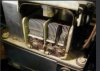
Has anyone ever used the antique/vintage radio tuner for use as a adjustable crossover? I want to use the tuner itself because I will be attaching them to the face of the cabinets, as I love the look of the tuner mechanism and really aim to make these cabs to have more of an industrial look about them.

Thanks very kindly!
 
Register to hide this ad
Sorry, but you would be wasting your time. Radio tuners work on radio frequencies, which are waaaay out of range of the audio frequencies. Those variable capacitors with the rotating plates and an air gap have capacitance values in the low picofarad range. That is considerably less (~ 6 orders of magnitude) than the microfarads often encountered in speaker crossovers.

If you like the steampunk look, you can just attach various parts to the speakers. They don't have to be functional.
steampunk_speakers_1.jpg
 
Just for fun, WOULD it be possible to make a variable capacitor big enough to get it into the microfarad range? Could the plates be made as big as you wanted, or is there a definite limit you hit? What if we also added into the mix- that the plates are in a sealed chamber, and we can fill it with any gas we wanted? How would the noble gasses stack up against our normal atmosphere air gap? DO the noble gasses show a trend of increasing or decreasing capacitance as you go down on the periodic table?

Too much coffee!
-K
 
Just for fun, WOULD it be possible to make a variable capacitor big enough to get it into the microfarad range? Could the plates be made as big as you wanted, or is there a definite limit you hit? What if we also added into the mix- that the plates are in a sealed chamber, and we can fill it with any gas we wanted? How would the noble gasses stack up against our normal atmosphere air gap? DO the noble gasses show a trend of increasing or decreasing capacitance as you go down on the periodic table?

Too much coffee!
-K

A big NOPE. Not possible in the real world because they would be HUGE. Physics is a bitch, sometimes.

Capacitance is determined by conductive plate dimensions and the separation between the conductive plates. There is a six order magnitude difference between picofarads and microfarads. Six orders of magnitude is one million times the difference. The noble gasses generally only affect the voltage breakdown levels. The effect on capacitance is not that significant. Consider the size of the typical RF tuner variable capacitor and then multiply by about a million. Those are pretty big plates. You could reduce the distance between plates, but then voltage breakdown becomes a problem.

A common way they make capacitors in the microfarad range is to take thin conducting sheets (generally a metallic film) and separate the sheets with another thin sheet of insulating material (or a non-solid dielectric for electrolytic caps). The sandwich of conductive sheets and insulator is rolled up with leads extending from each conductive sheet. In this way you end up with conductive plates with a large surface area separated by a very small distance.

This page has a good, basic description of capacitors:
https://learn.sparkfun.com/tutorials/capacitors/all
See, also,
https://www.electronics-tutorials.ws/capacitor/cap_2.html
 
Just for fun, WOULD it be possible to make a variable capacitor big enough to get it into the microfarad range?
As explained above, no, it would be totally impractical. However, a rotary switch to give you 6 possible capacitance values by combining several capacitors would be possible. I'm not sure how much use it would be in practice though. Best to design your crossover, fine tune it, then leave it as it is.
 
Back
Top Bottom