• Please note that Audiokarma will be offline briefly for updates early on Monday morning, September 28th.

Advice needed on use "general purpose" film capacitor as coupling cap in a tube amplifier.

GrisPato

Super Member
I am preparing my first restoration of a tube integrated amplifier. It is the Sansui AU-70.
My question is: can I use something like a Panasonic ECW metalised polypropylene film capacitor for stage coupling without loosing sound quality?
Not only is the price difference 20 fold but also easier to acquire.
 
Register to hide this ad
I've run Panasonic ECW caps in multiple things, its a perfectly decent cap. My 6L6 metal amp runs them, and i've used them in other things before. The only issue I've had is that its a radial form factor, which may not fit as well as axials in certain spots.

Other good, not-spendy options are Illinois MPW, Cornell 940C and 942C.
 
Thanks for the fast responses!
And the reassurance.
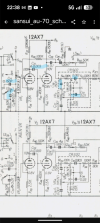
Is it common to also replace Mylar, ceramic, mica, etc?
There are a few in the pre amplifier stage.

Screenshot_20260923-223808.png
 
It isn't common to replace film or mica capacitors as they don't age and rarely fail. OTOH, there's a case to be made for replacing polyester (Mylar) caps with polypropylene for better sound. The problem is they may not fit. I could debate the sound improvement either way. In some amps you might find small PIO (paper in oil) caps. I've never tested one that was good. Or maybe they were but just have poor properties.
 
I usually leave mylar caps if they aren't causing problems. Some early types will go open circuit when the leads break inside but so long as that hasn't happened and its not leaking voltage I'm not immediately on a mission to fool with it.

mica and ceramic are generally left alone unless I have a specific reason to fool with them.
 
Film capacitors rarely need replacing unless subjected to heat. Most that work on old equipment for a living leave them be unless there is a problem in the circuit.

Nothing wrong with Panasonic but I will choose Wima if given the option but I have used both in new builds. I have both in stock. I use to frown on Mylar but after to listening to others, more talented and educated than myself, that say there is nothing wrong with Mylar as a coupling cap I consider Mylar as well. Usually smaller and cheaper and plenty good enough for that task. Some even say they like the sound better with Mylar.

Most engineers could care less for all they hype about capacitors considering it BS. They look at the data sheets and find a capacitor that will do the job at the price point given for the job and choose it. Data sheets tell what they need to know and use. They sometime will use a capacitor that is more popular at the moment just to satisfy the masses and not because it is better. Make reviewers and critics happy.
 
Last edited:
Film capacitors rarely need replacing unless subjected to heat. Most that work on old equipment for a living leave them be unless there is a problem in the circuit.

Nothing wrong with Panasonic but I will choose Wima if given the option but I have used both in new builds. I have both in stock. I use to frown on Mylar but after to listening to others, more talented and educated than myself, that say there is nothing wrong with Mylar as a coupling cap I consider Mylar as well. Usually smaller and cheaper and plenty good enough for that task. Some even say they like the sound better with Mylar.

Most engineers could care less for all they hype about capacitors considering it BS. They look at the data sheets and find a capacitor that will do the job at the price point given for the job and choose it. Data sheets tell what they need to know and use. They sometime will use a capacitor that is more popular at the moment just to satisfy the masses and not because it is better. Make reviewers and critics happy.
I do understand the sentiment, just wanted to be sure.
Initially i thought that the axial Boutique capacitors would all be film and foil, not metalised foil. Found out soon you have to go up in price more for that.
And if there were real quality benefits I would not even mind.
I did watch the video from Roger Modjeski that you posted last weekend. Was interesting to see him support his stand on Mylar versus polypropylene with arguments, something you rarely hear from the other side.
 
I am preparing my first restoration of a tube integrated amplifier. It is the Sansui AU-70.
My question is: can I use something like a Panasonic ECW metalised polypropylene film capacitor for stage coupling without loosing sound quality?
Not only is the price difference 20 fold but also easier to acquire.
:thumbsup:

You'll be fine. Panasonic PPE caps are an industry standard.

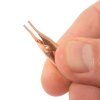
Take care when soldering. I like to use a lightweight alligator clip heatsink on the cap's body while soldering. You won't believe how many heat-damaged caps I have seen.

Heat kills capacitors. So keep the tip hot, short, and sweet.

small aliigator heat sink clps.jpg
 
Last edited:
The orange drop 716 caps are film and foil. Just notice that these and the Panasonic ECW are radial lead caps and may be less convenient to use when replacing axial lead caps. I've used the Illinois MPW, 940 and 942 and all are good axial polypro caps with the 942 being partly foil as well.
 
I do understand the sentiment, just wanted to be sure.
Initially i thought that the axial Boutique capacitors would all be film and foil, not metalised foil. Found out soon you have to go up in price more for that.
And if there were real quality benefits I would not even mind.
I did watch the video from Roger Modjeski that you posted last weekend. Was interesting to see him support his stand on Mylar versus polypropylene with arguments, something you rarely hear from the other side.
Roger was an audio engineer. He should know more than most when it comes to capacitors. Crazy in my opinion to pay extraordinary prices for something as simple as capacitor. I would say any of them Digikey or Mouser sells will do a good job or Mouser Digikey would not be selling them.

I just finished a SE 6L6 amplifier this week and I just reached in my my film capacitor box and picked the first one with the specs I was looking for and installed them. Do not remember the brand or type. If they were not any good they would not be my film capacitor box.
 
The orange drop 716 caps are film and foil. Just notice that these and the Panasonic ECW are radial lead caps and may be less convenient to use when replacing axial lead caps. I've used the Illinois MPW, 940 and 942 and all are good axial polypro caps with the 942 being partly foil as well.
I've used Panisonic ECW's a lot in my builds. For axial the Illinois are usually my go to also. I have used a few Solens though, but just because the price was right. I did use some Russian PIO's in my VTA ST-70 and M-125 mono blocks as well. The only fim caps I've really been able to hear a difference with was a couple Janzen Superior Z caps. I had two Identical SS power amps I was resroring at the time. I left the original film caps in one, and the Superior Z's in the other. The amp with the original film caps sounded a bit sterile and lifeless for a better way to describe it, compared to the other amp.
I've never noticed anything like that before or after.
 
One thing I did not hear mentioned is that if the manufacturer took the expense to use a silver mica capacitor in a particular location, I would leave it alone unless you have a good reason to change it. These caps are excellent up to extremely high frequencies (used in radio for that reason), and are very stable over both time and temperature and were chosen over cheaper ceramic/film for that reason. I also was going to mention the Modjeski (2015) video- very enlightening. If it were mine I don't know if I would be replacing any film or ceramic caps unless you find a problem with one. For really cheap chassis that used ceramic directly in the audio path I would definitely change to film though.
 
One thing I did not hear mentioned is that if the manufacturer took the expense to use a silver mica capacitor in a particular location, I would leave it alone unless you have a good reason to change it. These caps are excellent up to extremely high frequencies (used in radio for that reason), and are very stable over both time and temperature and were chosen over cheaper ceramic/film for that reason. I also was going to mention the Modjeski (2015) video- very enlightening. If it were mine I don't know if I would be replacing any film or ceramic caps unless you find a problem with one. For really cheap chassis that used ceramic directly in the audio path I would definitely change to film though.
Ceramics have no place in the audio path. Others have tested the difference between it and a film cap and the distortion is much higher. Manufacturers must have used them that way to save a buck. If used in other parts of a circuit, mostly used as filters, just leave them be. They hardly ever fail. I've never seen one fail myself.

Checking what I grabbed out of my film box to use for my last build was Jantzen Audio Cross Caps for $1.27 apiece at Parts Express. Jantzen Audio Cross Caps are what comes in the VTA ST-70 driver board kit I found as well. Probably grabbed them out of my box of film caps over others is because they are pretty. Black with gold writing. For years I only used Orange drops. Good capacitors but they are huge compared to other film caps. More expensive as well. IMHO too much talk about which film capacitor is better than others.
All of the major brands whether polyester or polypropylene will work and sound just fine these days as a coupling cap. Not much inside a filter capacitor actually. Sellers probably buy the same film material from the same source.

Found this out talking about camshafts for sale in automobile engines. Many different brands to choose from but only a couple or so manufactures of the camshafts themselves. Probably much the same in film cap manufacturing as well.

​

 
Last edited:
the low grade ceramics can also drift which may have some effect on this too. Less of a problem with the C0G / NP0 types but the low-buck Z5U or whatever are not great.


One thing that bugs me about the fancy caps is they tend to be physically very large. Makes it difficult to even fit them into some things. I had a set of AmpOhm copper foil in oil caps in something. Big, and they went leaky. They ended up in the trash and got replaced with some boring caps that fit and worked.
 
Ceramics have no place in the audio path. Others have tested the difference between it and a film cap and the distortion is much higher. Manufacturers must have used them that way to save a buck. If used in other parts of a circuit, mostly used as filters, just leave them be. They hardly ever fail. I've never seen one fail myself.
The problem is that many old-school tuner sections have disc caps. I looked at my MX110, and it was loaded with these puppies. I'm sure many were in the signal path.

82150759-c74a-40f4-bc05-61467f0a2711.jpg


You know, it sounded pretty darn good. Picked up FM signals okay. I didn't touch it and sold it to a die-hard McIntosh-addicted friend.
 
Back
Top Bottom