• The move to the new server is done. There are some software and database maintenance updates in process. This has us passing the hat around to help out. We appreciate any donations. Seriously, even a dollar helps. The payment page may be found here - https://www.audiokarma.org/support.html

Advice On Adding A Tone Arm

Andrew Heck

Active Member
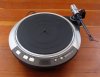
So, the plan is to nude my Kenwood KP-990 that currently has a DL-103 so I can add a lower mass arm that will be better for my Stanton 680EEE. I’ve got a DIY MC pre and an Advent 300 for the MM duties ready to go.
Here’s what I need to know:
• How do I determine the target length of the future tone arm
• For any given arm, can I count on the headshell angle being correct or will that depend
• What am I not thinking of for this project

If anyone has done this, please weigh in regarding your experience, it would be most helpful. Thanks for the time and wisdom.
 
Register to hide this ad
I assume you might mean "KD-990" as I can't find a KP 990.

The key dimension is the pivot-to-spindle distance. It's the distance from the center of the spindle to center of the arm pivot. Assuming yours is a KD990, the p-s is 230mm. You can use an arm with that same p-s length/distance it should be an easy fit. Depending upon the p-s measurement on your table, you may be able to modify the table to fit a slightly different one.

HOWEVER, on the assumption that yours is KD990, it is a semi-auto model. This means there is some mechanism that lifts arm at end of record. Replacing the arm will be more involved. Also, I didn't see anything in the vinylengine database that indicates the existing arm would not work with a Stanton cart. The effective mass of the arm was not listed, so I'm making this leap of faith based on range of cartridge weights. I'd recommend trying the new cart before performing surgery on this nice table.
 
Last edited:
I believe the KP designates that it was for the Japanese market. KD for US. Is it a 100V model or 120V? You'd need a transformer if it's a 100V Japanese market table. I'd also imagine swapping the arm will be a bit complicated, but I am sure it can be done.
 
Generally if it has automatic features, no arm upgrades can be done. I'd keep this Kenwood stock, your arm you have will function superbly with your Stanton 680 EEE with no modifications necessary. Most current MM or MI cartridges today it will also function superbly with, and quite a few MC options. Why hack up this classic, when it's not necessary?
 
Your TT/Tonearm were made when MM/MI carts were predominant — it was designed for carts such as Stanton. LOMCs were only just entering the scene.

BTW, which lower-mass arm will you use?
 
The cool thing about this table is that it is built in such a way as to support multiple arms when the plinth is removed. I just want the option to run higher compliance carts than the stock medium to high mass arm will allow, a light tracker like a EEE Stanton for example. And yes, it’s a Japanese market model that I use a step transformer with. I do realize that I won’t have the option for an automated end of record stop and lift, but that’s the price I pay for having options.
 
upload_2019-4-11_16-32-42.jpeg

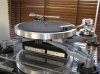
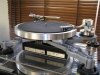
This is where I’d like to end up. I even like the industrial appeal. The plinth is nothing but a resonance collector anyway, it serves no structural function.
 

Attachments

  • upload_2019-4-11_16-30-6.jpeg
    upload_2019-4-11_16-30-6.jpeg
    10.4 KB · Views: 10
Great plan. I agree plinths are unnecessary — unless the innards need hiding, and yours don't (I'd paint them, or see if they polish, but that's personal taste). I have a Micro Seiki DQX-1000, designed to look like your "nude" Kenwood will look. The only trick is devising mountings for the arms.

That's really all plinths do: provide an easy place for the arm, and hide the internals. But they're "traditional".

I also use a Denon DP80. It's a broadcast TT and was sold as a drive-unit only (platter/motor). Radio stations just cut a hole in the counter and dropped it in. For home use, people build plinths for them — thick heavy layers of wood or slate or granite or combinations, and add some sorbothane between — all to reduce resonance that wouldn't otherwise be there.

Mine came in a VPI plinth, layers of steel/sorbothane, mounted on springs, that weighed a ton — and made Zero difference to the sound. I dumped it and leave my DP80 free-standing — takes less space, less cumbersome, and armboards are easy (I'll be adding a 12" soon).

Good luck with yours, I imagine it'll be a lot of work. Post photos when you're done, if you can...

aIMG_2533.jpg
 
Great plan. I agree plinths are unnecessary — unless the innards need hiding, and yours don't (I'd paint them, or see if they polish, but that's personal taste). I have a Micro Seiki DQX-1000, designed to look like your "nude" Kenwood will look. The only trick is devising mountings for the arms.

That's really all plinths do: provide an easy place for the arm, and hide the internals. But they're "traditional".

I also use a Denon DP80. It's a broadcast TT and was sold as a drive-unit only (platter/motor). Radio stations just cut a hole in the counter and dropped it in. For home use, people build plinths for them — thick heavy layers of wood or slate or granite or combinations, and add some sorbothane between — all to reduce resonance that wouldn't otherwise be there.

Mine came in a VPI plinth, layers of steel/sorbothane, mounted on springs, that weighed a ton — and made Zero difference to the sound. I dumped it and leave my DP80 free-standing — takes less space, less cumbersome, and armboards are easy (I'll be adding a 12" soon).

Good luck with yours, I imagine it'll be a lot of work. Post photos when you're done, if you can...

View attachment 1476813
Thanks for the encouragement ! Outside of fabricating a free standing mount for the controls boards, I’m thinking it’ll be manageable , but it’s rights in line with what I do for a living and I have access to machining tools and can do all types of welding so I’m pretty confident I’ll come up with something
 
The only trick is devising mountings for the arms.

View attachment 1476813
Actually, from what I understand, there’s a built in place on one of the “arms” of the structure that just has to be cleared out with a step bit or some such like and any given tone arm assembly drops in place. Then it’s just a matter of wiring up another set of RCA’s plus ground out. It’s lucky that I’ve become fairly competent with a soldering iron as of late.
 
By the way, @bimasta , do you have any suggestions as to a good, solid arm that’s not too technologically expensive, if you know what I mean?
Do you mean a low-mass arm? I have a SME 3009/Imp, but I've had it for ages and don't know current prices; and it's not ultra-low mass. My other arms are medium- to high-mass, as I usually run MCs.

Back to your TT — with the skills you mention, and access to good tools, you'll have no problem with the modification. Which makes photos of the finished product all the more imperative: you've raised your audience's expectations.;)

Found this shot, you've probably seen it. Solved the housing for the controls rather well IMO.

1kenwood-kd-990-naked.jpg
 
Last edited:
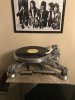
C21AE575-4369-42C3-AF75-6139BF21F84B.jpeg I’m delighted to announce the successful completion of Phase 1: Evaporation Of The Plinth. All wen smoothly but for a slight tweaking of the variable resistor at TP1 to pass adequate voltage to signal end of record and auto lift. Total investment of time, 4 hours. What did I learn? Everything. Seriously, I learned it’s gonna be fairly easy to install upgraded headshell wire and RCA sockets so as to upgrade cabling to the phono stage. I guess I plain reinforced how lucky I am to have found such fantastic equipment over the years, and I was also struck by the off chance occurrence of engineers really getting it right. This is a great, huge great piece of kit I scored for very little coin, and it’s only getting better.
 
I believe the KP designates that it was for the Japanese market. KD for US. Is it a 100V model or 120V? You'd need a transformer if it's a 100V Japanese market table. I'd also imagine swapping the arm will be a bit complicated, but I am sure it can be done.
I learn something new every day here on AK.
 
Back
Top Bottom