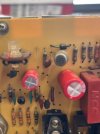
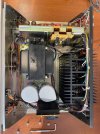
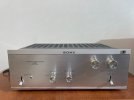
I have a Sony TA-3120F amplifier that was completely recapped by a professional two years ago.
Last night, Saturday, 8/8/26, I noticed something weird with one of my speakers. The left was not playing as loud as the right one. Then, I turned the left up and I heard distortion in the left.
I spent about two hours taking all the wires off and putting it all back together and testing along the way. And then both speakers seemed to be working fine. I thought maybe it was just a loose wire.
However, on Sunday morning, 8/9, the problem came back or persisted. I spent another 2 hours testing and swapping components. I discovered my Sony TA-3120F amplifier is out of spec somehow.
The left channel has -164 mV to -176 mV of DC on it. (should be 0 millivolts).
The right channel has -225 mV to -235 mV of DC on it. (should also be 0 millivolts).
(Not good. How bad this is, idk.)
The TA-3120F amplifier is almost always played very softly, so the problem went unnoticed for an undetermined time. But, on Saturday night (8/8/26) when I turned it up, I noticed the right channel was louder. Tired to use balance on my TA-2000 preamplifier and the left/right volume control on TA-3120F amplifier to match L/R sound. But turning left channel up to match the right caused the noticeable distortion in the left.
When the problem returned or persisted on Sunday morning, I isolated problem to the TA-3120F amplifier because I have two sets of speakers on it (so, tests show the problem is not the main or remote speakers) and two amps on this preamp (so it’s not the TA-2000 preamplifier). I removed the TA-3120F and installed a different amplifier (a TA-3200F) in its place. System function restored. It must be this TA-3120F.
After I pulled the TA-3120F amplifier out of the system, I tested it with a multimeter. See the test results above.
Please post any comments you think might help me. Thank you.
Last night, Saturday, 8/8/26, I noticed something weird with one of my speakers. The left was not playing as loud as the right one. Then, I turned the left up and I heard distortion in the left.
I spent about two hours taking all the wires off and putting it all back together and testing along the way. And then both speakers seemed to be working fine. I thought maybe it was just a loose wire.
However, on Sunday morning, 8/9, the problem came back or persisted. I spent another 2 hours testing and swapping components. I discovered my Sony TA-3120F amplifier is out of spec somehow.
The left channel has -164 mV to -176 mV of DC on it. (should be 0 millivolts).
The right channel has -225 mV to -235 mV of DC on it. (should also be 0 millivolts).
(Not good. How bad this is, idk.)
The TA-3120F amplifier is almost always played very softly, so the problem went unnoticed for an undetermined time. But, on Saturday night (8/8/26) when I turned it up, I noticed the right channel was louder. Tired to use balance on my TA-2000 preamplifier and the left/right volume control on TA-3120F amplifier to match L/R sound. But turning left channel up to match the right caused the noticeable distortion in the left.
When the problem returned or persisted on Sunday morning, I isolated problem to the TA-3120F amplifier because I have two sets of speakers on it (so, tests show the problem is not the main or remote speakers) and two amps on this preamp (so it’s not the TA-2000 preamplifier). I removed the TA-3120F and installed a different amplifier (a TA-3200F) in its place. System function restored. It must be this TA-3120F.
After I pulled the TA-3120F amplifier out of the system, I tested it with a multimeter. See the test results above.
Please post any comments you think might help me. Thank you.