Budnick123
Can't fight the addiction
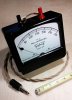
A friend has just purchased an AES AE-25 Super Amp from eBay. Both he and the seller did not realize at the time that it was the DJH version of the AE-25. Unfortunately, the amp didn't come with the biasing meter that was supplied when new nor the manual. My buddy is irritated by that since finding info for this particular version is not very easy and the differences between it and the regular and Signature versions are enough for my buddy to think that he can't use the same biasing procedure the Signature uses. He also sees that the tubes on the amp look tired, so he would really like to find out what the biasing procedure is if he ends up keeping it verse sending it back to the seller. Though, I suspect the seller probably never had the meter and didn't know that it originally came with one. For anyone wanting a biasing meter for their Cary or AES amp, and don't know how to make something that would work using a multimeter, you can currently get the Cary MA-300 meter from carydirect.com for $100 or musicdirect.com for $85. By the way, I have a regular AES AE-3 preamp (they did make a DJH version of that as well) and brought it over to my buddy's house so that we could have a listening session. They are both high quality pieces that sound very good on their own or together. Back to the amp. From what I could find on the internet, the regular version is auto biasing and the Signature version seems to have some info which is easy to find on the internet. I could not find the user manual for the DJH version. Given that it has a single output for a 1/4" phone connector and one adjustment for biasing all four tubes, my buddy knows that they are all biased at the same time. I found the biasing procedure for Cary amps on the caryaudio.com website in their FAQ section. It seems to differ from what is needed on the AE-25 Signature and DJH models because it only has one jack for both channels instead of a jack for each channel making my buddy unsure if it applies to his unit. After doing some searching on the internet, I found some info on the Audio Electronic Supply AES AE-25 DJH (Dennis J Had) Super Amp, which I copied and pasted from the now defunct superamp.com website. I found the below info using the WayBack Machine and digging through the old superamp.com website. It is presented as being a letter by Dennis Had. I cannot confirm this, but I don't know why it wouldn't have been his words given it was on one of his business's websites. It does provide the biasing current for the various types of tubes you can use in the amp but not the procedure on how to prepare the amp before making bias adjustments. Hopefully this info is helpful to those with the amp but not the manual and maybe, some individuals with the manual can add more info to complete the knowledge base for biasing the AES AE-25 DJH version.
Dear Audiophile Friend:
I have spent countless hours designing the Super Amp and this VERY special DJH version. My associates at Cary Audio have, on numerous occasions, asked why I was spending so much time with this product. If I may, I would like to give you the history of the DJH Super Amp.
The Super Amp started life as the model AE-25 stereo amplifier offered for the last two years by Audio Electronic Supply. The original AE-25 amplifier utilized a pair of EL-34’s in a basic push-pull configuration. At $800, in factory built form, I felt it was good but not quite approaching the magic of the single-ended triode sound. In fact, I would have to put it in the category of a good amplifier but clearly worthy of improvement. I may sound harsh by this description but once again I am accustomed to Cary, CAD-805 sound. This original AE-25 had EL-34’s, push pull, feedback and good specs. However, I felt, with much work, it could be improved. I wanted to make the AE-25 come closer to the music. I needed it to become an exceptional sounding amplifier.
For those of you not aware, I am a triode-crazed audiophile. Do KT-88’s or EL-34 tubes have any merit? They sure do! Simply take a look at the curves when connected in the triode mode. Looks similar to the good ole 300B or 2A3 for that matter. Even the 6L6 looks like a great tube when run in the triode configuration. So, off I went spending enormous amounts of time to create some realistic musical excitement. As I developed the Super Amp I soon discovered that I was enjoying it much too much. I mean, it was push pull in design. I was able to develop some nice triode parameters utilizing an extremely sophisticated output transformer design. I was on my way with the “fun factor”.
As I continued to design and listen, my wife, Donna, proclaimed, “you are producing some super sound tonight honey”. That’s it …. I'll call this the Super Amp. Super sound needs a super amp. Thus the name was born. Super Amp!
The first public showing and listening session of the Super Amp occurred on January 23, 2000, in Charlotte, North Carolina at the Charlotte Audiophile Society meeting. The raves and thumbs up approval were overwhelming. Several members even placed orders with me at the meeting, which was the ultimate compliment. I have been crazed with this lil ole amplifier since the first showing.
For the technically minded, a review of the circuit is in order. The DJH version of the Super Amp operates in a class A/AB mode. The output stage KT-88 tubes are fixed biased, with an equal negative bias voltage to ensure maximum linearity. Utilizing this bias network will permit the user to try many different types of output tubes if desired, a tweakers delight, if you will. Some of the choices may range from EL-34’s, 6550’s to 6L6’s. One might even wish to listen with 6V6’s. All these output tubes will present their own sonic signature, thus allowing the proud owner the ability to change the sonic character of his or her amp at their whim. There is a bias adjustment required when listening with these different types of audio tubes in the DJH Super Amp. The output power is 35 watts through each channel in the triode mode, utilizing KT-88’s, EL-34’s or KT-90’s. You may wish to operate with KT-66’s, 6L6’s or even 6V6’s. The output power with these lower dissipation tubes will yield from 20 to 25 watts output power. Speaking of output power, the DJH Super Amp has a peak envelope power of 57 watts into an average loudspeaker load.
There are a number of significant differences between the DJH Super Amp and the basic Super Amp. First, as mentioned above, a separate adjustable bias voltage supply. This is a two stage bias supply that even incorporates a filter choke in the supply. Secondly,channel independent B plus supplies utilizes film and foil power supply capacitors. The front-end driver stage 6922’s have separate left and right channel regulated B plus power supplies. A current source for the 6922’s is provided by separate EL-84 tubes. The power transformer in the DJH version is almost twice the size and capability of the standard Super Amp power transformer. To top off the ingredients, Jensen copper foil and oil coupling capacitors carry the audio signal from the 6922’s to the output stage KT-88 final output tubes.
Please remember to initially set the DC bias on the DJH Super Amp at 200 ma. DC current with the KT-88’s, EL-34’s or KT-90’s. Using 6L6’s, KT-66’s or 6V6’s the bias should be set at 160 ma. DC current.
In concluding, I am most fortunate to be able to do what I love. I consider my work to be a privilege and I take it very seriously, while never losing sight of the "fun" factor. I hope I have conveyed this fundamental principle through the DJH SuperAmp. I am honored to be able to contribute, in some small way, to your enjoyment of sound and music.
THE END
Dear Audiophile Friend:
I have spent countless hours designing the Super Amp and this VERY special DJH version. My associates at Cary Audio have, on numerous occasions, asked why I was spending so much time with this product. If I may, I would like to give you the history of the DJH Super Amp.
The Super Amp started life as the model AE-25 stereo amplifier offered for the last two years by Audio Electronic Supply. The original AE-25 amplifier utilized a pair of EL-34’s in a basic push-pull configuration. At $800, in factory built form, I felt it was good but not quite approaching the magic of the single-ended triode sound. In fact, I would have to put it in the category of a good amplifier but clearly worthy of improvement. I may sound harsh by this description but once again I am accustomed to Cary, CAD-805 sound. This original AE-25 had EL-34’s, push pull, feedback and good specs. However, I felt, with much work, it could be improved. I wanted to make the AE-25 come closer to the music. I needed it to become an exceptional sounding amplifier.
For those of you not aware, I am a triode-crazed audiophile. Do KT-88’s or EL-34 tubes have any merit? They sure do! Simply take a look at the curves when connected in the triode mode. Looks similar to the good ole 300B or 2A3 for that matter. Even the 6L6 looks like a great tube when run in the triode configuration. So, off I went spending enormous amounts of time to create some realistic musical excitement. As I developed the Super Amp I soon discovered that I was enjoying it much too much. I mean, it was push pull in design. I was able to develop some nice triode parameters utilizing an extremely sophisticated output transformer design. I was on my way with the “fun factor”.
As I continued to design and listen, my wife, Donna, proclaimed, “you are producing some super sound tonight honey”. That’s it …. I'll call this the Super Amp. Super sound needs a super amp. Thus the name was born. Super Amp!
The first public showing and listening session of the Super Amp occurred on January 23, 2000, in Charlotte, North Carolina at the Charlotte Audiophile Society meeting. The raves and thumbs up approval were overwhelming. Several members even placed orders with me at the meeting, which was the ultimate compliment. I have been crazed with this lil ole amplifier since the first showing.
For the technically minded, a review of the circuit is in order. The DJH version of the Super Amp operates in a class A/AB mode. The output stage KT-88 tubes are fixed biased, with an equal negative bias voltage to ensure maximum linearity. Utilizing this bias network will permit the user to try many different types of output tubes if desired, a tweakers delight, if you will. Some of the choices may range from EL-34’s, 6550’s to 6L6’s. One might even wish to listen with 6V6’s. All these output tubes will present their own sonic signature, thus allowing the proud owner the ability to change the sonic character of his or her amp at their whim. There is a bias adjustment required when listening with these different types of audio tubes in the DJH Super Amp. The output power is 35 watts through each channel in the triode mode, utilizing KT-88’s, EL-34’s or KT-90’s. You may wish to operate with KT-66’s, 6L6’s or even 6V6’s. The output power with these lower dissipation tubes will yield from 20 to 25 watts output power. Speaking of output power, the DJH Super Amp has a peak envelope power of 57 watts into an average loudspeaker load.
There are a number of significant differences between the DJH Super Amp and the basic Super Amp. First, as mentioned above, a separate adjustable bias voltage supply. This is a two stage bias supply that even incorporates a filter choke in the supply. Secondly,channel independent B plus supplies utilizes film and foil power supply capacitors. The front-end driver stage 6922’s have separate left and right channel regulated B plus power supplies. A current source for the 6922’s is provided by separate EL-84 tubes. The power transformer in the DJH version is almost twice the size and capability of the standard Super Amp power transformer. To top off the ingredients, Jensen copper foil and oil coupling capacitors carry the audio signal from the 6922’s to the output stage KT-88 final output tubes.
Please remember to initially set the DC bias on the DJH Super Amp at 200 ma. DC current with the KT-88’s, EL-34’s or KT-90’s. Using 6L6’s, KT-66’s or 6V6’s the bias should be set at 160 ma. DC current.
In concluding, I am most fortunate to be able to do what I love. I consider my work to be a privilege and I take it very seriously, while never losing sight of the "fun" factor. I hope I have conveyed this fundamental principle through the DJH SuperAmp. I am honored to be able to contribute, in some small way, to your enjoyment of sound and music.
THE END