• The move to the new server is done. There are some software and database maintenance updates in process. This has us passing the hat around to help out. We appreciate any donations. Seriously, even a dollar helps. The payment page may be found here - https://www.audiokarma.org/support.html

AK teamwork = a crazy pair of Fulton Modular J's with RtR ES tweeters

The Fultons' have some kind of fuzzy coating or debris on them.

I think that's called dust :) Seriously, I've seen a lot of Fulton cone tweeters and they didn't have any coating that wasn't already there from Peerless. In fact, the sticky damping added by Peerless attracted dust to stay and make a permanent home on these cones. I doubt it hurts anything. You might try a small soft artist's brush to whisk off what you can. Be careful of that fragile aluminum dust cap though.

...BobF seems to've been fastidious, to the point of specifying differences in the precise offset distance for stacking the 2 mid module choices.

Yes, he was. Actually it depends on where you sit relative to the speakers and how high your chair is, etc. I spent hours sliding the electrostatic tweeters forward and backward relative to the mids. I used a well-recorded female voice and could tell when the phase fronts were "locked in". Trust your ears on this.

The Mid module 6" seems to have a permiable dust cover. hmmm! I'd thought it was Acoustic Suspension! What do I call this cab?

Actually it is an 8 inch driver, but anyway...Most sealed cabinet boxes really aren't perfectly sealed - all have some air leaks. At very, very low frequencies all 2nd order sealed boxes really behave as 4th order vented cabinets. The goal is to make the air leaks small enough that the speaker rolls-out initially as a 2nd order sealed system, and that the additional two poles of a vented system don't hit until well below the working band. I suspect air leaks through the dust caps of the Rola woofer work like that - not a big enough "port" to hurt things in the intended pass-band of the driver. The benefit, besides voice coil cooling, is to avoid the resonance of the trapped air between the pole piece and the dust cap. Dick Sequerra removed his dust caps altogether, even in his sealed boxes.

 
FMI J pics

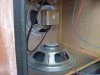
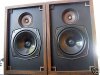
Let's see if I can figure out how to post some FMI J Modular images here. BTW, I wonder if the upper, forward-facing J woofer is the same as the E woofer.

PS: Does anyone know of a source of new Alnico and paper woofers besides the guitar amp folks?
 

Attachments

  • fulton J Modular.gif
    fulton J Modular.gif
    75.8 KB · Views: 93
  • Fulton J modular insides.jpg
    Fulton J modular insides.jpg
    12 KB · Views: 107
  • e592_3.jpg
    e592_3.jpg
    34.3 KB · Views: 109
  • 43b4_3.jpg
    43b4_3.jpg
    36.6 KB · Views: 234
  • b513_3.jpg
    b513_3.jpg
    32.9 KB · Views: 90
Thanks for the pics!

I don't know if it's easier to find more exotic alloys than good ol' AlNiCo. Woofers for guitar amps are usually intended for open cabinets, not just leaky ones; so the suspensions need to be stiffer.

About new/old and AlNiCo vs. Ceramic, those raise very heated discussions... what is known is that heat is your enemy. Ceramic recovers better eventually, although AlNiCo handles it more consistently during heavy playing, and can re re-magnetized.

A well-designed ceramic can be made to perform as well as some of the great AlNiCos, if you cut no corners. Some early ceramics suffered from a learning curve.

From what I see, it does look like the AlNiCo 12" is the same one I have in the 'E' cab. Same white dot sticker in the middle of the back.

If you can tell me the exact dimensions of your large bass cabs, I'd appreciate it a lot since I'm planning on cloning those. Looking for the exact placement of the drivers too since it's not centered. I know it's less of a deal to mirror the low frequencies but I'm just a bit funny...
 
Interesting about the Rola and Sequerra.

Despite sealing all interior joints, I've always suspected that 'sealed cabs' is an exaggeration. Usually the main leaks are at the back plate terminal posts and brittle or uneven sealant under the woofer rims. Cyclists know that butyl leaks some, so we air up tires. Uncoated Paper ought to be permeable too.

You don't really want 100% airtight or barometric changes would wreak havoc on your cones and surrounds but that's less likely than excessive leaks stealing your bass response.

(FWIW there were 3 mid types, FMI-60, 80, 100. I have the 6" version. ) edit - nope, I have the 8" version]
 
I had no idea there was crack available way back then. WOW.

attachment.php
 
FWIW there were 3 mid types, FMI-60, 80, 100. I have the 6" version.

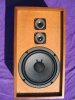
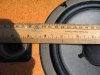
Yes, if you measure the cone only, but the standard in the industry is to measure from frame-edge to frame-edge. Here's are two pics I took last year of my FMI-80, one taken with a ruler over the woofer. Fulton's concept was FMI-60 means 6", FMI-80 means 8", and FMI-100 means 10". Clever guy, huh? Also I'm attaching a picture of the rare FMI-60.

I used to own FMI-100s, but failed to take a picture way back then (when film cameras ruled).
 

Attachments

  • IMG_1112_tiny_file.JPG
    IMG_1112_tiny_file.JPG
    116 KB · Views: 77
  • IMG_1122_tiny_file.JPG
    IMG_1122_tiny_file.JPG
    125.8 KB · Views: 49
  • FMI 60 3045_1.jpg
    FMI 60 3045_1.jpg
    21.3 KB · Views: 81
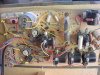
That crossover is a treasure. Solenoids for coils?
I heard the J Modular at Golden Grammophone in Akron, OH. I was a bit new to the world of high end, but I do remember the dynamics were there. Somehow the memory of imaging is missing, so maybe they weren't good in that regard. In the small room we couldn't get far enough away to do the sound justice, nor hear anything special about the bass. What was a treat was the Audio Research D150. If you want and amp that will drive the Fultons, this one will work well. Another suggestion is the Acoustat TNT200, a solid state amp totally at ease with 'stat tweeters.
 
I've corrected my mids measurement. Funny I had it right back in post #7 of this thread.

Thx for amp suggestions.

And the bass cabs have bracing. Actual two-by-fours in there. Vertically up the centers of the lower regions of both front and back baffles.

My Bozak Symphonies have 2x4's too, with one piece suspended in the middle joining the middles of the front-to rear baffles. Now that's what I call reinforcement, when your experience framing houses transfers to cabinet building.
 
What was a treat was the Audio Research D150. If you want and amp that will drive the Fultons, this one will work well.

That's the way I heard the J's back then. Also: ARC SP3A preamp and a Fulton-sanctioned Pro Musica Phono Unit (ERA table, Grace 707 arm and a modified Shure V-15 Type III with spherical stylus). Imaging was probably the one Achilles heel of this otherwise magnificent system. Too many diffractive edges. But natural tone colors, detail, dynamics, frequency range - it was all there.

PS: My posted snapshot of the FMI-60 shows a woofer that looks suspiciously like a KEF B200. A departure from paper and Alnico for the baby Fulton, I guess.
 
For imaging I'm thinking of extending the front baffles out to go flush with the front edges. Yep, I'd need to compensate for interior volume if I did that.

It may be that non-vertically aligned drivers (side-saddle arranged twin tweets) and polarity-reversed mids can never image though--even if I flattened and rounded all the front edges. Still, the soundstage may solidify...
 
For imaging I'm thinking of extending the front baffles out to go flush with the front edges. Yep, I'd need to compensate for interior volume if I did that.

It may be that non-vertically aligned drivers (side-saddle arranged twin tweets) and polarity-reversed mids can never image though--even if I flattened and rounded all the front edges. Still, the soundstage may solidify...

If they were mine, I wouldn't destroy their value by altering the box (or anything else that resulted in a non-reversible change). I would get plenty of 1/2 thick felt and make a diffraction "beard" to place around the drivers, especially the Peerless cone tweeters. Cut some holes for the tweeters (notch the holes in a star shape) and extend the felt to the edge, filling in the whole front recess, or even wrap around the edges. Felt may be ugly, but it should be used a lot more, in my opinion. It really sops up energy going out 90 degrees from the drivers before it can diffract. Ditto for the electrostatics box on the inside edges. The woofer's wavelengths are too large for the felt to help much with, so don't bother with the E cabinet.

Don't know about the reversal of phase. The FMI-80s used a first-order crossover and the tweeters and woofer are in phase, if I recall. Can't recall about the stats, but you can reverse the phase there easily and try it.
 
Yep, felt came stock on my Magnats all over the front baffles. But they already have no protruding front edges.

I could easily make a (reversable) standoff for the drivers to lift them flush with the felt (and thence the front edges). Still, internal volume compensation will be calculated.

I cannot say if that's original but the AAA battery trick, along with my DMM, confirms that on my set, the mid woofers are reversed polarity. Not the tweets, just the woofers.


Lotsa folks tried this back then, even Bozak, to attempt to sound brighter in showroom comparisons. Often it was a mistake.

Dahlquist used it as a device for passive crossover cancellation at the nodes (or it seems to me).
 
Lotsa folks tried this back then, even Bozak, to attempt to sound brighter in showroom comparisons. Often it was a mistake.

I can safely guarantee that this was not Fulton's scheme. He was a fanatic about realism.

Do you have a picture of the inside of your FMI-80s with the woofer pulled out? Show the wiring, crossover, etc.?
 
I have not looked inside the mid modules. (perhaps this weekend...)

Although I'd hope the only one monkying around in there was RF himself, I can't know that.

In my travels I've seen more than one driver marked wrong, even amps, so I don't care at all what it says. But the AAA battery trick does not lie. :D

Backs are wired + - on the screw posts just like the bass cabs. + onto the battery's +, and in most speakers the woofs push OUT, not IN.

Trickier to measure the tweets. Hook up the DMM and gently push on the cones. Most will then show NEG deflection on the DMM.

I said Gently. As in barely touching. <---- please I don't want hate mail 10 years from now!
 
If you do open them up, would you do me (us) a favor and take copious pictures of the insides? The back side of the woofer (there were two kinds), the crossover parts, and if you can twist the camera inside enough, of the wiring of your tweeters - so we can make a schematic. Thanks.

The Peerless tweeters had a red + terminal and they were pretty reliably phase correct. Their cones are so fragile that I wouldn't want to push mine in :tears:
 
Sure I'll take pics and if I can't get a mirror or something there I'll trace the connections by touch. Or just melt off the silicon that holds them there. But that would be 'ruining' them... :sigh:
 
I now have a second set of the tweeter modules. Yes they look even stranger, and sound even better.

With the Concept on the low/mid and the M-4 on the E-stats, it's quite an experience.

Now I tried the M-4 all by itself, with the SACD going straight to the amp (no pre). Darned if it doesn't sound the best I've ever heard it-- :music:

So is it true? The best Pre is no Pre?


.
Well not counting that VFET STAX grumpy just released...drool...
 
jaykoly has this same setup, if im not mistaken. Very nice speakers. But, his bass (or LF driver) bin was alot bigger. But i could be wrong.
 
Yes, the bass bin called the "F" was bigger around.

I have the model "E". It's no slouch in the bass though--the Xover frequency is the same as the lowest note on a grand piano, ~82-83 Hz.

I doubt that was a coincidence; Bob F started as a pro classical(?) musician.

.
 
Back
Top Bottom