• The move to the new server is done. There are some software and database maintenance updates in process. This has us passing the hat around to help out. We appreciate any donations. Seriously, even a dollar helps. The payment page may be found here - https://www.audiokarma.org/support.html

Allen C-4 organ pics, and help needed!

hammr7

AK Subscriber
Subscriber
In a related thread I got an answer to the mystery of the Allen PN-11 vacuum tubes. I uncovered a bigger problem regarding documentation. Allen Organ no longer offers anything specific to the model C-4 Organ, which was apparently a custom job. It is "sort of" related to the C-1, C-3 and C-10 versions available at the time. It is not related to any of the "TC" versions, which had already been converted to transistorized tone generation. So if anyone has ANY documentation related to late 1950's Allen analog organs please let me know. Documentation on the Allen 90 Watt amp (or the related Webster 90) would also be appreciated.

I've enclosed a few photos of the organ, and apologize that I can't show a frontal picture. It is beautiful, with nearly flawless Walnut cabinetry in a roll-top configuration. The unit is simply too large and heavy to move until a get some dollies and a few strong backs. The three attached pictures show:

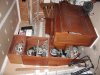
A general shot of the organ and two pairs of speaker cabinets - To give you a sense of perspective, my garage ceilings are about 10 feet tall. Each Bass cabinet has a pair of 15" Magnavox speakers, while the gyrophonic cabinets differ. One has 3-12" Magnavox mid-range speakers and 3 high frequency horns of unknown origin. The other has a pair of 12" Magnavox mid-range speakers. Each gyrophonic-bass speaker pair is driven by a 90 Watt Allen tube amplifier, which looks very similar to the Webster 90 from the time.

A close-up of the organ's tone cabinet. There are three banks of PN-11 (12AU7) tubes. Each tube is used for two notes, and there are separate banks for "reed", "diapason", and "flute" notes. There are about 120 tubes total.

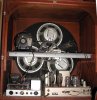
A close up of one of the gyro speaker units, showing the Allen amplifier.
 

Attachments

  • Allen-2.jpg
    Allen-2.jpg
    185 KB · Views: 318
  • Allen Organ 001.jpg
    Allen Organ 001.jpg
    118.5 KB · Views: 329
  • Allen-3.jpg
    Allen-3.jpg
    190.6 KB · Views: 387
Register to hide this ad
wow, that's amazing...:drool:

I'd almost be tempted to restore the amps and the rotary speakers (if they even need work), because I've heard that they have a cool musical effect. The tone cabinet I think is only good for its tubes...
 
Geez, why not restore it and have someone use it as an organ? Seems like something this well built with rotating speakers would be in demand just like the Hammond/Leslies. It would be a shame to part it out.
 
Yeah, if you can find a place/buyer for it, I think it would worth a lot more as an organ than parted out.
 
I think if you were extraordinarily patient and had a lot of storage space you *might* with some luck get more out of it as a whole assembly then you would get parting it out. There is just simply very little market value for organs, especially for tube based ones. To get that properly tuned would run on the order of 1500-2500 (estimated based on a quote i received for tuning a conn tube based organ amp that also used 12AU7s in a much simpler organ than what is shown there.

Personally, unless its one of the highly collectible hamonds or a gigantic transistorized theater organ, I don't think I'd bother trying to find a buyer. Grab those Allen 90s and enjoy!
 
The saddest thing of all is that this unit is pretty much functional. Although I haven't gone too wild yet (didn't want to keep the amps powered up long until I can check them out), everything appears to be in working order. The seller thought that one bank of speakers was out, but it seems they just weren't hooked up correctly. The cabling is reasonably intricate, and getting to the backs of the console and speakers is a major undertaking (the seller had everything up against a wall). Since the owner wasn't the user he probably didn't know the second gyro just hadn't been hooked up.

My initial gosl is to rebuild the amplifiers and then see how everything works. I can probably do this without documentation by simply testing and replacing exact components. Based on reputation, I doubt I'll need to replace much more than capacitors and perhaps a few resistors.

The tone cabinet should also be fairly straightforward, although time-consuming given the number of tone circuits. Each note has its own test point and a seemingly straight-forward adjustment. My guess is that I can throw an oscilloscope on each test point to confirm frequency. I do want to get documentation to confirm this and make sure I don't screw anything up. There are also a number of mechanical switches allowing you to pre-adjust stops, but I don't have a clue how involved the circuitry they control is. Still, the components used in this organ were top-of-the-line, so hopefully there will be few problems.

This organ is an AGO model, which means it conforms to the size and pedal configuration of the massive organs you see in churches. Originally I was going to replace my small spinet with this beast, but my wife isn't too keen on the idea, simply because of size. She was open to the idea until she actually saw it, and realized that even without speakers it would dominate the Living Room.

Unless I can change her mind over the next month or two I will look for another home for it. I might replace the tube amps with Allen solid state amps if I sell it whole. If I can't find a buyer, I'll look to sell the console shell (it would convert easily to a beautiful Walnut roll-top desk) and part out the rest.
 
Looks like I see a new tube on the top level there.

Not a new tube at all. Just one that I wiped the accumulated dust off of. The light coating came off quite nicely with a dry paper towel.

The empty slot next to it is the tube I took the bad photos of for the PN-11 thread. I cleaned up a couple to confirm that there weren't any differences among the installed tubes.
 
Hi organ lovers,

I restored an Allen tube organ in a church several years ago. Unfortunately it had already been "upgraded" with SS amps, but the tone chassis' (3ea) were full of 6SN7's. It took about 100 man/hours to get capacitors replaced and retune it. It was satifying in the end, but after about 2 years they decided to get rid of it. The only consolation was that I got to scrap it and keep whatever I wanted from it.

I can't offer you any advice about restoring or scrapping. Restoring is a lot of work, however.

Regards,
John
 

Attachments

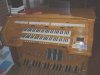
  • Allen B4 keyboard.jpg
    Allen B4 keyboard.jpg
    78 KB · Views: 129
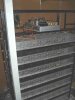
  • Allen B4 electronics rack 1.jpg
    Allen B4 electronics rack 1.jpg
    82.9 KB · Views: 173
I would be inclined to fully restore the organ for use (or to sell), but swap those sweet tube amps with solid state (may be possible to get an Allen Organ replacement pair on eBay). It should be a fairly easy procedure. Replacing caps in the organ itself, however, might be very time consuming.

Then, restore the tube amps and use them for hifi ;)
 
I would fix it and then play Toccata and Fugue in D minor with it cranked to full blast. :yes:
 
What a heap of speakers!

Two of the cabs are "Leslie" style systems, plus two other cabs? Man, if you ever get that going, I'll take a recording of "Whiter Shade of Pale", and get some vestal virgins to decorate the scene, maybe. :)

Seriously, that must roar something beautiful when it's all operational. Good luck with it!
 
Restore it.


I can think of only two reasons to restore.

1.) To donate to your church.
2.) Keep and enjoy if you play the Organ.

Reasons to not restore:

1.) Very little resale (If this were a collectible Hammond, I'd be all for restoration).
2.) Extraordinary cost involved with tuning a tube based organ.
3.) It's very large and probably a little overwhelming for anything smaller than a small church or commercial venue.
4.) The Allen 90 is reportedly an excellent hi-fi amp, using what is essentially an Acrosound TO-330 output transformer.

If the reasons to restore were compelling enough to follow through, I like the suggestion of converting solidstate.
 
Attached, is the Allen 90 schematic.

Thank you very much for the schematic!

The jury is still out on what I do with this organ. I will not scrap anything if I can help it, but its looking like it may not stay together. I think I can keep the speakers intact (minus the tube amps), but unless I can find service / maintenance documentation for the tone cabinet keeping the console functional may be beyond my capabilities. I'm still looking, but even the local service providers can't give me anything concrete.
 
Back
Top Bottom