• The move to the new server is done. There are some software and database maintenance updates in process. This has us passing the hat around to help out. We appreciate any donations. Seriously, even a dollar helps. The payment page may be found here - https://www.audiokarma.org/support.html

Altec 803A vs 416

Galaxie65

Always looking for new gear to try
Subscriber
So I have 4 of the Altec 803A which is stamped Heathkit for the Legato. My question is that some people rave about the 803A and others say the 416 is the better choice. I'm sure what I think just yet but wanted to ask anyone else that might have experience in this area. Is the 416 a better design or just a small improvement of the 803A? Also was the 803A a better woofer because of a specific reason, or just for the fact it was during the Altec/Hollywood era?

Any help would greatly be appreciated! Thanks
 
Register to hide this ad
The 803 is less efficient, has a higher resonant freq by almost an octave, has a totally different surround and a much lower power handling by over half compared to a modern 416. Todays 414 can out perform the 803 and thats a 12 inch woofer. The harmonic distortion of an 803 in some cases is much higher. As a personal observation I thought the 803 were more dedicated to be used with horns or bass reflex enclosures, where a 416 can be used in all types of enclosures, from infinite baffles to pure horns. An 803 I always associated with the more efficient 515 another famous speaker designed for horn use.
 
Last edited:
Weren't the original 803a paper surround and then the 803b a cloth surround? Also I have seen 803's with a reddish cloth surround.

I have heard the 803b turned into the 416a with little or no changes
 
I have heard the 803b turned into the 416a with little or no changes
Precisely.

Early 803A also used a phenolic spider similar to a 515, as well as a split rim. There is no adhesive holding the moving assembly to the basket. Working examples bring very good collector money.
 
Hey guys thanks for the replies!

So when I was researching into the history that's where I was able to find some information. The Legato was very popular during the mid to late 50's (1958 catalog has them). The Legato was about 325 per speaker and weighed around 200lbs each. When I looked into the drivers they were contracted out to Altec. I was also looking at it looks like the paper cone is also stretched out as the surround as well. I was told that this is specific to the 803A whereas the 803B used the accordion style surround.

I've heard a lot of good on the 803A as that was really something that bested the 515 when paired correctly and in a good enclosure. The 803B or later the 416 was a great piece that was used so there was more flex or so in the woofer.

Personally I haven't fired up the 803A's yet, but my buddy who has a setup with them loves them over his 803B's.

So I was just curious if there was one version that was preferred over the other for specific music. Or if there was just more of a collector value and the 803B was indeed a better driver hands down?
 
Last edited:
Pics are on the way, I'm at work and have limited service to post them from my phone.
 
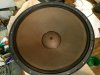
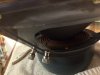
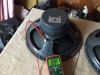
Here is the woofer
 

Attachments

  • image.jpeg
    image.jpeg
    84.4 KB · Views: 181
  • image.jpeg
    image.jpeg
    55.3 KB · Views: 175
  • image.jpeg
    image.jpeg
    95.2 KB · Views: 176
Precisely.

Early 803A also used a phenolic spider similar to a 515, as well as a split rim. There is no adhesive holding the moving assembly to the basket. Working examples bring very good collector money.

So if I understand correctly the 803a (and early 515) went through the following variations

First ones had paper hinge, phenolic spider, and smaller hole in the dustcap. I have heard these have the worst bass response (because of the very limited cone movement, but the best midbass/midrange.

The second variation had the same paper hinge, smaller dustcap hole, but had the cloth spider. These have better bass response because of more cone movement, and still have great mids.

Then after these versions came the cloth surround, cloth spider, and larger dustcap hole version. These (more so the 803b/416a versus the 515) have better bass response but the mids are not quite as sweet.

Would this be accurate Bowtie? I have always wanted to hear a phenolic spider driver.
 
What i have seen of 803's as best i can remember is that the very earliest can be found(rarely) in the same stamped steel baskets as the 601 used, smooth charcoal paint, water transfer decals, painted magnet with no can, phenolic spider, untreated paper hinge. The next generation came in the first cast basket, two pieces with split rim, charcoal krinkle paint, phenolic spider, untreated paper hinge. The generation after that moved to green hammertone paint, cloth spider, treated paper hinge, still retained the two piece split rim.

There were likely other subtle differences along the way, including the voice coil dimensions, wire type, former type, etc as well as the motor/magnet assembly. I just don't know them intimately enough to comment on more specifics.

The OP's appear to be from that late generation that would have been painted hammertone green if sold under the Altec label.

It's very difficult to assign hard and fast rules as evolution was ongoing, and there will undoubtedly be some exceptions to every rule a person would want to make.

I have heard these have the worst bass response (because of the very limited cone movement, but the best midbass/midrange.
In the right cabinet/horn, they make wonderful bass. But, not with the extension that most of us are looking for and used to with more contemporary music and systems.

I think the best way to sum them up would be to say that they were optimized for the high output impedance amplification of the day. Mate them to the proper period electronics and they can be wonderful. Just don't look for chest thumping, arrhythmia inducing kick drum output from them, or try to blow candles out by playing your favorite pipe organ tune using 64 foot pedal bombard stop.

 
The 803 is less efficient, has a higher resonant freq by almost an octave, has a totally different surround and a much lower power handling by over half compared to a modern 416. Todays 414 can out perform the 803 and thats a 12 inch woofer. The harmonic distortion of an 803 in some cases is much higher. As a personal observation I thought the 803 were more dedicated to be used with horns or bass reflex enclosures, where a 416 can be used in all types of enclosures, from infinite baffles to pure horns. An 803 I always associated with the more efficient 515 another famous speaker designed for horn use.
I'm really curious what the basis is upon which you are making this assertion, as the specifications for the two speakers are virtually identical. The resonant frequency for each speaker is specified as "no greater than 25hz". With respect to the surround, the specifications for each speaker state "high compliance cloth surround with mechanical resistance". Power handling as specified as identical. Also, what do you mean by your comment that harmonic distortion "in some cases is much higher". Are you saying there are differences between some 803Bs? Really, I'm curious about how you arrived at your conclusions, because the Altec spec sheet would not indicate or appear to support what you are saying.
 
Weren't the original 803a paper surround and then the 803b a cloth surround? Also I have seen 803's with a reddish cloth surround.

I have heard the 803b turned into the 416a with little or no changes
They both had the cloth surround. My thinking is that any example with a paper surround would have been repaired or reconed.
 
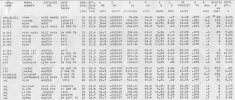
Here's ( a collage that I cobbled together years ago from some of ) William Meckles Ts publications.

WMeckle_TS_15inch_.png

A bit a thoughtful analysis will ( or at should should ) lead one to see that they support most of twiiii's assertions ( most particularly the measured Fs of the .803A when compared against the 416 variants ).

:)

PS : the top most row has the only known measurement ( that I'm aware of ) of the now famous Western Electric 728B, 12 inch speaker.
 
Last edited:
Thats what Ted Uzzel told me and what Don Davis told me and they worked for Altec. Remember it depends on which years you are comparing the speakers. They may have been similar back in the early 60's but with the advanced magnets and cone materials voice coils and formers the later 416's were rated at 75 watts RMS over a different band width than the 803's which were rated at 30 watts in the early 60's. They were using warble tones in the early days and Pink noise later on which gives the drivers totally different signals to deal with. I know my Carmels with two 414's out performed a similar Altec speakers system with an 803 any time. Because there were two woofers and a 800 hz versus a 500 hz crossover the Carmel could handle significantly more power. Changing from the included 806 driver to a an 802 driver allowed the system to handle even more power because the power to the horn could be reduced 3 or 4 db by the crossover. I would have loved to try a N-1201 crossover in a Carmel which would have gotten rid of that honky 811 horn sound. and why the Model 19 became so popular later on. Some owners use the model 19 with 300 to 600 hundred watt Mcintosh amps in larger rooms. There is no way an 803 can handle that kind of peak power. But I never liked the horn loaded bass sound. Doesn't matter if its Klipsch, JBL, EV, or Altec. Yes Bi amping helps a bit if the woofers are in infinite baffles and direct coupled to the amps. But other wise. I prefer well damped infinite baffles or a form of acoustic suspension. Remember you don't need big power for the home especially if you are using line arrays. I seldom use over 100 watts per channel. Thats about 104 db at my 14 foot listening position. Fast response or peak response, C weighted. Remember A weighting is only valid in conjunction with protecting the ear. It has nothing to do with how loud sound is actually especially above 70 db or so.
 
Last edited:
I STAND CORRECTED. In my reading this thread (which is the main one I see when I do a google search on Altec 416 vs 803) I overlooked the FACT that the original poster was specifically referring to 803As. As has been capably refuted in the replies above, I was completely wrong, incorrect, hasty and perhaps a bit personally "revved up" in my post. It is the 803B that is virtually identical to the 416A.
Please accept my apology if the tone of my comment came off as rude.
Again, my reason for resurrecting this old thread is that it is the one that comes up on a google search comparing these two families of Altec speakers, so my thinking is that it continues to be a key reference for those who are researching this topic.
 
Those heath 803A have the paper hinge, but it looks to be gooped?

I once had a pair of green 803A and I don’t recall the hinge being gooped. I do remember the phenolic spider.
Of course I gave them away…..
 
Back
Top Bottom