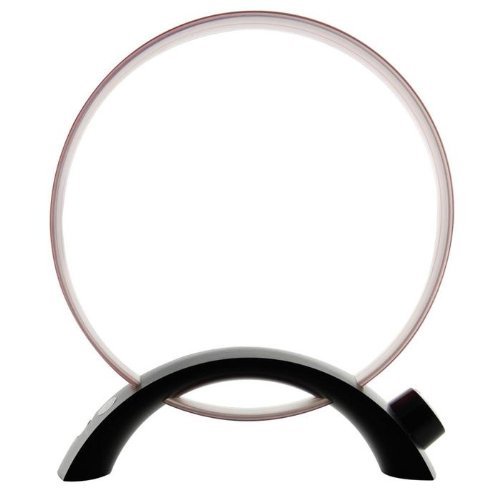
The Terk & the "Grundig" shown earlier are broadly similar and probably of equivalent performance -- and that level of performance is indeed pretty good.
http://radiojayallen.com/select-a-tenna-vs-terk-am-advantage/
The Select-A-Tenna was a good, relatively inexpensive tuneable AM loop -- they're no longer made, but it shouldn't be too hard to find one at a hamfest, antique radio fleamarket, or even on eBAY.
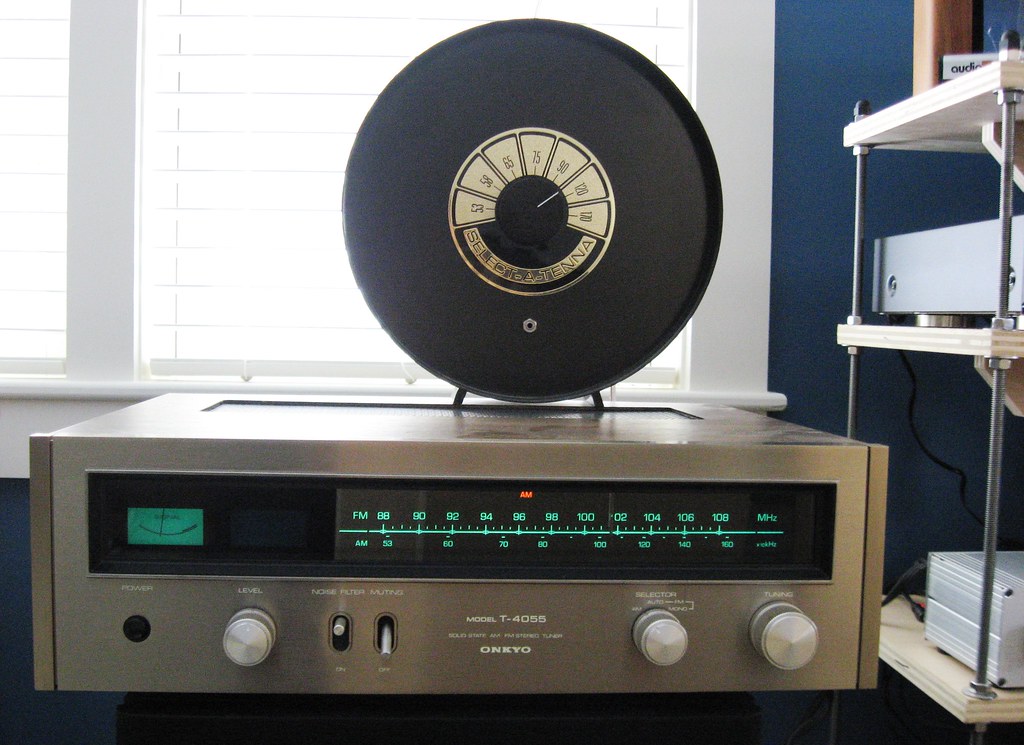 Onkyo T-4055 AM-FM stereo tuner receiving WBZ-AM (Boston) on a spring afternoon from about 120 miles away (& thanks to an inductively-coupled Select-A-Tenna!).
 by
mhardy6647, on Flickr
Photo shows an Onkyo T-4055 AM-FM stereo tuner receiving WBZ-AM (Boston) on a spring afternoon from about 120 miles away (& thanks to an inductively-coupled Select-A-Tenna!).
EDIT: Not sure if anyone directly addressed the nature of AM vs. FM when it comes to antennae. The bottom line is that the
wavelength of the transmitter "carrier wave" for AM is much greater than that for FM. This has many different implications for reception (not to mention the use of different modes of transmission to encode analog audio data on an AM vs. FM carrier!) -- for the current discussion, it relates to the
length of wire required for a properly-tuned antenna.
Midband in the standard AM broadcast band is about 1.0 MHz (1000 kHz): this corresponds to a wavelength of 934 feet (300 meters).
Midband in the US commercial FM broadcast band is about 98 MHz; this corresponds to a wavelength of "only" about 10 feet (3 meters).
The appropriate length of an antenna is thus about 100 times less for FM than for AM!
The AM loops, of course, have their antenna wire coiled in... well... a loop. This isn't just for compactness -- there are electrical properties of a properly made coiled loop antenna that are exploited by the Terk, the Grundig, and the Select-A-Tenna... but explaining
that concisely & accurately is beyond my pay grade

EDIT^2: I used this gizmo to calculate wavelengths, being the lazy blighter that I am:
http://www.csgnetwork.com/freqwavelengthcalc.html