• The move to the new server is done. There are some software and database maintenance updates in process. This has us passing the hat around to help out. We appreciate any donations. Seriously, even a dollar helps. The payment page may be found here - https://www.audiokarma.org/support.html

Amp Wattage and it's Relation to Speaker Impedance

CaseyWKC

Active Member
I'm sorry for asking a question that I know has been asked a couple times here before, but I just really want to make sure I'm understanding this correctly.

I just picked up a Realistic STA-2100D that sounds absolutely terrible with a couple sets of speakers I have around that are lower impedence, it sounds pretty good with anything 8ohms.

My main receiver/amplifier is a Kenwood KA-3300D rated at 150WPC @ 8ohms, 300 @4, and so on.

The 2100D is just rated for 120WPC @ 8ohms.

So, from my understanding, a good amplifier lets more current through with a lower impedance speaker because basic physics tells us it makes sense for us to take advantage of that and the only downside is the production of more heat.

Is that correct?

If that is correct, why don't all amps take advantage of doubling wattage in relation with the resistance attached.

Or, maybe I'm missing the point entirely?

I appreciate anybody's insight on the subject, and I hope nobody minds but I will definitely be posting here more often.

I have a Marantz 1200B on the bench right now with an Akai 1050 sitting next to it, and a soundcraftsman somewhere.

Thanks all!
 
Register to hide this ad
Before Solid State amps became common, most amps were tube based. Tube amps are much more well suited for delivering high-voltage than high-current, which is why many speakers from that era were 16-ohms. When 8-ohm speakers first became common, there were still a lot of tube amps in usage, and 8-ohms was a reasonable compromise for speakers that would work on both types of amps. Fast-forward to today and many/most new speakers are 6-ohms or even 4-ohms.

A lower impedance does allow more current to flow, and does produce more heat. This isn't a trivial concern, as it means the power supply, output transistors, etc, have to be more robust, and the heatsinks have to be larger and heavier (including the use of fans in some designs). Every one of those things drives up cost.

And you have to consider a few other things. Many stereos/amps support using more than one pair of speakers at the same time. That halves the impedance, obviously. So that headroom has to be built into the design. If it was targeted at 4-ohm speakers, then it's guaranteed that some clown would try to run two 4-ohm speaker pairs at the same time, which would mean that it would actually need enough headroom to be able to handle 2-ohms nominal.

Finally, consider that the listed speaker impedance is called "nominal impedance", because it's basically just an average. The actual impedance of the speaker will vary depending on frequency. For an "8-ohm" speaker, the actual impedance can vary considerably. Random example:

Cerwin_CLS-215_impedance.gif

Depending on what content is playing at any given moment, impedance can dip significantly below the nominal rating. This can be especially problematic if that dip is in the bass region and you are playing bass-heavy music, as that is when you will generally see the highest power output from your amp anyway. Most speakers will list their "minimum impedance" in addition to their "nominal impedance". I'd be curious about the minimum impedance of the speakers that you are having issues with.
 
Before Solid State amps became common, most amps were tube based. Tube amps are much more well suited for delivering high-voltage than high-current, which is why many speakers from that era were 16-ohms. When 8-ohm speakers first became common, there were still a lot of tube amps in usage, and 8-ohms was a reasonable compromise for speakers that would work on both types of amps. Fast-forward to today and many/most new speakers are 6-ohms or even 4-ohms.

A lower impedance does allow more current to flow, and does produce more heat. This isn't a trivial concern, as it means the power supply, output transistors, etc, have to be more robust, and the heatsinks have to be larger and heavier (including the use of fans in some designs). Every one of those things drives up cost.

And you have to consider a few other things. Many stereos/amps support using more than one pair of speakers at the same time. That halves the impedance, obviously. So that headroom has to be built into the design. If it was targeted at 4-ohm speakers, then it's guaranteed that some clown would try to run two 4-ohm speaker pairs at the same time, which would mean that it would actually need enough headroom to be able to handle 2-ohms nominal.

Finally, consider that the listed speaker impedance is called "nominal impedance", because it's basically just an average. The actual impedance of the speaker will vary depending on frequency. For an "8-ohm" speaker, the actual impedance can vary considerably. Random example:

View attachment 3327817

Depending on what content is playing at any given moment, impedance can dip significantly below the nominal rating. This can be especially problematic if that dip is in the bass region and you are playing bass-heavy music, as that is when you will generally see the highest power output from your amp anyway. Most speakers will list their "minimum impedance" in addition to their "nominal impedance". I'd be curious about the minimum impedance of the speakers that you are having issues with.
Thank you! Yes I figured it would fluctuate regardless and depending on the content could dip lower, especially if one was a bass enthusiast.

The speakers I were trying to drive are rated -

Sensitivity 86dB at 2.83 Vrms and 1.0 meter on axis
Impedance 4Ω nominal, 3Ω minimum, low reactance
 
Last edited:
The speakers I were trying to drive are rated -

Sensitivity 86dB at 2.83 Vrms and 1.0 meter on axis
Impedance 4Ω nominal, 3Ω minimum, low reactance

That does seem like it has potential to be a difficult load for some receivers, although the STA-2100D looks reasonably beefy.

One interesting tidbit. The first iteration of the STA-2100 shipped with a really nice looking large toroidal transformer as it's power supply. Pioneer filed a patent lawsuit against Realistic claiming that their receivers were too similar. Similar Pioneer receivers of the same era, such as the Pioneer SX-1050 also had a large toroidal transformer. As a result of the lawsuit, Realistic introduced the STA-2100D, a revision of the STA-2100 which included a few changes, one of which was swapping out the beefy toroidal transformer for a more conventional transformer. I'm theorizing at this point, but that could have easily had a negative impact on the receiver's low-impedance performance.

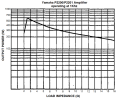
It's also possible that the receiver has a built-in current-limiter in order to protect itself. For example, my Yamaha P2200/P2201 amplifiers have a built-in current limiter that triggers when the load drops below 2.5 ohms. You can see the effect that it has quite clearly in the graph below. If you were actually listening to it while the current limiter was being triggered, I have zero doubt that it would have a significant negative impact on the quality of the audio.

P2200_Poweroutput_Stereo.png
 
One of the biggest topics here is why won't this (that I already have) work with that (that I just bought.) Gear combinations do not always work and, many times, people just want them to work because of sunk cost fallacy, or a preconception of how things are supposed to be, instead of learning. It is good that you want to learn.
 
Realistic liked to use thermal devices for protection.
Maybe they're on the edge of tripping open? Limiting current?
I have a Realistic SA-2001 integrated amp. It's the best integrated amp they ever sold under the Realistic name. It has a thermistor type device, one for each channel attached to the heatsink for the output transistors.
If I use a pair of 4 ohm speakers, after about 20 minutes or so, one channel will start sounding bad, then garbled with a low output, then no sound at all.
Using a single pair of 8 ohm speakers the amp will play all day long.
The outputs and drivers tested good. I'm pretty sure the thermal device is failing. Thermal switches like these can drift in value over time and start to trip early. I had the same problem with some poly switches in a pair of speakers that protected the tweeters instead of using fuses.
 
Per the user's manual, that receiver can accommodate a 4 ohm load. However, they did not provide a power rating into that load. At absolute minimum, it would be around 60 watts. More likely it is just a bit more than 120 watts.

Those speakers have a very low sensitivity rating; 83dB with 1 watt at 1 meter. At a normal listening distance of 8-10 feet, and allowing a 12dB headroom reserve for peaks, the amp is probably clipping (distorting) at much beyond an average output of 88dBSPL or thereabouts assuming an output capability of 120 watts. 85dBSPL assuming 60 watts.

Either way, that's pretty darned loud, at least to me. But not concert level loud...so depending upon your listening level, you may be getting some clipping distortion. It may also be that this particular amp (receiver) moves out of its linear response range at a relatively low output level, but the fact that it sounds good with different speakers at the same volume suggests that its ability to deliver current into more difficult loads is at least part of the issue. It also appears that it has a current limiting circuit, which may be kicking in at the more demanding parts of the speaker's impedance curve and impacting signal linearity, and thereby sound quality.

How do these same speakers sound when connected to your Kenwood amp?
 
That does seem like it has potential to be a difficult load for some receivers, although the STA-2100D looks reasonably beefy.

One interesting tidbit. The first iteration of the STA-2100 shipped with a really nice looking large toroidal transformer as it's power supply. Pioneer filed a patent lawsuit against Realistic claiming that their receivers were too similar. Similar Pioneer receivers of the same era, such as the Pioneer SX-1050 also had a large toroidal transformer. As a result of the lawsuit, Realistic introduced the STA-2100D, a revision of the STA-2100 which included a few changes, one of which was swapping out the beefy toroidal transformer for a more conventional transformer. I'm theorizing at this point, but that could have easily had a negative impact on the receiver's low-impedance performance.

It's also possible that the receiver has a built-in current-limiter in order to protect itself. For example, my Yamaha P2200/P2201 amplifiers have a built-in current limiter that triggers when the load drops below 2.5 ohms. You can see the effect that it has quite clearly in the graph below. If you were actually listening to it while the current limiter was being triggered, I have zero doubt that it would have a significant negative impact on the quality of the audio.

View attachment 3327829
My sta2080 next step down in power from the sta2100 is rated for 80wpc at.03% had no problems driving a set of Mach 2s and klh8s at the same time and can get very loud and still sound very clean ! Maybe there’s an issue with the sta2100 or perhaps it just doesn’t work well with those speakers .
 
Per the user's manual, that receiver can accommodate a 4 ohm load. However, they did not provide a power rating into that load. At absolute minimum, it would be around 60 watts. More likely it is just a bit more than 120 watts.

Those speakers have a very low sensitivity rating; 83dB with 1 watt at 1 meter. At a normal listening distance of 8-10 feet, and allowing a 12dB headroom reserve for peaks, the amp is probably clipping (distorting) at much beyond an average output of 88dBSPL or thereabouts assuming an output capability of 120 watts. 85dBSPL assuming 60 watts.

Either way, that's pretty darned loud, at least to me. But not concert level loud...so depending upon your listening level, you may be getting some clipping distortion. It may also be that this particular amp (receiver) moves out of its linear response range at a relatively low output level, but the fact that it sounds good with different speakers at the same volume suggests that its ability to deliver current into more difficult loads is at least part of the issue. It also appears that it has a current limiting circuit, which may be kicking in at the more demanding parts of the speaker's impedance curve and impacting signal linearity, and thereby sound quality.

How do these same speakers sound when connected to your Kenwood amp?
Sorry for the delay I didn't mean to abandon the thread.

Has to be the current circuiting limit with the more difficult load. The speakers are a pair of Aerial LR5's and paired with the Kenwood sound absolutely gosh darn great if I do say myself. And I've heard these speakers with a handful of different amps.

My sta2080 next step down in power from the sta2100 is rated for 80wpc at.03% had no problems driving a set of Mach 2s and klh8s at the same time and can get very loud and still sound very clean ! Maybe there’s an issue with the sta2100 or perhaps it just doesn’t work well with those speakers .
I hope it's not an issue with the receiver as nothing else is out of the ordinary. It's been completely recapped and restored, looks like it was done proper with nichicon caps, even an OEM power switch was sourced as the original was broken.

Again, with any 8 ohm speaker I have laying around they're great, maybe I should grab my pair of Phase Tech PC 3.5s from downstairs and test them?

They have a nominal 4 ohm load as well, though I'm guessing a bit higher sensitivity.

One of the biggest topics here is why won't this (that I already have) work with that (that I just bought.) Gear combinations do not always work and, many times, people just want them to work because of sunk cost fallacy, or a preconception of how things are supposed to be, instead of learning. It is good that you want to learn.
Well the good news here is I didn't buy this receiver to replace my Kenwood, I bought it because the price was just too good to pass up and I hadn't heard one before.

Plus I still learned something! I didn't know some (nicer) receivers/amplifiers designed for high current delivery will let more power pass through due to the speakers lower impedance!
 
My sta2080 next step down in power from the sta2100 is rated for 80wpc at.03% had no problems driving a set of Mach 2s and klh8s at the same time and can get very loud and still sound very clean ! Maybe there’s an issue with the sta2100 or perhaps it just doesn’t work well with those speakers .
Update : I grabbed a single Phase Tech speaker to test because it was bothering me.

Sounds great, them and the aerials both share a nominal load of 4 ohms, but these guys have a sensitivity rating of 91db.
 
Update : I grabbed a single Phase Tech speaker to test because it was bothering me.

Sounds great, them and the aerials both share a nominal load of 4 ohms, but these guys have a sensitivity rating of 91db.
Sometimes it’s just speaker compatibility !
 
In the big picture only a relative few amps claim to double down, let alone receivers or integrated amps. Curiosity got the best of me. Not seeing 300@4 in the manual/specs. Is there some other reference saying that?
Here’s a screenshot from the manual.
 

Attachments

  • IMG_5566.png
    IMG_5566.png
    226.2 KB · Views: 20
Yup, that's what I saw.

Doubling down in normal context refers to continuous rated power doubling from 8 to 4 and maybe again from 4 to 2.

The continuous 1kHz DIN ratings are 160W@8 and 220W@4.

The peak power where you see 300-some watts in the specs is a different thing, more related to what may be referred to as dynamic power or dynamic headroom (the latter usually stated in dB relative to continuous power).

Looks like a pretty stout unit no doubt, but it does not double down in the normal context.
 
Thank you! Yes I figured it would fluctuate regardless and depending on the content could dip lower, especially if one was a bass enthusiast.

The speakers I were trying to drive are rated -

Sensitivity 86dB at 2.83 Vrms and 1.0 meter on axis
Impedance 4Ω nominal, 3Ω minimum, low reactance
The speaker impedance doesn't necessarily dip with a more bass heavy music. Some speakers drop to very low impedances at higher frequencies which can be much worse for some amps causing very audible distortion. I've found that when speaker impedance dips at low frequencies, it sounds like the amp is power limited while impedance dips at higher frequencies can sound grainy or grating.
 
Yup, that's what I saw.

Doubling down in normal context refers to continuous rated power doubling from 8 to 4 and maybe again from 4 to 2.

The continuous 1kHz DIN ratings are 160W@8 and 220W@4.

The peak power where you see 300-some watts in the specs is a different thing, more related to what may be referred to as dynamic power or dynamic headroom (the latter usually stated in dB relative to continuous power).

Looks like a pretty stout unit no doubt, but it does not double down in the normal context.
Gotcha, that's good to know!

There's something about it I just love. Haven't found anything that can really touch it yet. Tons of power and the fact that it's from the 80's I believe? And has a built in DAC that take optical in is pretty darn handy.
 
Some amps are linear in that they double the power when you go from 16, to 8 to 4 to 2 ohms. Accuphase for instance. But most units don't have the necessary heat sink area, and strong enough power supplies are enough outputs and driver transistors to accomplish that. Recievers and most integrated amps that folks can afford to buy are lucky to handle 4 ohms loads. I know my Left and right speakers are supposed to be 8 ohms for the woofers as I bi amp , but they dip down into the high 2 ohm range in the midbass area around 180 HZ. But the amps I use are rated down to 2 ohms, so no worry for me. Plus most of the time I am using less that 20 watts and the amps are rated at 200 watts 8 ohms. Plus I do use 4 inch whisper fans for each amp. one push and one pulling air.
 
And some amps that claim/appear to double down do so only because the higher-impedance ratings are sandbagged.

But if it's stable, and rated in to a 2 or even 1 ohm load you can generally figure that it's the real McCoy ..
Krell .. Aragon .. there are others ..
 
Last edited:
Back
Top Bottom