• The move to the new server is done. There are some software and database maintenance updates in process. This has us passing the hat around to help out. We appreciate any donations. Seriously, even a dollar helps. The payment page may be found here - https://www.audiokarma.org/support.html

Amplifier TA 818 RMS doubt

nubetrueno

New Member
Good afternoon. My English is bad.

QUERY.
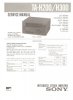
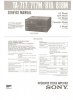
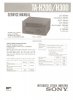
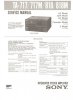
I have a Sony TA 818 amplifier. The manufacturer's specifications are:

Continuous RMS power output (AEP, UK, West Germany, Italian model)
-> TA-717M = 30 + 30 watts (6ohms, at 1khz, 5% THD)
-> TA-818M = 45 + 45 watts (6 ohms, at 1khz, 5% THD)

Peak music output (E, Saudi Arabia model) = 380 watts (5% THD, 6ohms).

Power cosumption.

AEP, UK, West Germany, Italian model 105w
E, Saudi Arabia model 105w

my doubt:

1.

my model is differentiated from the others. Its power is not expressed in "RMS power output". The value is expressed in PMPO (380 watts). I need to know the RMS equivalent to 380 watts. I do not understand why the output power is expressed in a unit of value different from that used in the other models. When trying to convert from PMPO to RMS, the value in RMS is always much lower than the 45 + 45 watts expressed in the TA-818m model, a situation to which I find no sense as both devices are completely the same in all other specifications.
2.
I also attach the specifications of another amplifier that I have. I would like to know if there is much difference in sound quality and final power.

3.
My intention is to use the TA 818 with SS D105 speakers (attached specifications). I am concerned this amp is not enough to get good sound.


Of course, I am very grateful to you.
7A6B1AF203B0438389B18D79C346C9C151A64FE7001.png HI905.jpg HI566.jpg
 

Attachments

  • HI905.jpg
    HI905.jpg
    36.8 KB · Views: 3
  • HI566.jpg
    HI566.jpg
    43.8 KB · Views: 3
Register to hide this ad
PMPO is pretty much a meaningless power rating which is why most use RMS. I would go by what the other countries models say if they are the same.
I'd guess if it's putting 45 watts out at 5% distortion that will give you something like 35-40ish watts of usable power per channel.
 
It's the same (but different). :)

45W @ 6 ohms = 16.43Vrms

16.43Vrms = 46.47Vpp (Volts peak to peak)

46.47Vpp @ 6 ohms = 360W peak to peak, so to speak. A little generous rounding up of that 16.43 to 17 volts and you're right there at the 380 watt PMPO rating.

That's my story, anyway, and I'm sticking to it. ;)
 
Last edited:
Peak music power output (PMPO) is a very inflated power rating. As an example if a 30 volt power supply could put out 10 amps for 1 micro second its PMPO would be 30 x 10 or 300 watts. Completely meaningless compared to long term RMS power over the entire bandwidth.
 
30 watt per channel amp into 6 ohms, and 6 ohm relatively efficient (like the SS-D105) speakers should be a good match.
 
Peak music power output (PMPO) is a very inflated power rating...

Is it really overinflated, or is it really more just a different way of stating the same thing in different terms?

As I see it, based on the math previously given, 380w PMPO isn't an overstatement of the amp's capability, it's merely stating the amps performance in a different way. It is the exact same amp whether you call it 45wpc by the RMS method or 380W PMPO.
 
Last edited:
To get that high of distortion the unit is obviously a compromised design and should be treated as such.

The distortion level can be easily manipulated by where the power rating is taken.

Want a real clean distortion number? Rate the unit at a little less power output.
Want a higher power number? Allow a higher level of distortion in the measurement.
 
Is it really overinflated, or is it really more just a different way of stating the same thing in different terms?

As I see it, based on the math previously given, 380w PMPO isn't an overstatement of the amp's capability, it's merely stating the amps performance in a different way. It is the exact same amp whether you call it 45wpc by the RMS method or 380W

PMPO is calculated by multiplying the ‘virtually instantaneous’ current to the voltage that the transformer can produce iwo the rail voltage of the amplifier. As the current rises to meet demand, the voltage will have to decrease (voltage rail sag) to maintain the VA rating of the transformer. Since the interaction between current and voltage has some damping, the rise in current is not instantaneously met with a decrease in voltage. The very high current for a very short duration (milliseconds) is used in PMPO calculations @ the rates voltage, giving the impression that the amplifier is more powerful than it actually or realistically is.
 

It's not more powerful. It's exactly the same, just shown by a different calculation.

If the amp can do 45Wrms then by default it can do ~380Wpmpo.

380Wpmpo is inherent to 45Wrms. Ref. post #3.

It's akin to saying the standard household mains voltage here in the USA is 340Vpp rather than 120Vrms. It's exactly the same functional result for your light bulb, just stated differently.
 
Last edited:
It's not more powerful. It's exactly the same, just shown by a different calculation.

If the amp can do 45Wrms then by default it can do -380Wpmpo.

380Wpmpo is inherent to 45Wrms.

Your mathematics in this example makes sense, however, this is not mathematically correct with most statements of PMPO’s. I, and l’m sure most here, have seen kW claims of PMPO on many a modest system.
 
I have amps that produce 22,400 watts PMPO.

Crown CE4000 @ 4 ohms bridged.

2800 watts @ 4 ohms = 105.83Vrms

105.83Vrms = 299.3Vpp

299.3Vpp @ 4 ohms = 22,400Wpmpo @ 4 ohms. ;)
 
Last edited:
PMP was always used by the cheap plastic cr@p makers to make their CPC gear sound powerful compared to all the good stuff

It's all marketing tosh ;)
 
Back
Top Bottom