• The move to the new server is done. There are some software and database maintenance updates in process. This has us passing the hat around to help out. We appreciate any donations. Seriously, even a dollar helps. The payment page may be found here - https://www.audiokarma.org/support.html

AMT Tweeter clone orientation

Rick Owen

Well-Known Member
I have ordered 4 of these Dayton Audio AMTPRO-4 Air Motion Transformer


As well as already having 4 Airborne RT-20021, 4cm2 Air Motion Ribbon Tweeter, 4ohm


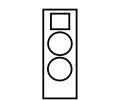
The plan is to remove them all from their housings and install them in a custom plate, roughly 8" x 7" and install them into a tower recessed about 1/2" and with a 45 degree chamfer around the edges. The two larger will be wired in series for an 8 ohm load, and the 2 smaller utilized as almost a "super tweeter arrangement" (also wired in series) crossed over with a simple 6 db crossover cap. (the Dayton falls off considerably after 12-14khz). the objective is to have each "pod" perform l in unison like a single driver. Hope to crossover to this pod @ 1.2k.

My Question is in regards to the arrangement and orientation. Almost all the AMT tweeters I see are mounted vertically, but I am guessing this is mainly a product of their face plates, and was wondering if two mounted horizontally would be ok? I was thinking of an dayton amt on the bottom, then the two airborne in the middle, with another Dayton AMT on top. They should all be in phase, so I do not think cancellation will be much of an issue?

Thoughts?
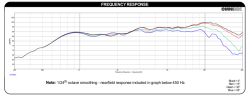
dayton.pngimage_2024-03-31_114240447.png
 
Register to hide this ad
In the typical configuration, the Dayton driver will have a wide horizontal dispersion and a narrow vertical dispersion. Similar to line array disperson patterns. Mounting them horizontally will create a narrow horizontal dispersion and wide vertical. In an average room, a wide vertical dispersion will result in more reflected sounds from the ceiling and floor. The longer the driver length, the more pronounced this effect becomes. The manufacturers of these devices will occasionally use terms such as "controlled vertical dispersion" to describe this effect.
 
In the typical configuration, the Dayton driver will have a wide horizontal dispersion and a narrow vertical dispersion. Similar to line array disperson patterns. Mounting them horizontally will create a narrow horizontal dispersion and wide vertical. In an average room, a wide vertical dispersion will result in more reflected sounds from the ceiling and floor. The longer the driver length, the more pronounced this effect becomes. The manufacturers of these devices will occasionally use terms such as "controlled vertical dispersion" to describe this effect.
How much of this "effect" is a product of the mounting plate?
Will utilizing two inside a recessed chamfer mitigate this?
 

Attachments

  • config .jpg
    config .jpg
    22.8 KB · Views: 2
If this is what you expect, it will sound awfull bright.
Oh, I am aware it will need to be dampened down, the objective is to throw a good sound stage. By mounting them on a plate, it will be easier to try a few different configurations.
 
How much of this "effect" is a product of the mounting plate?
Will utilizing two inside a recessed chamfer mitigate this?
Very little. It's not deep enough to provide much control. Its primary function is to protect the diaphram. Also, arranging the Dayton's in that manner is likely to cause lobing problems. However, Infinity used the below configuration with success. Another suggestion would be an vertical MTM arrangement with a single Airborne between the two Daytons and all 3 mounted above a woofer.

infinity.jpg
 
Very little. It's not deep enough to provide much control. Its primary function is to protect the diaphram. Also, arranging the Dayton's in that manner is likely to cause lobing problems. However, Infinity used the below configuration with success. Another suggestion would be an vertical MTM arrangement with a single Airborne between the two Daytons and all 3 mounted above a woofer.

View attachment 3164310
yes, something like this, the trouble is, I do not have enough room for the two AMT's to be mounted vertically, thus why I am thinking about trying the horizontal installation. Bear in mind those mids are twice the width. But even using the term "mid" isn't correct as the amt's will be producing between 1.2k to 12-14k.

The infinities you have pictured have a different type of crossover, where the upper and lower are phased out as the frequency increases. That is why you see the two tweeters aligned next to the middle. And they are planars, not AMT's, at least that is my understanding and how Paul McGowan explained them.

Dam nice speakers though.
 
Last edited:
yes, something like this, the trouble is, I do not have enough room for the two AMT's to be mounted vertically, thus why I am thinking the horizontal installation. Bear in mind those mids are twice the width. another thought is to mount them stacked so they almost appear as one mid.
Someone stacks them with one on its side for vertical and horizontal dispersion.
 
yes, something like this, the trouble is, I do not have enough room for the two AMT's to be mounted vertically, thus why I am thinking about trying the horizontal installation. Bear in mind those mids are twice the width. But even using the term "mid" isn't correct as the amt's will be producing between 1.2k to 12-14k.

The infinities you have pictured have a different type of crossover, where the upper and lower are phased out as the frequency increases. That is why you see the two tweeters aligned next to the middle. And they are planars, not AMT's, at least that is my understanding and how Paul McGowan explained them.

Dam nice speakers though.
AMTs are planars as well, regardless of what Paul McGowan says. there is still a mylar/kapton substrate the aluminum is bonded to.
Key Features
  • Folded Kapton ribbon diaphragm delivers clean, detailed, and highly dynamic output
  • Open back design permits dipole or chamber loading
  • Pro-level output and ruggedness for PA boxes, studio monitors, or high-efficiency home playback
i would not suggest you run them 90 degrees from vertical, the original infinity speakers emits were able to rotate to mount either way, depending on which way you planned to have the speakers, vertical or horizontal

the dispersion will be super narrow widthwise, and super wide heightwise.
those tweeters do look fantastic, I hope it sounds good!
 
Last edited:
You could mount one on the top or in the back of the cabinet in reverse polarity and crossed over higher in the F range to add some airry-ness as well. Throw a passive rad as well and go all out.
 
AMTs use a folded-pleat style of diaphram that "squeezes" the air sort of like a bellows would. A ribbon or planar driver vibrates a (mostly) flat diaphram. The AMT can move more air and play lower frequencies than a ribbon. However, they both share the characteristic of having wide horizontal dispersion and somewhat narrow vertical. If the membrane is square, directivity is more uniform. As the length increases, so does the previously described effect.
 
AMTs use a folded-pleat style of diaphram that "squeezes" the air sort of like a bellows would. A ribbon or planar driver vibrates a (mostly) flat diaphram. The AMT can move more air and play lower frequencies than a ribbon. However, they both share the characteristic of having wide horizontal dispersion and somewhat narrow vertical. If the membrane is square, directivity is more uniform. As the length increases, so does the previously described effect.
Understood. But, if you have an amt that is for example 2 x 4 and then stack two making it 4x4, then it would at least seem the dispersion would be identical, both vertically and horizontally, no?

Also, not being taken into consideration is the fact, from the graphs I posted, this dispersion pattern really does not occur until +10k, which is about the same time the Airborn tweeters will start to roll in, thus negating a large part of this adverse dispersion everyone mentions.
 
Last edited:
They are not ribbons or AMTs. They are planars. I don't know why they use AMTs for description. I find it deceptive. I would mount vertical for horizontal dispersion. But that's just my understanding of the beast. Have fun and tell us of your findings.
 
Back
Top Bottom