• The move to the new server is done. There are some software and database maintenance updates in process. This has us passing the hat around to help out. We appreciate any donations. Seriously, even a dollar helps. The payment page may be found here - https://www.audiokarma.org/support.html

An Unloved Sony TA-AX401 Gets Some TLC

MFRD

AK Subscriber
Subscriber
Some months back I spotted a small stack of audio components out by the curb on trash day. Not wanting them to end up in a landfill, i stopped to rescue them. There were an Onkyo TX-8211 receiver, a MCS 3873 amp, and the titular Sony.

When I quick-tested them, the Onkyo worked just fine - in fact it's been on bench duty since my little Yamaha took ill - but the MCS and the Sony were stuck in protection so they went on a shelf.

But last weekend I brought home a massive pair of JBL 15" speakers whose electrical health is highly suspect. I needed an expandable amp with which to test them, so I thought I'd take a more in-depth look at these two.

The MCS had 3 blown outputs and repairing it makes no economical sense, so after getting some good advice in this thread I started an organ-donor pile in my garage with the MCS as founding member.

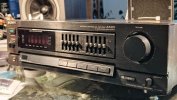
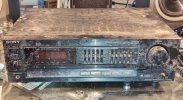
Which leaves the Sony. Here she is; she sure looks filthy.
1000000901.jpg
 
Last edited:
Register to hide this ad
But I'm not going to clean it or spend any time on it until it's been diagnosed and I know I'm going to repair it - because if I don't repair it, cleaning it is just a waste of time.

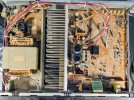
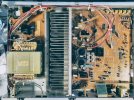
The inside doesn't look quite as gross, but there's plenty of dust

1000000903.jpg

It's a pretty clean layout; most functions are handled by ICs. The Sanken outputs are so large I first thought they were some kind of STK. Stated power is 135wpc RMS both channels driven at "no more than .9% THD" - not exactly a specs queen, this one :)

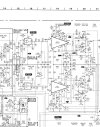
A very clean scan of the service manual is available on Elektrotanya. The set of schematics is outstanding, probably the best I've seen.

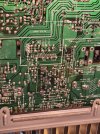
The foil side of the PCB is extremely well labeled, sections are delineated, pinouts are marked. All in all, this humble amp is just a joy to work on, and maybe just because of that I'm determined to save it.

1000000906.jpg
 
On power up, everything looks normal but the speaker relay doesn't close. There's 0V at the coil, so the protection circuit must be seeing something it doesn't like. There's no DC at the relay input, however.

After warm-up nothing looks out of the ordinary. Everything is quiet. No suspect smells. The thermal camera reveals no overheating.

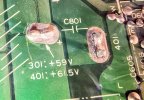
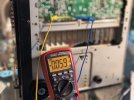
Soon enough it appears that B- is -65V as per schematic, but B+ is only 43V. While checking power supply voltages it appears that touching the negative pin of C801 the B+ filter cap with my DMM probe causes the speaker relay to close!

Which, on closer look, kind of makes sense:

1000000907.jpg

I didn't write it down but I think there was 35 kilohms between cap pin and solder pad when I measured it later.

I reflowed all four joints and turned the amp back on, and sure enough the relay closed!
 
I was sure I nailed it, but when I connected sacrificial speakers and a signal generator and turned up the volume, there was no sound.

B+ and B- were both in spec, however; so that was encouraging.

I traced the signal with a scope and it disappeared at IC501 and IC601, the VAS ICs if I'm not mistaken? They're NEC uPC1342 so I downloaded a datasheet and started probing at the pins
1000000909.jpg
 
Turns out 65V was present at pins 1 and 2, but at pins 9 and 10 there was 150mV instead of -65V, and that could cause issues.

Backtracking on the B- rail, there was 0V everywhere until I got to R537, a fusible resistor and therefore an excellent potential culprit. And while there was ~0V downstream of R537 there was a healthy 65V upstream!

I didn't have that type resistor on hand, so I jumpered the blown one with my DMM set to current mode, ready to yank it if the current was too high, but as it turns out current seemed perfectly normal at 60mA.

1000000898.jpg

But... still no sound out of the speakers, with the selector on A+B. So I started pushing all the switches and twiddling all the knobs, as one does when one is frustrated and has no clue what to do next... and with the speaker selector on A, there was sound! The A+B position is either not working, or two pairs of speakers need to be connected for it to work and I only had one.

I listened to music for an hour or so and the amp worked great, it's quiet, and it runs just slightly warm. There's a couple more things I want to look at, and also give it a well-deserved bath, but that will be for tomorrow.
 
Last edited:
If the A+B speaker position is wired in series you will get that result. It will not work with only one pair of speakers hooked up.
 
These sound surprisingly good considering how they look. They overachieve for what they are in my opinion and have a relatively basic circuit design and are easy to access/ work on.
 
These sound surprisingly good considering how they look. They overachieve for what they are in my opinion and have a relatively basic circuit design and are easy to access/ work on.
I agree, it sounds much better than expected.

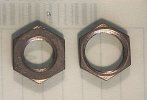
And working on it is a dream. Honestly the easiest I've ever had on my bench. Best service manual diagrams ever. Similar-sized screws have different finishes so they can't be confused. And this is my favorite:

1000000917.jpg

These two nuts fit different diameter shafts, yet they're the same size so only one socket is needed. Brilliant!

Oddly, that size is 7/16. Japanese using standard hardware? That's kind of unusual
 
I'll get 2R2 fusible resistors next time I order from Digikey. Until then I'll stick a standard 1R8 resistor in there. I was wanting to power-test the amp, but maybe I'll wait until a proper fusible resistor is installed :)

Here are "after" pictures. "Before" ones are in posts 1 and 2.

1000000925.jpg

1000000918.jpg
 
Well that was fun!
Thanks for posting this story. I think finding broken or not working stuff and saving it is the most rewarding / interesting / enjoyable part of this "hobby". You are very good at systematic trouble-shooting! I hope all of the lights are working!
 
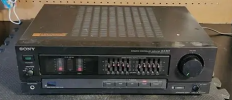
Looks very similar to a TA-AX301 I used to have which looks like this. Yours must be the higher version of it.

1789747556930.png
 
I agree, it sounds much better than expected.

And working on it is a dream. Honestly the easiest I've ever had on my bench. Best service manual diagrams ever. Similar-sized screws have different finishes so they can't be confused. And this is my favorite:

View attachment 3837495

These two nuts fit different diameter shafts, yet they're the same size so only one socket is needed. Brilliant!

Oddly, that size is 7/16. Japanese using standard hardware? That's kind of unusual
Are the threads metric or Imperial? My guess it the hexes are 11mm (=.433") not 7/16 (=.437").
 
Are the threads metric or Imperial? My guess it the hexes are 11mm (=.433") not 7/16 (=.437").
Not sure about the thread, but I tried metric sockets first and my 11 mm didn't fit in the balance pot nut recess while my 7/16 socket did, though just barely. It's entirely possible that my 7/16 socket just has a thinner wall though. Thanks for pointing that out.
 
Now that a proper fusible resistor has been installed, it's time for some testing.

I've been using the amp, and I've been thinking it runs a little warm. At some point it dawned on me that I never checked bias, and when I did I found 5mV, which is 3x spec. After adjusting both channels to the prescribed 1.5mV, power draw from the wall dropped from 45W to 33W.

DC offset was darn near ideal, which is good because it is not adjustable:

1000000979.jpg

On power test the little Sony pushed 34.5V into 8.2 ohms at 1000Hz, both channels driven. That's 145wpc, a not-insignificant increase over the 135wpc factory rating.

Did I mention this amp sounds a LOT better than it has a right to? I find it quite musical and fast, with plenty of well-controlled bass, and quite decent imaging and soundstage.

TA-AX401's median price as I write this hovers around $100. At that price, it's one heck of an entry-level audiophile bargain. I concur with all the folks who've said this amplifier is criminally underrated.

It sounds great but it's not going to win beauty contests though :)
 
Back
Top Bottom