• The move to the new server is done. There are some software and database maintenance updates in process. This has us passing the hat around to help out. We appreciate any donations. Seriously, even a dollar helps. The payment page may be found here - https://www.audiokarma.org/support.html

Another Altec 414 Box Volume question??

ictwoody

I like vintage gear — my preamp is from 2007.
Hey speaker building gurus. I didn't want to hijack the other thread on Altec 414 box volumes, so I'm starting this one.

I was also looking to replicate the infamous JE Labs Altec 414 2-way speakers written about here...

http://jelabs.blogspot.com/2014/01/altec-2-way-horn-system-redux.html

-and here-

http://jelabs.blogspot.com/2014/01/altec-2-way-xo-update.html

I was going to build a pair of 614 boxes for my 414's, but I just acquired a set of Altec Flemincos which I pulled the components out of but then I thought about repurposing the boxes. The internal dimensions are 24" wide x 26" tall x 14.5" deep. I'm not great at the maths, but I believe this puts the box volume at about 5.25cu/ft.

Altec 614's are about 3.2cu/ft. Altec 612's are about 6.6cu/ft.

If I build a new front baffle for my 414's will they work well in these boxes in a 2-way? What kind of port do I need. I am not super technical. I just someone to spell it out for me. I'm a graphic designer - drawings and sketches are always appreciated. :-)

I want to run the 414's full range and then bring the horn in using his crossover detailed in the second linked article. I have several horn and driver combos to play with including Altec 32's, 811's, Emilar EH800's. And I have 802A's and 806A's in 16ohm. My 414Z's are 16ohm as well of course.

Thanks for the help!

- Woody
 
Register to hide this ad
I wish I could help you Woody, because I want to do something similar, but speaker building has always been a black art to me... Hopefully someone will chime in. I know it's easier to fill a too-big cabinet than it is to stretch a too-small cabinet, so those Flamenco cabs might be a good test bed for you.
 
http://www.lansingheritage.org/html/altec/plans/1960s-plans.htm

Page 3 will cut to the nitty gritty and show you via a chart the volume range and porting Altec felt was ideal.

Before i leave this Earth, i fully intend to build a pair of petite onkens for a pair of 414's.

http://www.diyaudio.com/forums/multi-way/253853-la-petite-onken.html

onkenschematic2.jpg
 
If I'm reading the chart correctly, that's 3dB down @ 60Hz for the 414 in the Petit Onken cabinet. Then the text says that the Petit delivers "subjective and measured performance . . . generally on par with the larger Onken."

Is the writer referring to the performance of the 414 in an original Onken, or a 416 in the original Onken? Surely the reference is to a 414. I'm assuming that a 416 would deliver low response down to 40Hz, at least?

So, with a 414, are we looking at using a sub to deliver the low frequencies we've come to adore in modern configurations?

GeeDeeEmm
 
I have only heard very good things about 414s in Petite Onkens. Before I got my Feastrex, a friend was building a pair of them for me but I changed course in the interest of domestic peace... I need a bigger listening room!
 
I'm actually planning something pretty close to a clone of the Shindo Petite Latour. Based on a few sources someone suggested an optimal volume of 180L. Or about 6.36 cu/ft.

I would consider Petite Onkens... but since I already have 360L Onkens I wanna do something different.

I have the 416Z's that came out of the Flamenco's... I might put them back in a reworked box with a new baffle and new back. Rework the box and then mount the horn and crossover externally.

Because I started down this path a number of weeks back I'd come into a BUNCH of Altec parts. I have enough for like 4 pairs of speakers. Here's my current inventory:

Compression Drivers

  • Black 802-8D’s (Pair - 8ohm)
  • Black 802D’s (Pair, Ti Phrams - 16ohm)
  • Green 802D’s (Pair - 16ohm)
  • Green 806A’s (Pair - 16ohm)
  • Green 806A (Single, good - 16ohm)
  • Green 806A (Single, bad phram, rough - 16ohm)
  • Black 908-8A’s (Pair, mint - 8ohm)

Horns

  • 811A’s (5qty - Green)
  • 811A (1qty - Black)
  • 511A (2qty - Black, nice)
  • 511A (2qty - Silver, decent)
  • 32B (2qty - Plastic, Black, nice)
  • 32A (2qty - Aluminum)
  • Emilar EH800 “Bowties” (2qty - Black, nice)

Low Frequency Drivers

  • 414A (Pair, GPA Rehabbed, Nice - 16ohm)
  • 414Z (Pair, Original, Nice - 16ohm)
  • 416Z (Pair, Original, Nice - 16ohm)
  • 515B (Pair, Original, Nice - 16ohm)
  • 416-8C (Pair, GPA, Nice - 8ohm)
  • Parts Express / Dayton Audio PA380-8 (Pair, nice - 8ohm)

Crossover/Dividing Networks

  • N-501-8B (Black, Nice)
  • N-800-G (Green, Nice)
  • N-800-F (Green plate, Nice)
  • Werner Jagusch Custom Network for 802/414
 
So, with a 414, are we looking at using a sub to deliver the low frequencies we've come to adore in modern configurations?

I'm not worried about plumbing the depths. I have other speakers that will do that. These are going to be TONE speakers. Jazz. Vocals. Acoustic stuff.

I'm even debating between 1/2" and 3/4" ply for the boxes. I've read Shindo uses 1/2" on some stuff?

- Woody
 
I guess I'm kinda talking about three different speakers here at this point. The 414/32B/802 Shindo Petite Latour Clones. The JE Labs speaker using 414/32A/TBD. And the freakshow speaker using the 416Z in the rehabbed Flamenco box and who knows what up top for horns and compression driver.

Too. Many. Choices.

- Woody
 
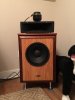
I'm running a 414/32A/802 setup at the moment. My drivers are all from GPA. I put the 414's in a 3.5 ft3 cabinet, because that's what I had. Tuned to 45 Hz with a port out the bottom. Not the most authoritative deep bass, but still very pleasant down low and glorious in the mid-bass. I tried several crossovers before settling on a recommendation posted by Joe Roberts. I run the 414's full range and a first order high pass on the horns. I ended up around 6500 Hz and I use an autoformer for attenuation. Powered by a direct coupled 2A3 amp, a nice double IPA, and I'm all set for audiokarma.

Someday a petite onken cabinet is my goal too. You have lots of nice drivers and horns. Have fun with them.IMG_1871.JPG IMG_1993.JPG
 
Doc, those look fantastic! Did you build those cabs? Every element about them just screams CLASS!

I'm not familiar with how the auto transformer functions. Can you clue me in?

GeeDeeEmm
 
Thanks for the compliment. Those are Barzilay cabinets. The bottoms were damaged so I sawed them off and put some cheap turned aluminum legs on there that are reminiscent of the very pricey JBL vintage legs. The original grills were damaged. I glued on a piece of 3/4 oak ply on the old front baffle for extra stiffness. Internal bracing also added.

Somewhere on the web is an excellent article about autoformers. I'll have a look for it.
 
I'm running a 414/32A/802 setup at the moment. My drivers are all from GPA. I put the 414's in a 3.5 ft3 cabinet, because that's what I had. Tuned to 45 Hz with a port out the bottom. Not the most authoritative deep bass, but still very pleasant down low and glorious in the mid-bass. I tried several crossovers before settling on a recommendation posted by Joe Roberts. I run the 414's full range and a first order high pass on the horns. I ended up around 6500 Hz and I use an autoformer for attenuation. Powered by a direct coupled 2A3 amp, a nice double IPA, and I'm all set for audiokarma.

Someday a petite onken cabinet is my goal too. You have lots of nice drivers and horns. Have fun with them.View attachment 927475 View attachment 927476

Those do look great!

I took the same advice from Joe and run my 414b's full range also. I bring the horns in pretty close to your 6500hz.
The speakers sound great this way.
 
I'm running a 414/32A/802 setup at the moment. My drivers are all from GPA. I put the 414's in a 3.5 ft3 cabinet, because that's what I had. Tuned to 45 Hz with a port out the bottom. Not the most authoritative deep bass, but still very pleasant down low and glorious in the mid-bass. I tried several crossovers before settling on a recommendation posted by Joe Roberts. I run the 414's full range and a first order high pass on the horns. I ended up around 6500 Hz and I use an autoformer for attenuation. Powered by a direct coupled 2A3 amp, a nice double IPA, and I'm all set for audiokarma.

Someday a petite onken cabinet is my goal too. You have lots of nice drivers and horns. Have fun with them.View attachment 927475 View attachment 927476
That is almost exactly what I would like to do. I even have the pricy autoformers from Germany. A couple of questions: do you have a schematic for the crossover? And what are the dimensions of your Barzilay enclosure?

Thanks,
R
 
R

I don't have a schematic but it's pretty basic to describe. The + from the amp is connected to a 2 uF cap in series to the input of the autoformer. The amp - to the autoformer ground. I use a shunt resistor across the autoformer input to ground. I run 12dB of attenuation, which I believe is tap #8, to the 8 Ohm Altec 802 driver. The shunt resistance consists of a 12 Ohm Mills wirewound and a 3 Ohm variable wirewound pot, in series (12 to 15 ohm range). The 414 woofer is run full range straight from the amp.

Now the math.

12 dB of attenuation is achieved by a transformer turns ratio of approx. 3.98 (I forget the formula but you can find it on the web). The reflected impedance towards the amp is equal to the autoformer turns ratio squared times the impedance of the Altec 802. That equals 127 ohms of reflected impedance to the amp. The shunt resistor is in parallel with the 127 ohm reflected impedance. 12 ohms in parallel with 127 gives you about 11 ohms combined. That 11 ohm impedance is the load the amp is seeing. A first order crossover calculator using a 2uF cap into an 11 ohm load yields a crossover point of 7250 Hz. With my 3 ohm pot, I can go up to 15 ohms of shunt resistance, which equals a combined amp load of 13.4 ohms. That crossover point is about 6000 Hz. So, by varying the pot, I can change the crossover point. You have to work out the values for other tap settings. I made a crude spreadsheet so that I can play with different cap values and autoformer tap settings.

The downside of this approach is that when you change tap setting on the autoformer, you also change the crossover point, unless you can adjust the shunt resistor. The other approach is to put the series cap between the autoformer and the driver. That way, the crossover point doesn't change when a different tap setting is used. The cap will always see the same driver impedance.

My cabinet is about 3.5 cubic feet internal volume. If you are building a cabinet, I think you may want to go larger. I think GPA recommends 4 cu. ft.

Hope I got all of that straight and you find it helpful. I confuse myself sometimes on autoformers. I've been using them for years since I tried to figure out how they worked on a pair of Klipsch Cornwalls.
 
Back
Top Bottom