Dim Bulb Tester Build
First, What is a dim bulb tester? It is a current limiting device. It is used to protect a device that is in unknown condition or suspected of not working for any reason. If the device under test (DUT) has a short, the device will be protected from drawing too much current, the line power equipment will be protected, the circuit breaker will not trip, and the technician will be protected. The DBT is best suited for the initial startup of a device. It can also be used when troubleshooting the DUT to protect the technician and the test equipment being used.
The smaller the wattage of the bulb being used the lower the max amperage will be allowed to be drawn by the DUT. On a standard US line system, a 40W bulb should only let .32A flow when presented with a dead short. (I=40W/125V) If there is a dead short in your DUT, the bulb will fully light to alert you to a problem. The bulb presents a higher resistance as it gets hot. If your DUT is only drawing 1A the bulb will dimly light and present a low resistance to the circuit and you will know the device is not shorted. The bulb will quickly rise in resistance as the current though it rises and the filament heats up. If your DUT uses more wattage than the bulb will allow, then your DUT will be starved for energy and will not work right. The bulb will be a little too bright in this case, but not fully lit. Using a higher wattage bulb after the initial test or adding another bulb in parallel with the first bulb will allow more current flow and allow the DUT to work properly in most cases. With this setup the DUT can be more safely probed with a multimeter and diagnosed for problems other than a dead short. If you were to slip with the probe the dead short would light the bulbs and the current would be limited to a lesser extent than the lower wattage bulb but still better than not at all. A 240W bulb would limit the current to 1.92A (I=240W/125V).
A dead short can pull 30W+ before the breaker is tripped in the main house panel without a DBT. That is enough to weld your probe to the chassis!
There is a lot of info about these protection devices on the web. The math here in my explanation is simplified and only represents the bulb’s effect under a full short condition. I am not a trained electrical engineer so please let me know if my use of Ohm’s law is flawed and why. As with most topics, there is a rabbit hole that goes as deep as one is willing to dive.
I Have been using a Dim Bulb Tester that I quickly screwed to an old piece of plywood for a few years. It works fine and nothing better is really needed but I wanted to make something a little nicer.
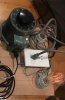 old DBT and a variac
I wanted to go with a two-bulb setup, and I wanted to use some nice Triplett meters that I have had for a few years. I usually use a variac and the dim bulb for initial testing and often use my DMM to see what voltage I have dialed in on the variac so I know the voltage meter will be useful. The Amp meter I have matches the voltmeter so although it will probably not be very useful I wanted to put it in the unit also.
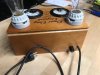
I have been looking for a chassis to recycle these parts into but have not come across any free/cheap options that were the right size. Then one day it hit me. I went to a local tobacco shop and purchased a cigar box that would accommodate all the parts. $5 for a project box is a good deal these days!
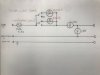
I did not have any toggle switches on hand, so I wanted to design for as few as possible and got a good deal on a pair of 10A SPDT toggle switches on eBay. One switch (limit/bypass) either bypasses all bulbs or engages the first bulb. The second switch adds/removes the second bulb when the first switch is in the limit position or does nothing if the first switch is in bypass.
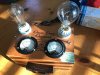
I chose a 40W Edison cage retro-repro bulb for the first bulb to give me a lot of protection on initial startup of a device. The second bulb is a 200W bulb which when added in parallel with the first bulb gives me a 240W bulb equivalent. This will let most units under test run well and still provide dead short protection if I short something with my test leads. Of course, the bulbs can be switched out for different devices under test but this should work for 99% of what I repair.
I went with a 7.5A Fuse to protect the amp meter in case I have the unit in ‘Bypass’ mode and have a short or failure with the DUT.
I may add a power switch if I come across a nice looking one on a salvaged unit. If so, I will add it after the fuse on the hot line with perhaps an indicator light between hot and ground.
I used a vintage surface mount duplex grounded outlet in the front to plug in the device to be tested.
Here is the schematic I drew so I would not get confused while wiring the unit.
The finished product came out pretty cool! IMHO. It looks a lot nicer than the older one I had and has more functionality.
I am sure I will be using cigar boxes again as project chassis. They are easy to drill and already have a finished look and a hinged top. Great access for wiring and storage for extra bulbs.
Here is the finished product: