• Please note that Audiokarma will be offline briefly for updates early on Monday morning, September 28th.

Any difference between coax digital cable and RCA?

What do you mean by that? Coaxial cable is called like that because conductors are on axis (one insulated solid wire inside another "tube" wire). Afaik ordinary audio cable is side by side except for the connectors if it's RCA.
Actually, most "audio" cable I've come across has been coax as well. That's not to say that what you describe doesn't exist but it would more susceptible to induced noise and hum than the coax I've used.
 
One major difference is that 75 ohm coax typically uses a single, fatter, conductor and this makes the cables very unflexible.
 
Actually, most "audio" cable I've come across has been coax as well. That's not to say that what you describe doesn't exist but it would more susceptible to induced noise and hum than the coax I've used.

Okay, now I'm really confused. I suspect that if I take the cable that connects my DAC's RCA connectors to my receiver's and pull it rip it will split into two single cables. How can that be coax? They're not el cheapo interconnects, although I didn't pay a fortune for them they were around $20. Was I ripped off or what? Lemme have a look at them... hold on.
 
Not sure about RCA cables, but you better not confuse digital XLR cables with analog XLR. Two totally different animals. Analog XLR won't work with DMX lighting controllers and digital XLR won't do your mics or sources any favors.
 
Not sure about RCA cables, but you better not confuse digital XLR cables with analog XLR. Two totally different animals. Analog XLR won't work with DMX lighting controllers and digital XLR won't do your mics or sources any favors.

Good point! You never know what you might run into, or who might have grafted together what cords or connectors.

Power_chord.jpg
 
OK, I'll let my pedantic side rise to the surface.

"coaxial" is a cable. Period. You can put any connectors on it you wish. Likewise, that cble with parallel runs on it s simply a cable as well.

"RCA" is a connector that's put on the end of that cable. BNC, XLR, "F", etc are all types of connectors that can be put on the ends of a cable,

So, there is really no "RCA cable". You can have cables with RCA ends on it but that's about it.

Maybe this should be in the pet peeves thread?
 
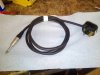
View attachment 1664225 View attachment 1664226

I have been trying regular RCA audio cables on literally hundreds of receivers amps and CD/ DVD players, from my tv to my receivers over and over until I just gave up. I buy and sell stereo stuff, so I'm getting 4 to 6 receivers a week on average, they range from crappy all in ones with built in DVD players to nice Denon 7.1 receivers and when I have a cheap one set up for a buyer to come hear, I always have to explain that they will need to use the digital or optical inputs from their tv to be able to hear surround sound on that receiver (when they aren't playing a disc), I always try another RCA right away for demonstration to show that it does work but every time I need to come and get my special cable from my own system. I have also had numerous buyers contact me asking why they aren't getting any digital sound when using a regular RCA since they can't find the digital ones for sale. So I've been through this so many times I gave up even trying them. After 50 failed attempts I came to the conclusion that it simply won't work. Last time I tried it was a week ago using a very nice thick cable with big gold ends, I tried all 5 cables that were in bunch and also tried a nice composite right away and had nothing. I have piles of cables but only 1 digital. I use it to send sound from my tv to my many revolving av receivers that come and go. I have settled on an old pioneer elite VSX-56TSi since one of the speaker posts snapped off and I had to do a quick fix that didn't involve removing even one screw. I drilled a hole in the center of the broken output then tapped the hole to screw another post directly on the old one. Works perfectly but nobody is going to buy it like that, so it's mine for life now (or I get something nicer that has worse cosmetic damage). It's 150w per chnl 7.1 THX. I don't even have a sub connected, Snell series 4 fronts put out enough bass, no HDMI, no DVD or Blu-ray, never bought a DVD in my life, don't have pay services, don't go to movies, don't care to watch movies unless it has real actors and a good story (so that's very limited to maybe 1 or 2 a month and only when it's free and I have nothing to do which is never). But I do have a stack of 2 channel amps and receivers and a wall covered in speakers with wired selectors to choose which amp and that leads into another switch that selects which speakers. TV is rarely on, mostly I sit in silence listening to the tenitus ringing in my ears.

Nice receiver the 56txi. 110 watts, not 150.
 
Not sure about RCA cables, but you better not confuse digital XLR cables with analog XLR. Two totally different animals. Analog XLR won't work with DMX lighting controllers and digital XLR won't do your mics or sources any favors.

Ah, that explains why some studio headphone amps have both digital and analog XLR's outs then.
 
I know this is an ancient discussion but I have never been able to use a regular audio RCA type interconnect and guest any sound out if my Digital RCA output. I just the cable marked digital audio and it works perfect every time. Keep in mind that a have a very large bin full of audio interconnect cables as well. I have also fabbed my own custom length cables for car audio competition systems using very high quality microphone cable and nice heavy duty gold RCA ends. I keep on reading how there is no difference, but yet i can only get sound using a specific cable. I have also tried all yellow, red, blue, green and every other cable made and haven't ever heard any found so hiw many of you have actually used a regular cable and had it work? Or are you all just assuming this is possible? Also if you do hear anything is it registering as a surround sound compliant source. Is your receiver decoding it as 5.1 or 7.1 or is it simply a mono signal or a stereo analog signal. Also what about the quality of the signal, is it still getting 96bit sound with sample rate frequencies above or equal to CD quality (41000)?
I really find this are to believe since I've been trying this for at least 15 years and never had it work! I bought a 10 foot digital RCA 15 years ago for $10 and to this day it's the only cable that will produce sound. I just tried about 20 regular cables on 5 different combinations of receivers and DVD players and nothing worked!
If you need to, use the yellow, video cable in place of the labeled digital one
 
Not sure about RCA cables, but you better not confuse digital XLR cables with analog XLR. Two totally different animals. Analog XLR won't work with DMX lighting controllers and digital XLR won't do your mics or sources any favors.

Zombie thread but you're taking about the pinout/wiring of the cables rather than the cable itself.

For example, Belden 1800F is generally intended for AES/EBU cable, normally terminated with XLR connectors, used largely for "professional" digital audio cabling and some higher-end consumer gear. But, given the very low capacitance and good shielding, makes for excellent balanced analog connections too, also terminated with XLR. In fact, the pinout is the same for both these types of cables and as such could be used interchangeably for AES/EBU digital and analog audio balanced connections with equally good results.
 
Zombie thread but you're taking about the pinout/wiring of the cables rather than the cable itself.

For example, Belden 1800F is generally intended for AES/EBU cable, normally terminated with XLR connectors, used largely for "professional" digital audio cabling and some higher-end consumer gear. But, given the very low capacitance and good shielding, makes for excellent balanced analog connections too, also terminated with XLR. In fact, the pinout is the same for both these types of cables and as such could be used interchangeably for AES/EBU digital and analog audio balanced connections with equally good results.

No. The difference between the XLR and DMX cables is that DMX cables have a 75 ohm impedance.
 
Back
Top Bottom