• The move to the new server is done. There are some software and database maintenance updates in process. This has us passing the hat around to help out. We appreciate any donations. Seriously, even a dollar helps. The payment page may be found here - https://www.audiokarma.org/support.html

Any solution for turntable speed faster than normal?

Caerwent500

New Member
I’ve just completed my refurbishment of my 1972 vintage record player radio combo. Playing some old John Denver I noticed his voice was a little higher pitched than what seemed normal for him. I clocked all the tracks on one side and found they are running 7.8 % faster than the label speed, and exactly the same for a Neil Young album.

Without measuring, the platter drive wheel is about 4” in diameter and the spindle at the motor is maybe 9/16” in diameter. The only mechanical solution would be for the spindle wheel (stainless steel) to be commensurately smaller or about 7 to 8 % smaller.

I’m left puzzled to what a workable solution might be. Going in the wrong direction I have wrapped some dental rubber bands around the spindle to create friction because of slippage which I calculate causes maybe 1 pct of the 7 to 8 %. I’m probably going to have to live with it as it is but any thoughts would be appreciated.

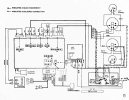
I have a technician’s wiring diagram but it only shows how the wires are routed from connector to connector and what types of plugs are used.
 
Register to hide this ad
Depends on the player, please post the model. Often you can plug the TT into a Variac instead of a wall outlet and lower the voltage to the TT. That may slow the platter speed.
 
Those can be slowed down by carefully and lightly sanding the motor spindle with very fine sandpaper, it only takes a little so monitor carefully.
 
IMG_4706.jpegIMG_4701.jpeg
Top you can see the final unit number by Magnavox, not a serial number but the final style number that includes the TT, a radio, and an 8track tape player. On the turntable there is no other manufacturer’s identification label or mfgr’s stamp, so I have to believe it was made by Magnavox (1972).

Also above is the technician’s wiring diagram which shows (off to the bottom left the TT feed) how the TT receives its power through a transformer circuit which is powered from the plug from the house line voltage - 120 volts AC.
It’s unknown what the voltage is as it finally reaches the TT, which at the point of connection to the TT is a plastic plug similar to a molex, including three wires W11, W12, and W13; mentioned because to enter the motor separately it would have to be at that point, otherwise at the point of line voltage entering the whole unit.

So if I powered the TT through a Variac, then the whole system would be affected, notwithstanding the 8-track which is of no concern.

I have already wrapped the motor spindle with about 10 tiny and very strong dental rubber bands (maybe 1/128th inch in thickness) which was my solution to the belt slipping on the spindle when the tone arm was in its cycle. That effectively increased the diameter (radius) of the spindle which would have to have increased the speed of the platter pulley which is integral to the platter at its bottom. I’ve thoroughly cleaned the TT mechanism such that now its immaculately clean and lubricated. If I were to find a suitable new belt (or use a friction enhancer) to remove the need for the rubber bands I calculate I might lower the 7.8% excess speed down to 6.8%, so I need more than that.
 
have already wrapped the motor spindle with about 10 tiny and very strong dental rubber bands (maybe 1/128th inch in thickness) which was my solution to the belt slipping on the spindle when the tone arm was in its cycle.

Get a new belt and lubricate the mechanism, and you should be able to get rid of all those rubber bands, and make it work properly.
 
^^ this, the motor runs at the speed it runs at. The final speed is a ratio of motor spindle size to whatever it drives against. If this is an idler wheel drive, an overly hard idler I've found makes them run a little fast because it doesn't squish properly. Seems counter-intuitive but the speed adjust on a Rek-O-Kut is simply motor pressure against the idler. The harder you shove the motor into the idler, the slower it runs. Can't manually jam the motor into the idler on most things but the same principal applies.

Hard idlers tend to have poor traction and make extra noise when hard so having that rebuilt would be a good first step. Also remove the extra stuff from the motor spindle since making it fatter isn't going to help any.

Magnavox bought out Collaro at some point so its a Magnavox table but based on the Collaro design. I don't know those intimately to know if there is any speed adjustment via the idler position. Some things had a tapered motor spindle and moving the idler up or down could tweak the speed.
 
Get a new belt and lubricate the mechanism, and you should be able to get rid of all those rubber bands, and make it work properly.
Doesn't have a belt. Likely idler drive. Lubricate the mechanism, and accept the fact that it likely will run a little fast. Note this is a Collaro changer, it likely needs a full overhaul at this age.
 
Have a machinist carefully grind down the motor pulley. You know thats what they do for Harry Junior at VPI as most of their TT's run fast. So unless you have a synchronous motor and want to add a speed controller. I can't think of anything off hand. MY VPI/Levinson 515B/Dragon runs about .6 percent fast. 105 1/2 revolutions in 3 minutes instead of 100. The way the motor control box and motor are made it almost impossible to adjust the speed with out taking the box apart and reassembling it numerous times. Thats why I still have my TD 125, because I can adjust the speed and get it down to zero error after about 15 to 30 minute warm up.
 
Doesn't have a belt. Likely idler drive. Lubricate the mechanism, and accept the fact that it likely will run a little fast. Note this is a Collaro changer, it likely needs a full overhaul at this age.

The OP said belt, I took at face value. If it's an idler then the idler needs to be dealt with.
 
The OP said belt, I took at face value. If it's an idler then the idler needs to be dealt with.
I’m the OP, yes belt. So does this mean there’s no idler? And I can forget about that detail?

But the speed isn’t something I can ignore. Almost 8 pct is a lot. Lyrics and tempos sound rushed and voices too shrill. Even classical pieces can sound off.
 
I’m the OP, yes belt. So does this mean there’s no idler? And I can forget about that detail?

But the speed isn’t something I can ignore. Almost 8 pct is a lot. Lyrics and tempos sound rushed and voices too shrill. Even classical pieces can sound off.

Picture is worth 1000 words. Your repair with the dental bands, while clever, is impairing performance. Rather than stack a new bodge job on top of that one, I'd suggest to remove the bands, lubricate the mechanism, and get a new belt.

www.turntablebelts.com is a place to start
 
I’m the OP, yes belt. So does this mean there’s no idler? And I can forget about that detail?

But the speed isn’t something I can ignore. Almost 8 pct is a lot. Lyrics and tempos sound rushed and voices too shrill. Even classical pieces can sound off.
A Micromatic (Collaro made) changer from the Fort Wayne Magnavox era is idler drive. You likely need a rebuilt idler. The Magnavox changer should not run that fast. Magnavox didn't do a belt drive turntable until the Philips era post 1975.
 
Back
Top Bottom