

You are using an out of date browser. It may not display this or other websites correctly.
You should upgrade or use an alternative browser.
You should upgrade or use an alternative browser.
Any Southwest Technical Products Builders/ Owners Out There?
- Thread starter Tour2ma
- Start date


Seems the 198/A used 4 of the 195 preamp boards to provide a HiFi preamp, not sure if there ever was a construction article for it.
I found a construction manual for a 198/A in my 275 notes. I must have made a copy of the manual when I fixed one for a friend (in the 70s).

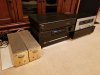
rickl, would you be willing to share your manual? I am slowly working my way through the 198/A.I found a construction manual for a 198/A in my 275 notes. I must have made a copy of the manual when I fixed one for a friend (in the 70s).
It appears that Mike Holley's page has been moved to this location:
https://deramp.com/swtpc.com/
I think it is the same info from the Wayback Machine Archive.
https://deramp.com/swtpc.com/
I think it is the same info from the Wayback Machine Archive.

RobMcCall
New Member
I built a pair of 207/A’s. To this day they are the best or at least as good sounding as any amps I have owned, including one high-end Sanyo and another Macintosh. They have better damping and are less muddy sounding than many other amps I have built or purchased. The biggest drawback to the Southwest technical products, as I recall is that they lacked some of the bells and whistle‘s that most of us appreciate, For example, turning on a 207/A always produces a bit of a thump in your bass speaker. No delay relay or circuitry. I cannot identify with the comments about fire or overheating. I ran these amps at high and medium power for many years and never had a problem. The problem may have arisen with how well they were built. Recently I pulled these out of storage, replaced the large electrolytic capacitors just for good practice, and drove my two Wharfdale‘s with them. The sound was very rewarding. I love these amps. One can only imagine what kind of products they would be producing today if they had stayed in business.
I ran these amps at high and medium power for many years and never had a problem.
we used to use a window box fan to keep them from over heating and shutting down at frat parties. seemed to work.
I pulled these out of storage, replaced the large electrolytic capacitors just for good practice.
I thought the Mallory PS caps were the weakest part of the amp. I was always replacing them.
I too recently recapped the amps and thought they sounded fine.

audiomaniac2
Active Member
Here is a Universal Tiger amp I built from scratch in 1977. I used way more caps than called for in the power supply. I had a big transformer that was two high of voltage so I used a variable xfmr in the primary to lower the output voltage of the main xfmr. I used a 25 amp bridge rectifier. It was a really good sounding amp.I was 22 when I built it. Being bored one night , I decided to crank up the voltage on the power supply to see what would happen. I found out. The amp did not like it and blew out. I shelved it.
I still have it and checked it out around a year ago.I found that all the transistors are still good It just took out a few of the caps on the amp board and I think a resistor or two. I plan on repairing it and listening to it for old times.
I removed the variable xfmr years ago for another prodject. I have one to replace it.


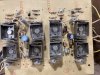

I still have it and checked it out around a year ago.I found that all the transistors are still good It just took out a few of the caps on the amp board and I think a resistor or two. I plan on repairing it and listening to it for old times.
I removed the variable xfmr years ago for another prodject. I have one to replace it.
Last edited:

audiomaniac2
Active Member
That's a printed circuit board that I eched. I tinned all the copper traces.There is something beautiful about an amp built on plywood with masonite circuit boards!

RobMcCall
New Member
I mostly drove 8 ohm loads, I think that helped with the temperature.we used to use a window box fan to keep them from over heating and shutting down at frat parties. seemed to work.
I thought the Mallory PS caps were the weakest part of the amp. I was always replacing them.
I too recently recapped the amps and thought they sounded fine.
If anyone's interested in documentation for the Tiger .01 (AKA 207/A), I have the schematics, chassis wiring diagram, and build instructions (which include the Radio-Electronics March and April 1973 articles). I have two units in very good condition (recently "dusted off" and powered up).
Wow... amazing that this thread which started almost 18 years ago is still active!
Wayne
Wow... amazing that this thread which started almost 18 years ago is still active!
Wayne

miniman82
Go Navy!
I meant to reply to this thread ages ago, but here goes.
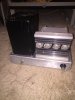
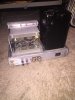
I acquired a pair of the Tigers that Bob (ohohyodafarted) had removed from the multi amp cabinets he spoke about in a previous post, I welded a chassis for them and bought a large steel cased Freed power transformer to power it. This is the end result, it sounds as good as it looks.


I acquired a pair of the Tigers that Bob (ohohyodafarted) had removed from the multi amp cabinets he spoke about in a previous post, I welded a chassis for them and bought a large steel cased Freed power transformer to power it. This is the end result, it sounds as good as it looks.
Attachments
Last edited:
miniman82
Go Navy!
I also have a pair of 210A’s, these have been repaired and are working but I haven’t done anything to beautify the chassis yet. Thinking of using perforated aluminum with a fan to keep those 4 big sand resistors from destroying the boards.

Attachments

amazing that this thread which started almost 18 years ago is still active!
Every time I see a tiger post, I want to pull out mine for a listen. Amazing amps for early 70s.