• The move to the new server is done. There are some software and database maintenance updates in process. This has us passing the hat around to help out. We appreciate any donations. Seriously, even a dollar helps. The payment page may be found here - https://www.audiokarma.org/support.html

Any way to get a value off this old x-over cap?

angelaudio

Super Member
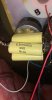
Recapping the crossovers on my speakers but there is no schematic available so I’m not sure as to what the value of this particular cap is. Is there any way to find out just by the codes they have printed on them? Photo below.


35625F43-DF3C-4650-A1FA-7FE7F4CA6A16.jpeg
 
Register to hide this ad
Nothing else printed on them?

date code 40th week of 1976

They're film caps, and likely haven't degraded if that has any bearing.
Nope, nothing else printed on them. And the possibility that they have probably not degraded does raise a few questions. So if are still pretty much as good as they were when installed then would a recap change the sound much at all then? Even if I switched over to something like PIO?
 
Likely they were custom made(or labeled) for the speaker manufacturer, probable that 4022 is the speaker manufacturer's part number. Omitting the values and OEM numbers helps them keep their design proprietary. Crown does it in their amps.

My opinion, most caps can sound different in a revealing circuit/system. I would emphasize small differences in most cases.

My thought, you should be able to trust their measured values within 10% and can probably just select values referencing measurements taken with a cheap LC meter

 
Likely they were custom made(or labeled) for the speaker manufacturer, probable that 4022 is the speaker manufacturer's part number. Omitting the values and OEM numbers helps them keep their design proprietary. Crown does it in their amps.

My opinion, most caps can sound different in a revealing circuit/system. I would emphasize small differences in most cases.

My thought, you should be able to trust their measured values within 10% and can probably just select values referencing measurements taken with a cheap LC meter
I’ll be using these both in my music studio and main system so I was originally planning on springing for some Auricaps but taking your advice into consideration I’m wondering if it would be worth it. I was hoping to improve the bass extension as it sounds somewhat weak. It’s not muddy just somewhat “veiled” but that could just be the way these monitors are voiced.
 
Or maybe it’s just the woofers themselves that just don’t extend as much as I would like them to. They go low down to about 25hz but I would just like to “feel” the bass a bit more
 
If these are the shunt caps in a 2nd order low pass on the woofer it seems unlikely that changing them out would affect the "bass extension" on the woofer. Need a different / bigger woofer and a retuning of the box for that.

... I was hoping to improve the bass extension as it sounds somewhat weak. It’s not muddy just somewhat “veiled” but that could just be the way these monitors are voiced.
 
If these are the shunt caps in a 2nd order low pass on the woofer it seems unlikely that changing them out would affect the "bass extension" on the woofer. Need a different / bigger woofer and a retuning of the box for that.
Thanks for the crash course Riley. These were advertised by RSL as studio monitors so maybe they aren’t intended to have so much low end extension in that case. It’s clear, flat and audible just not ground shaking. I can live with that in my music studio, but for main system listening I’ll have to stick to my Adventure In Sound speakers.
 
First off, I am sorry, but my brain is screaming at me so I have to ask...have you looked at all sides of those caps?
Is it possible the specs are hidden from view?
Please don't hate me, hate my brain.
 
First off, I am sorry, but my brain is screaming at me so I have to ask...have you looked at all sides of those caps?
Is it possible the specs are hidden from view?
Please don't hate me, hate my brain.
No worries. I did. Took a flashlight and looked at all sides as best i could
 
No worries. I did. Took a flashlight and looked at all sides as best i could

I figured that but my darn brain doesn't always listen to me. After reading your response I've told my brain to shut up and go to bed now.

Sounds like you can use them for the studio and you have another set up for more demanding or powerful listening.
Win-win.
 
I figured that but my darn brain doesn't always listen to me. After reading your response I've told my brain to shut up and go to bed now.

Sounds like you can use them for the studio and you have another set up for more demanding or powerful listening.
Win-win.
My brain does the same dang thing except it doesn’t always listen when I tell it to shut up, workin on it though:biggrin:

And yup The RSL’s will most likely be relegated to studio duty and my other ones will serve me in my main setup :beerchug:
 
Are all three caps soldered in parallel? If so you can measure the capacitance and divide by 3 since those look the same. If they are different sizes you could probably figure out the values needed to add up to that total. Most meters that do capacitance should be able to measure those, probably in the 3-10uF each.
 
Are all three caps soldered in parallel? If so you can measure the capacitance and divide by 3 since those look the same. If they are different sizes you could probably figure out the values needed to add up to that total. Most meters that do capacitance should be able to measure those, probably in the 3-10uF each.
Yup, all four actually, in parallel. I’ll have to get an LC meter as my current multimeter doesn’t do capacitance. Thank you for the help Blue Shadow
 
Are all three caps soldered in parallel? If so you can measure the capacitance and divide by 3 since those look the same. If they are different sizes you could probably figure out the values needed to add up to that total.

Yup, all four actually, in parallel. I’ll have to get an LC meter as my current multimeter doesn’t do capacitance.
It would be wonderful to know the designer's reasoning for multiple parallel caps.

One possibility is that the designer was looking for the most precise capacitance value/lowest tolerance at a cost that's in line with a profitable business model.

OP should measure them as paralleled, and individually. That may give some clues.

It would likely be more cost effective for a speaker manufacturer to buy large lots of smaller value, high tolerance caps, and pay a general laborer to hand match them to achieve the precise target value, than to buy lots of low tolerance caps at the target value.

Example, our company contracts with a high quality film cap manufacturer for a couple basic values of 10% or 20% caps with a custom label that replaces the electrical values with our "in house" part number. Upon our receipt of the caps we put someone to work hand measuring each cap on a precision rig and mate them into parallel bundles that add up precisely(1% tolerance or less) to the target value needed for the design.
 
I redid a crossover for a friend years ago, can't remember the speaker, but the crossover consisted of like 7 caps, all the same values, in various groups.

Maybe some designer felt that this would be better than sourcing 4 different value caps? Some esoteric design choice?
 
It's fairly common to parallel multiple caps or resistors to achieve a desired value in crossovers. Much more expensive to source a custom value in those than in say inductors. That said in looking at the RSL 6600h speakers in a web search I don't think I'd spend a lot of time or money in making a silk purse out of these. Pretty bizarre design with multiple low cost drivers scattered across the baffle doesn't make for many of the attributes of a mediocre home stereo speaker let alone a control room monitor.
 
It's fairly common to parallel multiple caps or resistors to achieve a desired value in crossovers. Much more expensive to source a custom value in those than in say inductors. That said in looking at the RSL 6600h speakers in a web search I don't think I'd spend a lot of time or money in making a silk purse out of these. Pretty bizarre design with multiple low cost drivers scattered across the baffle doesn't make for many of the attributes of a mediocre home stereo speaker let alone a control room monitor.
Can you elaborate? What is bizarre about the design? How do you figure that the drivers are low cost?
 
Back
Top Bottom