• The move to the new server is done. There are some software and database maintenance updates in process. This has us passing the hat around to help out. We appreciate any donations. Seriously, even a dollar helps. The payment page may be found here - https://www.audiokarma.org/support.html

Anyone Adding Fuses Inline to Speakers?

RS Steve

Tube Junkie
Subscriber
Just checking to see if anyone is adding fuses to protect their speakers from damage, and what amp rating is good for most applications. Having an amp rated to go beyond 1000 watts now has brought a bit of concern that a bad connection or unexpected pop through the system could cause the woofer cones to be sent across the room. I know some speakers come with fuses to protect the small drivers, I was curious though to see if adding fuses was something being done much.
 
Register to hide this ad
Just checking to see if anyone is adding fuses to protect their speakers from damage.
Honestly, I've gone the other way around and bypassed them before. I've never blown a speaker in over 40 years.

Just listen and don't do anything stupid. You'll know when either the amp or speakers are unhappy. :)
 
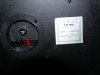
Vintage Spica TC-50 tweeters are known failers. I've replaced a number of their teeny speaker terminal cups at the back of the speaker with a larger one containing an integral fuse holder. I generally install a 2 amp AGC 3 slo-blo fuse before shipping back to customer. Below is a picture of an installation.

Spica fused connector.jpg
 
I'm with E-Stat on this one. I've removed fuses altogether and replaced all internal wiring to match the quality of my speaker wire as well.
 
Even at a more basic level, what's the point of having a big-ass amp only to fuse so small as to preclude any possibility of damage?
 
Even at a more basic level, what's the point of having a big-ass amp only to fuse so small as to preclude any possibility of damage?
One should pick an appropriate fuse rating that protects the weakest component in the circuit, which usually is the tweeter. Tweeter wattage ratings cover a broad range. A simple calculation of the wattage rating and the impedance will yield an amperage to consider when choosing a fuse.
 
I use 1.5 AMP fuses on my Yamaha NS-1000s only because the tweeters are virtually irreplaceable these days. My ADS speakers are unfused due to plentiful replacement parts.
 
To answer the OP, yes, people are doing fusing. I've done a number of them for Spicas in particular.
However, if there exists an enormous power imbalance between upstream power and a speakers ability to sustain a short, no fusing will help. Fusing is good for a careful, average listener who knows he has delicate, hard to replace drivers and wants to protect against an un-anticipated power surge from a musical passage.
 
The only speakers I've added fuses to are Original Large Advents per their recommendation when using an amp rated at over 60 wpc. I blew a tweeter or two back in the day prior to fusing them. I was driving two pairs with a Pioneer SA-9100. After that, fuses were blown on occasion when I lived in a party house shared with 3 other guys.

Since then, and eventually driving them with a Crown DC300A, I've never blown a fuse in the past 30 years or so. I still have one pair of the Advents that I bought in 1976 in my bedroom system. I'm driving them with a Kenwood KA-7300. My son took the other pair with him when he moved out last summer. To my knowledge, he's never blown a fuse. I'm presently using 2.5 amp fast acting fuses.
 
Last edited:
You should find your self an owners manual to one of Crown's DC series amplifiers. There's a section on how Murphy's law applies to sound systems. One of the rules states more or less that a speaker fuse will protect everything but the speaker. Most fuses react rather slowly and require two to many times the current to flow before the fuse activates. Even the fast FNA type fuses the phone company uses are still rather slow. If you want to push your speakers that hard, you need to spend some time with the Mcintosh group on this site. Once you know what the RMS power handling with a 10 db crest factor is of your weakest driver, then you can pick which 2000 or later series power amp that is right for you. Its not as easy as it sounds. You have to figure out which driver is the most susceptible to damage and what percentage of the power is handled by that speaker. And what are the odds of that speaker receiving that power. Thats one reason Mac loves to build line array speakers. All the drivers combined into their different groups can easily handle the power output of the recommend amplifier. So if you have a XRT 22 thats rated at 250 watts, it doesn't matter if the power goes to the entire speaker or just to the tweeters you're still safe. Can you imagine what would happen to a Heritage Klipsch speaker if 100 watts went to the tweeter, sure failure And yet the woofer and mid would be fine for brief periods, Another issue is sensitivity. Lets say you have a JBL speaker and the woofer has a sensitivty of 96 db and the horn 106 db. So the crossover attenuates the HF driver `10 db. So if the HF driver s rated at 25 watts, it can now handle 250 watts, and if the woofer has a 250 watt rating, now the speaker should be able to handle 500 watts if the signal is divide between the two. But what if it isn't. Then you have decide do you want a 250 watt amp or a 500 watt amp. Hopefully as in this case the speaker is sensitive enough you will probably be happily with 10 to 20 watts and a Mac amp with 150 watts with Power Guard is all you will ever need as the amp will be limited to about 200 watts output with less than 2% distortion. You wouldn't want a 452 because though rated at 450 watts continuous can put out 700 watt peaks with the Power Guard coming on around 550 to 600 watts, which is way more than either the woofer or tweeter can handle on their own. Those beautiful blue meters on Mac amps are there fore a reason, not just decoration, they are 95 to 98 percent accurate, depending on the vintage and give you fair warning when you are approaching dangerous territory.
 
Even at a more basic level, what's the point of having a big-ass amp only to fuse so small as to preclude any possibility of damage?

Because I can!

My 250ti's love the power my WOPL has, but I was just wondering if adding fuses in line for testing other speakers would be worth the trouble.
 
In 25 years I've never used speaker fuses - until I bought a pair of XRT22s which have 4A fuses in each speaker. I run bridged MC2600s to them. Hmmm ...

About a month ago, I was installing a new phono cartridge. With the volume on my preamp set to 77, I did the stupidest thing ever - removed the headshell. Now I thought I had pressed mute on the preamp ... nope.

The resultant noise through the system shook the entire house! Oddly enough, the right channel took the brunt of it. This took out the 4A fuse in the right channel speaker in the process. With trepidation, I replaced the fuse and all was A-OK.

With 1700 wpc on tap, I got really lucky that was all that blew. Fuses for me from here forward.

Agreed that was a really incredibly stupendously dumb move on my part but that $1 fuse saved my ass.
 
In 25 years I've never used speaker fuses - until I bought a pair of XRT22s which have 4A fuses in each speaker. I run bridged MC2600s to them. Hmmm ...

About a month ago, I was installing a new phono cartridge. With the volume on my preamp set to 77, I did the stupidest thing ever - removed the headshell. Now I thought I had pressed mute on the preamp ... nope.

The resultant noise through the system shook the entire house! Oddly enough, the right channel took the brunt of it. This took out the 4A fuse in the right channel speaker in the process. With trepidation, I replaced the fuse and all was A-OK.

With 1700 wpc on tap, I got really lucky that was all that blew. Fuses for me from here forward.

Agreed that was a really incredibly stupendously dumb move on my part but that $1 fuse saved my ass.

Great reply, that is pretty much what I want to do, have another protection there to avoid any damage if something goes wrong, or I do something stupid.
 
Just remember when you use fuses, there is no need for fancy speaker wire as the weak link (the fuse) will also be the weak link in the speaker audio chain. Just use whatever correctly sized speaker wire you choose.
 
Fuses on speakers are entirely useless ... until you need them ... <G>

My McIntosh XR16's come stock with 1a for the tweets and 3a for the woofs, and I've managed to blow them all over the years. Yet another case of unobtanium drivers, so a bit of protection goes a long way.
 
Back
Top Bottom