• The move to the new server is done. There are some software and database maintenance updates in process. This has us passing the hat around to help out. We appreciate any donations. Seriously, even a dollar helps. The payment page may be found here - https://www.audiokarma.org/support.html

AR 4x Cap wiring question... Three wires ?? Blue Green BLACK (Continued)

uenjoymyself

Surrender to the flow
Hello,
Finally got around to servicing my AR 4x speakers and have been following threads here and at the Classic speaker pages on cleaning the high level pots and re capping the crossover. I was getting ready to order caps and noticed that my original cap has an extra black wire and is wired a little different from what I see in other 4x's.

Classic speaker pages.
Kents-AR-4x-Crossover-REVISED.jpg.5dc852d9e7ff53136d75b433559a22fa AR 4x.jpg


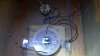
My crossover
P1160681.JPG

Do I just remove the black wire or should I leave it and wire it to one leg of the new cap?

Is my original cap of a differing value than the usual 20 uF 250v?

The marking on the inductor is 265 and one lead is attached in a different location. No visible markings on the cap.

Has a simple project been complicated by my overthinking or is there something unusual about this crossover?

Any help is appreciated.

Thank you,
Uenjoy
 
Last edited:
Register to hide this ad
Hi Uenjoy,

I'm not sure about the black wire. Looks like it connected to one of the woofer wires at the tie point.
I did a little digging on the net, and that black wire didn't show up. The cap should be a 20uf, but if you can, pull off the fiberglass if possible fo confirm the cap spec.

You may want to contact Roy C., our resident AR expert. He co-authored the 3a restoration guide on CSP.
My 4xs are all original, haven't been inside them, so can't compare yours to mine.

Sorry I wasn't more helpful, but I don't want to give you incorrect info.

Glenn
 
Hi Uenjoy,

I'm not sure about the black wire. Looks like it connected to one of the woofer wires at the tie point.
I did a little digging on the net, and that black wire didn't show up. The cap should be a 20uf, but if you can, pull off the fiberglass if possible fo confirm the cap spec.

You may want to contact Roy C., our resident AR expert. He co-authored the 3a restoration guide on CSP.
My 4xs are all original, haven't been inside them, so can't compare yours to mine.

Sorry I wasn't more helpful, but I don't want to give you incorrect info.

Glenn

The black wire is indeed connected to the woofer tie point.

I see the black wire in other AR models but not the 4x which is why I was concerned. I did take a peek under the fiberglass wrap but dont see any markings however I tried not to disturb the wrap too much. It may be necessary to remove it to see if their is any markings.

The rest of the network looks to be the same accept for the inductor wire location which is opposite the the woofer tie point but still in contact with the same strap?

I would assume that regardless of the rating of the original cap that if I wire in a new 20uF cap and abandon the black wire; that the crossover would be identical to the above pictured crossover from CSP. My only other concern would be the inductors tie point to the blue woofer wire. But, as stated it is connected to the same metal strap.

I will try to contact RoyC. Untill then, or I can get more info from members here, this project is tabled:dunno:

Thanks for your help GD

Uenjoy
 
Last edited:
I know of no reason that black wire should be connected to the cap. The 4x LP xo is just a simple coil and nothing else as shown in the CSP pic and other 4x schematics.
KLH had some caps that had a 3rd wire. They were dual purpose caps with a common input and two outputs. I don't recall ever seeing one of these in the AR's I've worked on over the years.

ROY?
 
Hi guys,

Although I don't know the exact timeline, some earlier 4x's have a different crossover. The cap in your cabinet is a dual cap (20uf/24uf). The blue lead is a shared input wire, the green wire is the output for the usual 20uf tweeter cap, and the black wire is for a 24uf cap connected in parallel with the woofer through the bracket holding down the cap. The 265 turn inductor is also larger than the usual AR #4 (200 turn) or #5 (225 turn) inductor found in most AR-4x cabinets. If you have the original woofers, you may also find a larger magnet on the woofer (a holdover from the AR-4) from this cabinet.

If the woofers are not original, or appear to be identical, I would simply convert it to the later single cap crossover.

Roy
 
Hi guys,

Although I don't know the exact timeline, some earlier 4x's have a different crossover. The cap in your cabinet is a dual cap (20uf/24uf). The blue lead is a shared input wire, the green wire is the output for the usual 20uf tweeter cap, and the black wire is for a 24uf cap connected in parallel with the woofer through the bracket holding down the cap. The 265 turn inductor is also larger than the usual AR #4 (200 turn) or #5 (225 turn) inductor found in most AR-4x cabinets. If you have the original woofers, you may also find a larger magnet on the woofer (a holdover from the AR-4) from this cabinet.

If the woofers are not original, or appear to be identical, I would simply convert it to the later single cap crossover.

Roy

Hello Roy,

Thank you for your input regarding my speakers. Both of my cabinets have the same dual cap. However, the woofers differ in that one, I beleive, is an earlier model with the yellow surround and the other has the black surround. The baskets are different as well. P1160672.JPG P1160673.JPG

If your recommendation is still to convert to the single 20uF cap then I assume that I would cut the black wire from the tie point and abandon it, is that correct?

Also, what effect does the larger inductor have on the sound. Will it differ form a #5 inductor usually found in the 4x?

I dont necessarily have to change the capacitors but while inside cleaning the high freq pots I figured I could freshen the caps since they're fifty some odd years old.

I dont want to change or modify a rare early model speaker if I dont need to. However, the fact that the woofers do not match would indicate that the speakers are not in original condition.

What would you do? Especially regarding the black wire if I do install a single 20uf capacitor. Remove it? Also, do I need to move the inductor wire to the blue woofer wire tie point or is it already connected through the tie down bracket holding the capacitor?

This should wrap it up for me. Thank you again for taking time to help with my questions!


Cheers,
Uenjoy
 
Last edited:
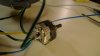
Hello Roy,

Thank you for your input regarding my speakers. Both of my cabinets have the same dual cap. However, the woofers differ in that one, I beleive, is an earlier model with the yellow surround and the other has the black surround. The baskets are different as well. View attachment 791648 View attachment 791649

If your recommendation is still to convert to the single 20uF cap then I assume that I would cut the black wire from the tie point and abandon it, is that correct?

Also, what effect does the larger inductor have on the sound. Will it differ form a #5 inductor usually found in the 4x?

I dont necessarily have to change the capacitors but while inside cleaning the high freq pots I figured I could freshen the caps since they're fifty some odd years old.

I dont want to change or modify a rare early model speaker if I dont need to. However, the fact that the woofers do not match would indicate that the speakers are not in original condition.

What would you do? Especially regarding the black wire if I do install a single 20uf capacitor. Remove it? Also, do I need to move the inductor wire to the blue woofer wire tie point or is it already connected through the tie down bracket holding the capacitor?

This should wrap it up for me. Thank you again for taking time to help with my questions!


Cheers,
Uenjoy

Your speakers appear to be in original condition, and have different crossovers because they were equipped with different woofers. For this reason alone I would stay with the original crossovers. The older woofer will respond differently to the later crossover. You have a better chance of a sonic match by leaving them as is.

Roy
 
Roy is correct. There is a version of the 4x with two caps, and it uses the AR-4 woofer with the non-circular basket frame and a 265 inductor. I think the serial numbers are normally in the 30000 to 40000 range, or thereabouts. You should be aware that the metal strap holding down the wax cap(s) is actually part of the circuitry. Read up here:

http://www.classicspeakerpages.net/IP.Board/index.php?/topic/7798-ar-4x-unfamiliar-crossover/&page=1

Your speakers appear to be in original condition, and have different crossovers because they were equipped with different woofers. For this reason alone I would stay with the original crossovers. The older woofer will respond differently to the later crossover. You have a better chance of a sonic match by leaving them as is.

Roy

Exellent Roy and ra.ra!

Thank you for the link ra.ra!

I found your drawing (ra.ra) and your advice (Roy) with his crossover work to be very enlightening.

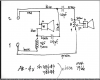
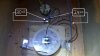
As recommended, I will be going with the original crossover design. I am hoping that I am understanding the drawn schematic correctly. Here is a copy of the diagram and a picture of what I plan to do.

Can one of you, Roy, ra.ra, or anyone else that cares to, please confirm that I have it right?

EDIT: It looks like parts express carries a 20uF and a 25uF would that be acceptable?

Thank you to all that contributed!
Uenjoy

Courtesy of ra,ra
Capture AR 4x dual cap x0ver.PNG
My renduring
P1160681painted pic.jpg
 
Last edited:
I can offer a few additional thoughts, but I am confused about your second crossover that you have not shown with pics. Having the black surround round woofer, your second crossover should be different from the one you have already shown.

To summarize, what you should find:
Yellow woofer surround (non-circular) - 265 coil - 24uF cap on woof - 20uF cap on tweet - drivers wired with similar polarity.
Black woofer surround (circular) - #5 coil - no cap on woof - 20uF cap on tweet - drivers wired with dissimilar polarity.

For the crossover you have shown, your notations are essentially correct. Blue and green wires for the 20uF tweeter cap; blue and black wires for the 24uF woofer cap. My schematic sketch could have been improved if I had drawn the 24uF cap underneath the woofer and going straight to the #2 terminal - - - same circuit, just a more clear diagram. Or, as Roy noted in the CSP link, the 24uF cap could simply be installed on the backside of the woofer, with one lead to each terminal.

About the caps - - it is a wise decision to replace them at this time, but I want to suggest maybe you consider using an electrolytic cap for the 24uF woofer - - it is less important than the tweeter cap; it is not directly in the signal path; it is far smaller dimensionally; and will save you substantial costs. At Parts Express, you could get a 20uF Dayton poly plus two generic 12uF NPE's and spend about $8.50 per cabinet: similarly, at Madisound, you could get a 20uf Carli plus two Bennic 12uF NPE's and be under $8 per cabinet. No need to spend $8 or $12 for 24uF poly caps for the woofer, and yes, 25uF would be close enough for this purpose.

Please report on your cabinet serial numbers, too.
 
I can offer a few additional thoughts, but I am confused about your second crossover that you have not shown with pics. Having the black surround round woofer, your second crossover should be different from the one you have already shown.

To summarize, what you should find:
Yellow woofer surround (non-circular) - 265 coil - 24uF cap on woof - 20uF cap on tweet - drivers wired with similar polarity.
Black woofer surround (circular) - #5 coil - no cap on woof - 20uF cap on tweet - drivers wired with dissimilar polarity.

For the crossover you have shown, your notations are essentially correct. Blue and green wires for the 20uF tweeter cap; blue and black wires for the 24uF woofer cap. My schematic sketch could have been improved if I had drawn the 24uF cap underneath the woofer and going straight to the #2 terminal - - - same circuit, just a more clear diagram. Or, as Roy noted in the CSP link, the 24uF cap could simply be installed on the backside of the woofer, with one lead to each terminal.

About the caps - - it is a wise decision to replace them at this time, but I want to suggest maybe you consider using an electrolytic cap for the 24uF woofer - - it is less important than the tweeter cap; it is not directly in the signal path; it is far smaller dimensionally; and will save you substantial costs. At Parts Express, you could get a 20uF Dayton poly plus two generic 12uF NPE's and spend about $8.50 per cabinet: similarly, at Madisound, you could get a 20uf Carli plus two Bennic 12uF NPE's and be under $8 per cabinet. No need to spend $8 or $12 for 24uF poly caps for the woofer, and yes, 25uF would be close enough for this purpose.

Please report on your cabinet serial numbers, too.

Hey ra.ra

Im unsure of what similar and dissimilar polarity is could you elaborate?

Both of my cabinets have the same dual cap crossover with the third black wire as pictured so I can only assume that at one point they both had the yellow surround woofer and that the black surround woofer has been substituted by the original owner for what ever reason.

From your statement above the yellow surround woofer belongs with the dual cap crossover and the black surround woofer is miss matched to the dual cap crossover and should be matched with a single cap crossover is that correct?

Thank you for the confirmation of my layout of the circuit using your drawing. If the black surround woofer will not work with the dual cap crossover I will have to convert that cabinets crossover to a single 20uF cap. To do so I will have to clip the black wire and abandon it, change the wires on the high frequency pot moving the yellow and green wires from the tweeter to opposing positions and unwind the 265 inductor to make a #5 inductor. How many turns in a #5 inductor or how many turns to unwind a 265 to make a #5


Dual cap crossover present in both of my cabinets (click on image to enlarge)
P1160681.JPG

File photo of a single cap crossover for AR4x with black surround woofer. Note the difference in the location of the yellow and green wire on the pot to/from the tweeter
inside-box-before-sm AR 4x.jpg


Serial#'s
Speaker 1 with yellow surround woofer FX 43673
Speaker 2 with black surround woofer FX 40291

Sorry long day at work, I hope this is making sense.

Is it absolutely necessary to convert the crossover for the black surround woofer? Do I understand correctly that it will not work properly with the dual cap crossover... and if converted to a single cap will the two speakers (crossovers correct to their drivers) be sonicly matched or will they differ?

Thanks,
Uenjoy (very much a novice at this type of thing)

EDIT: From the file photo above it looks like 200 turns for the #5 inductor?
I wonder what the likelihood of finding another yellow surround woofer would be...

To be continued...
 
Last edited:
Hey ra.ra
EDIT: From the file photo above it looks like 200 turns for the #5 inductor? I wonder what the likelihood of finding another yellow surround woofer would be...

I was also under the impression you only had one cabinet with the early crossover. Regardless, in my first post I noted the number of turns in the #4 and #5 coils. 200 turns is the #4 coil, which is in the 2nd iteration of the 4x crossover. It is very possible your other woofer is original to its cabinet. There was considerable overlap as AR changed things along the way. You have two different woofers, and they may not be a precise match regardless of the crossover changes you are able to make. On the other hand they are probably close enough to work just fine with the original crossovers in each cabinet.

Roy
 
I was also under the impression you only had one cabinet with the early crossover. Regardless, in my first post I noted the number of turns in the #4 and #5 coils. 200 turns is the #4 coil, which is in the 2nd iteration of the 4x crossover. It is very possible your other woofer is original to its cabinet. There was considerable overlap as AR changed things along the way. You have two different woofers, and they may not be a precise match regardless of the crossover changes you are able to make. On the other hand they are probably close enough to work just fine with the original crossovers in each cabinet.

Roy

Roy,
Thank you for your time and consideration with my many questions. I can now move forward with confidence and understanding... Well, almost...

About the caps - - it is a wise decision to replace them at this time, but I want to suggest maybe you consider using an electrolytic cap for the 24uF woofer - - it is less important than the tweeter cap; it is not directly in the signal path; it is far smaller dimensionally; and will save you substantial costs. At Parts Express, you could get a 20uF Dayton poly plus two generic 12uF NPE's and spend about $8.50 per cabinet: similarly, at Madisound, you could get a 20uf Carli plus two Bennic 12uF NPE's and be under $8 per cabinet. No need to spend $8 or $12 for 24uF poly caps for the woofer, and yes, 25uF would be close enough for this purpose.

Ra.ra Thank you as well for your time and consideration. I appreciate your recommendations for capacitors.


There seems to be a bit of a learning curve here and I find myself with more questions.

Whats the difference in the designations uF and MFD?
Is tolerance a concern 1%? 5%? 10%? (must the 20uF and 24uF match?)
What about voltage ratings? 150vdc? 250vdc or 400vdc (must the 20uF and 24uF match?)
Whats the difference between a polypropylene and a mylar?

Bennic 12 mfd Non-Polar Electrolytic Capacitor 100V Tolerance 10% to 2.5%
http://www.parts-express.com/12uf-100v-electrolytic-non-polarized-crossover-capacitor--027-342 Tolerance 5%

Madisound
Carli MET 20 mfd Non-Polar Mylar Capacitor 150V Tolerance 10%
Solen PB 20 mfd Metalized Polypropylene Fast Capacitor 400V Tolerance 5%

PE
http://www.parts-express.com/dayton-audio-dmpc-20-20uf-250v-polypropylene-capacitor--027-436 Tolerance 5%
http://www.parts-express.com/dayton-audio-pmpc-20-20uf-250v-precision-audio-capacitor--027-252 Tolerance 1%
http://www.parts-express.com/solen-20uf-400v-polypropylene-capacitor--027-582 Tolerance 5%

Recommendations?

The Carli mylar, the Dayton poly, the Dayton precision poly or the Solen poly fast cap? I dont mind spending a bit more if there is actually a difference in SQ.

Had I found the more common single cap configuration when I opened these cabinets I would have just bought the kit from Vintage AR and been done with it. Before I re solder re stuff and re seal I want to be sure I've made no mistakes so I dont have to...
re do it again!

Any and all input is welcomed.

Thanks again,
Uenjoy
 
Last edited:
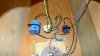
Caps that are 5% 250V are fine. Most important to match the original cap values.
The PE caps are good, I've used them in all of my re-capped speakers.
The kits from vintage-ar are way over priced. The only thing I've purchased from them is woofer surround sealer, and cosmetic pads for my AR12 tweeters, which were not really the correct size. Ended up making my own which look like the originals.
 
It sounds like you are well on your way now, but just to address some of your leftover questions. Yes, uF and MFD are the same designation, which stands for microfarad, a unit of electrical measurement used for capacitors. And as GD70 states, 5% caps are more than adequate - - - some people think they are getting better performance with 1% caps, but even 5% caps have superior tolerance performance over the original caps. Spend your extra pennies elsewhere. And voltage?....the originals were rated at only 50V, so anything equal or higher will work fine, but I often avoid the larger voltages because it is simply unnecessary and excessive, and generally, as the voltage increases the physical dimensions increase as well, and these large caps can sometimes become clumsy to install. The voltages of your two caps do not need to match, which is one reason I was trying to steer you toward a smaller and less costly NPE (non-polar electrolytic) for the 24uF woofer cap, and maybe consider the Dayton 5% or Carli for the 20uF tweeter cap - - both are very good caps at excellent prices.

To respond to your polarity question, if you look at the schematic you attached in post #9, you can see that the positive terminals of each driver are connected to the #2 (positive) terminal on the speaker backside. This is similar polarity. If you were to look at the schematic for the more typical AR-4x, you'd see that the positive tweeter terminal connects with terminal #1, while the positive woofer terminal connects with terminal #2. This is dissimilar, or opposite, polarity.
 
Caps that are 5% 250V are fine. Most important to match the original cap values.
The PE caps are good, I've used them in all of my re-capped speakers.
The kits from vintage-ar are way over priced. The only thing I've purchased from them is woofer surround sealer, and cosmetic pads for my AR12 tweeters, which were not really the correct size. Ended up making my own which look like the originals.

It sounds like you are well on your way now, but just to address some of your leftover questions. Yes, uF and MFD are the same designation, which stands for microfarad, a unit of electrical measurement used for capacitors. And as GD70 states, 5% caps are more than adequate - - - some people think they are getting better performance with 1% caps, but even 5% caps have superior tolerance performance over the original caps. Spend your extra pennies elsewhere. And voltage?....the originals were rated at only 50V, so anything equal or higher will work fine, but I often avoid the larger voltages because it is simply unnecessary and excessive, and generally, as the voltage increases the physical dimensions increase as well, and these large caps can sometimes become clumsy to install. The voltages of your two caps do not need to match, which is one reason I was trying to steer you toward a smaller and less costly NPE (non-polar electrolytic) for the 24uF woofer cap, and maybe consider the Dayton 5% or Carli for the 20uF tweeter cap - - both are very good caps at excellent prices.

To respond to your polarity question, if you look at the schematic you attached in post #9, you can see that the positive terminals of each driver are connected to the #2 (positive) terminal on the speaker backside. This is similar polarity. If you were to look at the schematic for the more typical AR-4x, you'd see that the positive tweeter terminal connects with terminal #1, while the positive woofer terminal connects with terminal #2. This is dissimilar, or opposite, polarity.

Thank you Gentlemen!

I really appreciate the guidance and have learned a lot. I'll post more after the caps arrive and I'm making progress. I'm excited to finish and hear the results!

All the best,
Uenjoy
 
Hello all
While I wait for parts to arrive I figured I may as well refinish the cabinets. What flavor of Watco danish oil best matches the original color. Im wondering if I should sand and oil or just use some steel wool and RAF followed by the danish oil. What have you guys used? I'm not in a position to spray anything so a hand rubbed finish is what I'm after.

Thanks,
Uenjoy
 
hello uenjoy et al,

great thread. I have been in Rocky Mountain National Park for a week with no service so haven't seen this. great info and just another AR revision as this wonderful model was being developed.

As for cabs, my favorite part, I have wondered about them while reading through this thread. Are there any pics b4 any further comments please.
 
Hello all
While I wait for parts to arrive I figured I may as well refinish the cabinets. What flavor of Watco danish oil best matches the original color. Im wondering if I should sand and oil or just use some steel wool and RAF followed by the danish oil. What have you guys used? I'm not in a position to spray anything so a hand rubbed finish is what I'm after.

Thanks,
Uenjoy
Sand so you're down to the veneer but go slow. In all my restorations I've used Watcos natural color. No need for walnut colored oil unless you want it darker than the original.
Glenn
 
hello uenjoy et al,

great thread. I have been in Rocky Mountain National Park for a week with no service so haven't seen this. great info and just another AR revision as this wonderful model was being developed.

As for cabs, my favorite part, I have wondered about them while reading through this thread. Are there any pics b4 any further comments please.

Sand so you're down to the veneer but go slow. In all my restorations I've used Watcos natural color. No need for walnut colored oil unless you want it darker than the original.
Glenn

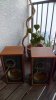
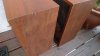
Thanks for the advice Glenn, and here are some pics Stupidhead.

I haven't gotten around to thinking about refinishing yet and don't know which route I'll take. They are a little rough but not terrible.

P1160728.JPG P1160725.JPG P1160726.JPG P1160727.JPG

About the caps - - it is a wise decision to replace them at this time, but I want to suggest maybe you consider using an electrolytic cap for the 24uF woofer - - it is less important than the tweeter cap; it is not directly in the signal path; it is far smaller dimensionally; and will save you substantial costs..

Exellent advice! Thanks rara.

The caps finally arrived and I've been busy Installing them. I started by wiring the pots outside of the cabinets and attaching the 20uF cap. I wired the two 12uF NPE's together, in parallel, ouside the box then began assembly inside. I layed foil down to protect components while soldering .

P1160690.JPG P1160704.JPG P1160691.JPG

I read that others recommend wrapping the HF pot in plastic or covering it some how to shield it from fiberglass but also read that it needs to breath to dissipate heat. Here's what I came up with using some left over speaker surround glue and a bit of vinyl screen I had laying around. The screen is not glued to the pot.

P1160697.JPG P1160698.JPG

Here is the finished crossover inside the box less wire keepers and fiberglass stuffing.
P1160709.JPG

All of my connections are soldered and shrink wrapped with the exception of the three blue wires which are soldered and crimp capped.
 
Last edited:
Back
Top Bottom