• The move to the new server is done. There are some software and database maintenance updates in process. This has us passing the hat around to help out. We appreciate any donations. Seriously, even a dollar helps. The payment page may be found here - https://www.audiokarma.org/support.html

AR Tweeter Diaphragm Replacements (AR12s)

turnitup

No, the stereo won’t break the crystal...Oh CRAP!
Was just messing with an RCA cable on my receiver, and sent a lethal signal to a pair of vintage AR12s. Blew both tweeters…ugh…

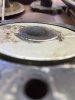
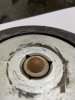
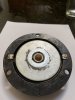
Does anyone know if the diaphragms can be replaced on these, and if so a known source? Mid 70s tweeters from the Teledyne lineage. 8 ohm tweeters as I am reading. Here’s a few pictures. Thanks for the help. Some of my favorite speakers, I’m mortally wounded! Bone-head move on my part…
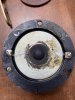
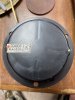
55CFAD28-D6C4-42EF-ABAC-7375D4EEF374.jpeg 117566A6-2FF6-429E-9AF9-867D0FA9124E.jpeg6FA7D5B2-130B-4DBF-B338-F06AD1F4A29B.jpeg
 
Last edited:
Register to hide this ad
Sorry to hear about the mishap. It happens to all of us, in one way or another.

As far as replacement diaphragms, I've never seen any available. Most of the later AR's used the same diaphragm, including the 9s, 90s, 91s, 92s, 48s, and 58s. Even the AR-1MS. But I'm not 100% sure with the AR12, since that was an 8 Ohm tweeter. So, your best bet would be new tweeters. Midwest Speaker sells a new replacement AR tweeter, that is said to sound very good. Like an AR tweeter. Many at Classic Speaker Pages recommend it. Just be sure to order the 8 Ohm version.

Midwest AR Tweeter

Good luck.
 
There are suddenly at least three sellers on ebay with a variety of diaphragms. I've just
received some for the 3a tweeter but haven't installed them yet. I'm very interested to
see if these will do the job. They answer some challenges of the old style but present
some new ones, mainly to do with insulating and routing the wires.

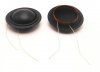
"silk dome tweeter diaphragm"

diaphragm.JPG
 
What is it that fails on those tweeters? I see very thin wires lying on the plate surrounding the diaphragm, slightly similar to those exiting the cone on some KLH tweeters, which are prone to breaking and are sometimes easily re-soldered. Is there a way to check continuity along the visible wire, or is the problem always the vc?
 
There are suddenly at least three sellers on ebay with a variety of diaphragms. I've just
received some for the 3a tweeter but haven't installed them yet. I'm very interested to
see if these will do the job. They answer some challenges of the old style but present
some new ones, mainly to do with insulating and routing the wires.

"silk dome tweeter diaphragm"

View attachment 2580718

The AR diaphragm is pretty small. So maybe those will work? Definitely curious.

s-l1600 - 2022-05-30T110440.475.jpg
 
What is it that fails on those tweeters? I see very thin wires lying on the plate surrounding the diaphragm, slightly similar to those exiting the cone on some KLH tweeters, which are prone to breaking and are sometimes easily re-soldered. Is there a way to check continuity along the visible wire, or is the problem always the vc?

I pulled the coil, after checking the heck out of the tweeter for possible external breaks in the wires (no luck). The inner coil was fried, with multiple breaks, so no fixing these guys, at least with the existing diaphragms. Also found out that these were ferrofluid tweeters, which I wasn’t aware of...

I did see (and purchase) a set of the diaphragms off of the auction site for the AR12’s. Don’t know what luck I’ll have with them, but thought I’d spend the $20 to find out. Also spent another $20 on ferrofluid. This should be an interesting learning experience for me, hoping for the best, but if not guess I can always go with the Midwest speaker route (thanks @StimpyWan ).

Anyone have any experience in centering the voicecoil on a soft dome tweeter with no guideposts? Can’t be shimmed, and the surface of this tweeter give you nothing to help, it’s flat as a pancake! I also need to insulate the leads with something. Fingernail polish maybe? Also, what type of adhesive do you use to secure the diaphragm to the housing? Will surround adhesive work?

Jumping into a new zone with attempting to repair these. REALLY sucks that I blew these, but if all goes well, maybe (just maybe) they’ll be better than what I started with, since I’ll have to clean out and replace the ferrofluid as well (which definitely needed to be replaced after ~40 years). Keeping my fingers crossed, big time. I’ll document the process, since surprisingly there is very little out there on doing this. Love these speakers, just kills me what I did. Dumb-ass move...

Wish me luck!
 
If you can accurately find the center of the pole piece, maybe you can use a compass to draw a circle just beyond the outside diameter of the new dome flange and use that as a cue for centering.
 
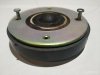
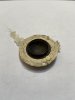
Here’s a photo of the coil that I pulled. Note the “frazzled hair” in the pic, that’s my fried coil wires all soaked in ferrofluid. Was hoping it might be a single break that could be salvaged, but it ended up being a lump of steel wool! Interesting finding on the housing, there is a small wooden “support button” under the dome. Don’t think this will help in my alignment quandary, but guess it helps keep the dome from being crushed. Guess it could also play a role in dampening the tweeter to some regard.

Kind of like attempting this, in a $&@!?$& kind of way…

E1A607FE-20FF-4510-BD8B-F8F936D77654.jpeg 9E4C0BA0-CB01-4C73-9438-59EB3ADBA97A.jpeg BFF38D37-A372-453A-B49F-462B2EE8B55A.jpeg
 
I hope to get on these in the next few days.

Let me know how it goes @RxDx, you’ll be a few weeks ahead of me in the shipping of your part. Maybe you can give me some pointers from your experience. “Worked in my sleep” on this one last night in my head. Thinking of ways to insulate the leads before soldering them. Fingernail polish came to mind (a bottom coat on the housing, lead wires, and then a top coat to encase them, as did double stick tape, then covered with fingernail polish as a top coat…
 
This video
will be helpful I would think.

That’s an awesome video, thanks for posting! The pros make it such a walk in the park...

Two questions though;

1) when he hooked up the AA battery to the diaphragm, it looked like he flipped the leads around, based on the outcome from the diaphragm’s reaction to the charge. Is there a polarity to a diaphragm? If so what outcome am I looking for to determine the +/- connection?
2) what kind of tape was he using to insulate the leads from the magnet housing?

Anyone know? (he says sheepishly to the experts)...

Thanks again @Earthnz!
 
It’s interesting, the 3a tweeters look (exactly) like the relatively newer tweeter I’m working on from the Teledyne era. I wonder if the 3a’s would benefit from ferrofluid? Don’t think I’d want to take that leap if I were rebuilding one, but definitely curious...
 
This video
will be helpful I would think.

Thanks for that.

That looks much easier than I expected. Plus, I have access to that type of work station and tools. Even the insulating tape. Though, I am curious as to the adhesive used to glue the new diaphragm? Anyone recognize it?
 
The plus lead of the diaphragm will cause the dome to push out when connected to the plus of the battery. In the video the diaphragm moved inward so the polarity had to be changed to get correct voice coil polarity.

This works for all drivers, not just tweeters, to determine correct positive polarity.
 
Thanks for that.

That looks much easier than I expected. Plus, I have access to that type of work station and tools. Even the insulating tape. Though, I am curious as to the adhesive used to glue the new diaphragm? Anyone recognize it?

It was white, so wondering if something as simple as Aleene’s flexible would work? Can’t imagine why it wouldn’t. What’s the insulating tape? Source??? Probably a really good quality 3M electrical tape would work I’m guessing. The adhesive just needs to hold up for another 40 years, or I’ll be pissed in my grave!
 
The plus lead of the diaphragm will cause the dome to push out when connected to the plus of the battery. In the video the diaphragm moved inward so the polarity had to be changed to get correct voice coil polarity.

This works for all drivers, not just tweeters, to determine correct positive polarity.

Thanks! Just the info I needed.
 
Back
Top Bottom