• The move to the new server is done. There are some software and database maintenance updates in process. This has us passing the hat around to help out. We appreciate any donations. Seriously, even a dollar helps. The payment page may be found here - https://www.audiokarma.org/support.html

AR3, AR3a and AR2 owners - passive bi-amping

yearly resurrection

I'm bringing this back to clarify what's been said. Excuse me if I'm missing something.

Per onplane's method, an integrated amp or receiver is filtering the signal so that lows go to the woofers, and mids/highs go to the mids/tweeters. In the quest to limit coloration, Is there a good reason why one wouldn't feed full signal into both positive terminals of each speaker, i.e. one stereo preamp --> two stereo power amps? If the woofer is a power-hog, would a 150 wpc amp work in this way with a 60 wpc amp for mid/high duty? Or, would the power discrepancy overemphasize the woogers, given the same signal from the preamp?

Assuming I can safely share the ground terminals between the two amps, I'd like to give this a shot, using a JBL 6260 for the woofers and an Adcom GFA 535II for the mids/tweets.

Is this lunacy?
 
The AR3 is not a bi-wire crossover but disconnects one leg of the tweeter only to use an outboard tweeter array such as the JansZen. I'd be leary of trying to use it in a bi-wire setup. You could really fry the speakers and/or amps.

The issue with the amps as to the difference in power is not the power but the input voltage vs power out, i.e. the gain of the amp. If you have a 60 watter with a .25 volt input for max output and a 150 watter with 1.5 volts in for max output you could end up with the opposite of what your suggest. Your reasoning is correct if say they input voltages for full power output is equal or in favor (so to speak) of the larger amps. Many persons do use larger amps on the woofers than the mids and tweeters but pay close attention to the matching of the amps. They even use SS on the woofers and tubes on the other drivers so it is possible to get it all to work.

In bi-wire arrangements, the full frequency response does go to the speakers and the internal crossover rolls off and filters the frequncies not used by the driver. The limitation to this is that the amp for the tweeters and mids still is producing the low end and hence the PS is still being hit for everything. In an active crossover setup, the woofer amp is not reproducing the mids and highs and the other amp is not reproducing the lows.
 
Is this lunacy?

Probably. :D

You can accomplish this without tone controls if you don't care about it being less efficient.

Standard caveats apply: Make sure your amps are compatible with this experiment. It'll be easy to cook your mids and highs with that much power - don't. Taking either potentiometer out of the circuit will change the characteristics of the crossover. The mid-pot is particularly necessary. Taking the pots out is not necessary to try bi-amping. It will be hard to get the volumes mated up and you'll will probably require twiddling two knobs to re-balence the ratio each time you want to turn it up or down.

Jerry claims not to mind any of this. He'll chime in here any time to tell you it's a good idea and argue vociferously for it. He always does.

Fair acknowledgment, I've never tried bi-amping vintage ARs.
 
After all this discussion, (and all this time), I actully never tried the bi-amping. Too protective of my AR's, I guess. :D

an integrated amp or receiver is filtering the signal so that lows go to the woofers, and mids/highs go to the mids/tweeters.
No. The amps are both feeding a full-range signal, the internal speaker crossover is still responsible for filtering.


Is this lunacy?
Probably.
 
No. The amps are both feeding a full-range signal, the internal speaker crossover is still responsible for filtering.

Jerry's original scheme involved using the tone controls on the integrated or receiver (bass down on the "upper," treble down on the "lower") to act as a primative line-level crossover to keep from throwing away too much power. Remember, though, he hooks them up via tape outputs, necessitating each volume control be used independently.

I can see a much better system with a custom y-interconnect, using a preamp or receiver's pre-outs to drive a bigger power amp for the woofer and running a high-pass line-level passive filter on the RCA leg that goes back to the a smaller amp (perhaps the receiver's amp section) driving the mids/highs. Ideally, the passive crossover inside the speakers would be fully separated at the terminal plate with full quad binding posts. This would eliminate the necessity of the shared ground and entirely prevent amplifier incompatibilities in a bi-amping configuration.

I'm not even convinced this ambitious plan would result in better performance (matching amplifier output would seem difficult and the proposed passive filter may introduce audible phase issues), but I may incorporate quad binding posts into my own AR-3a refurbishment so that I can try it for myself some day.
 
In bi-wire arrangements, the full frequency response does go to the speakers and the internal crossover rolls off and filters the frequncies not used by the driver. The limitation to this is that the amp for the tweeters and mids still is producing the low end and hence the PS is still being hit for everything. In an active crossover setup, the woofer amp is not reproducing the mids and highs and the other amp is not reproducing the lows.
Well, no, not generally. Once split, the passive highpass filter presents a high impedance load at low frequencies, so, while the full-range amp is still producing low frequencies, its PS (Power Supply?) isn't getting hit for much of anything more than the mid/high load.

Depending upon the filter topology, there may still be some dissipation, but it is typically minimal in comparision to the normal low-frequency load....
 
The issue with the amps as to the difference in power is not the power but the input voltage vs power out, i.e. the gain of the amp.

Well, just for S&G, I found in the manuals that the JBL's input sensitivity @ rated power (150 wpc/8 Ohms) is 1.1V, while the Adcom's (60/8) is 0.97V.

For the record, I have 2ax's, and will probably end up just changing from the Adcom to the JBL once I get the chance. Heh, my son is 6 months old.
 
I need some education here. I have a pair of AR 2a's and a pair of KLH Fours that I'm assuming can be passively biamped as described above. I also have a pair of Spica TC-60's which can be both biwired and biamped. Wherein lies the difference?
 
Biwired is simply running separate wires to the LF vs HF from the same amp outputs. The benefits are dubious.

Biamping is running them on separate amps, passively or actively crossed.... :yes:
 
Biwired is simply running separate wires to the LF vs HF from the same amp outputs. The benefits are dubious.

Biamping is running them on separate amps, passively or actively crossed.... :yes:

I don't see the sense in biwiring then, the Spicas have thick copper strips connecting the banana plugs.
 
Actually, bi-wiring is running to an internal crossover and have the internal crossover filter the amp response. In this arrangement each amp is producing the full frequency range which negates the advantage of having 2 amps except in the case when you are using 2 amps for a specific reason such as SS on the woofer and tube for the top end.

Bi-amping is the use of an outboard filter between the preamp and separate amps allowing each amp to have only a limited reposnse output.

Somehow the terms seem to have gotten smeared a might from when they were coined in the '60s.
 
I don't see the sense in biwiring then, the Spicas have thick copper strips connecting the banana plugs.
There are extensive arguments that relieving the HF from having to ride on the LF in the same wire improves its clarity. Also, the "Different wire for different frequencies" proponents can sell you twice as much premium wire.

DIY Cat5e fans like the concept, as well, recognizing that it's not appropriate to use that to drive big woofers due to current demand, but perceiving improved performance when it's used for high frequencies only.

Bi-amping is the use of an outboard filter between the preamp and separate amps allowing each amp to have only a limited reposnse output.

Somehow the terms seem to have gotten smeared a might from when they were coined in the '60s.
Using separate amps without an external crossover is termed "Passive Biamping," as distinct from simple biwiring:

http://sound.westhost.com/bi-amp.htm

It's also possible to employ passive filters on the inputs of multiple amps, a different implementation of passive multi-amping.

When biamping three- and four-way systems, the passive filters for the multiple MF and HF drivers are left in place. Separate those, and it becomes tri- or quad-amping, whether the actual filtering is done actively or passively.

The terminology is not so confusing if "Biamp" is narrowly read as meaning, uhmm, two amps.... ;)

Actually, bi-wiring is running to an internal crossover and have the internal crossover filter the amp response. In this arrangement each amp is producing the full frequency range which negates the advantage of having 2 amps....
Not so, as illustrated by your own example. The amps only produce what their respective loads demand. Passively biamped, employing the speaker's internal filters, one can use a chip amp for the HF and monster SS for the woofer.... :yes:
 
Lots of good discussion.

Many folks believe that relieving the mid/tweeter amp from the heavy current load of the woofer, just improves that amp’s ability to produce clear, clean high frequencies. Please remember, IM distortion occurs whenever we amplify and mix signals of diverse frequencies.

By limiting frequency range (especially the heavy current draw frequencies in the fundamentals), we should get clearer and cleaner high frequencies. Now whether our ears are sensitive enough to hear any difference is another matter entirely. That’s why I recommend passive bi-amping just one speaker and then listening to see whether you can hear any difference with the stock speaker.

Next, there is another issue that is irrefutable. That is, when you un-hook the complex passive xover network and divide into simpler pieces, there is less unintended interaction between all of the components.

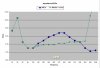
The graph below shows actual measurements I made on the impedance of the AR-3a in the frequency range of 30 to 1000Hz. The green line shows the same measurements with the strap removed. That is, I measured the impedance that my woofer amp would see (low frequency driver + internal low pass filter). Notice that with the strap removed the impedance is much better behaved. In addition, the woofer alone will draw more current (at the same voltage) than the woofer connected to the complex xover.

This difference must absolutley result in a difference in the resulting sound. I think the bass is better defined, but you may find it ... unacceptable.


Last advantage is those old pots are a serious nusiance. I have totally by-passed the tweeter pot (which gives a modest .5 to 1 db tweeter boost) and soldered the mid pot to it's max output position. To control the balance of power in each speak half, I simply use the volume controls on the independent amps. This gives me far better control than you'll ever get with those corroded pots.

Regards,
Jerry

PS: woofer amp ==> 170wpc (rms) 4 ohms
mid/tweeter amp ==> 25wpc (rms) and this is more than enough!!
 

Attachments

  • impedance-woofer.JPG
    impedance-woofer.JPG
    41.1 KB · Views: 21
I tried out Jerry's suggestion today with my restored AR3's and two similar amps, a McIntosh MC2300 and MC2105. There only real difference is the power. They each have separate gain controls, which I set, then run both into the 2 mains of a McIntosh C24 preamp. I then can control system gain with a McIntosh CR7 remote. All of the benefits that Jerry has described here and other places I am hearing. Better imaging, separation, sparkling highs and that wonderful, heavy AR3 bottom. And I get to use both amps instead of only one. As long as I stay judicious with the volume(and I'm several years past my kick out the jams period) I should be fine.

That said, would love to try a smaller tube amp for the mids/tweets at some point.
 
Last edited:
I tried out Jerry's suggestion today with my restored AR3's and two similar amps, a McIntosh MC2300 and MC2105. There only real difference is the power. They each have separate gain controls, which I set, then run both into the 2 mains of a McIntosh C24 preamp. I then can control system gain with a McIntosh CR7 remote. All of the benefits that Jerry has described here and other places I am hearing. Better imaging, separation, sparkling highs and that wonderful, heavy AR3 bottom. And I get to use both amps instead of only one. As long as I stay judicious with the volume(and I'm several years past my kick out the jams period) I should be fine.

That said, would love to try a smaller tube amp for the mids/tweets at some point.
So, I’ve read through this, and I’m convinced I’m an idiot! I cannot grasp how this works, but, if I saw a diagram of how this is all connected, DOH, thenI I would get it! Any possibility that someone could do this?
 
So, I’ve read through this, and I’m convinced I’m an idiot! I cannot grasp how this works, but, if I saw a diagram of how this is all connected, DOH, thenI I would get it! Any possibility that someone could do this?

He provided a diagram in post in another thread(https://audiokarma.org/forums/index.php?threads/anyone-bi-amping-ar3a-fisher-500-c.195695/) In the same post, he wrote this which got me going.


"We connect the amps to the speakers as in the diagram below. The black or ground connections on both amps are connect to terminal #1 on the AR's.

We next remove the external strap between 2 and "T". Then the red or HOT amp output for the woofer amp is connect to terminal 2. The Red output for the mid/tweeter amp is connect to terminal T.

That's it!! Each amp has control over just a portion of the speaker."

index.php
 
All amps behave differently with speakers because speakers are not linear devices. They are not pure resistors either and they can generate back voltages that can give amps feed back networks fits. So doing what you did you were just plain lucky that everything you chose to do worked out the best for you. I always found that 3'a could be irritating with SS amps produced at the time when they were first being released. But not always. It just proves that not every amp or speaker work well together. I liked AR3a's pushed in Multiples by Mcintosh 3500's. Not so much by 2105's or 2300's. Marantz SS stuff even less. Some older professional Yamahas sounded great and yet the consumer M series amps gave me headaches. They sounded good with Tandberg amps but not B&O. They worked well with some SAE but not Carver's class D amps. But who knows you might like them that way. I always connected them with #10 awg wire when available.
 
All amps behave differently with speakers because speakers are not linear devices. They are not pure resistors either and they can generate back voltages that can give amps feed back networks fits. So doing what you did you were just plain lucky that everything you chose to do worked out the best for you. I always found that 3'a could be irritating with SS amps produced at the time when they were first being released. But not always. It just proves that not every amp or speaker work well together. I liked AR3a's pushed in Multiples by Mcintosh 3500's. Not so much by 2105's or 2300's. Marantz SS stuff even less. Some older professional Yamahas sounded great and yet the consumer M series amps gave me headaches. They sounded good with Tandberg amps but not B&O. They worked well with some SAE but not Carver's class D amps. But who knows you might like them that way. I always connected them with #10 awg wire when available.

I don't know if it's "luck" per se. I've been reading Jerry's posts regarding biamping here and other forums for sometime now but was always a bit intimidated to try it. Or I didn't have the extra amps to try. Now that I have two Mc amps that I love, and who's sonic signature are very similar to each other I finally decided to give it a try. Both those amps sound fantastic to my ears with my 3's, and being able to combine them and particularly have the 2300 handle just those big woofers really makes a difference. But that it does isn't really that surprising.
 
He provided a diagram in post in another thread(https://audiokarma.org/forums/index.php?threads/anyone-bi-amping-ar3a-fisher-500-c.195695/) In the same post, he wrote this which got me going.


"We connect the amps to the speakers as in the diagram below. The black or ground connections on both amps are connect to terminal #1 on the AR's.

We next remove the external strap between 2 and "T". Then the red or HOT amp output for the woofer amp is connect to terminal 2. The Red output for the mid/tweeter amp is connect to terminal T.

That's it!! Each amp has control over just a portion of the speaker."

index.php
Perfect! Cheers!
 
Back
Top Bottom