
• The move to the new server is done. There are some software and database maintenance updates in process. This has us passing the hat around to help out. We appreciate any donations. Seriously, even a dollar helps. The payment page may be found here - https://www.audiokarma.org/support.html

AR6 resto - I'm scared of pots.

I've followed the directions of the wonderful AR Potentiometer resto thread. I'm currently stalled at the pots-cleaning section, because I see that I'm dealing with a slightly different animal in the AR6 pots.

Here's a pic of the AR4x pot cleaned in the resto thread:
DSC_7495.jpg


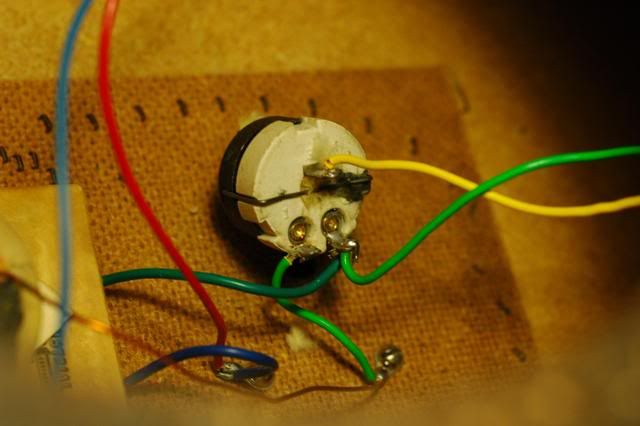
And here's what I'm dealing with in the AR6:

post-3-1143783259.jpg


See the "extra" copper wires in the AR6 pot, one with the yellow lead and one with the light green? That's what has me flummoxed. Too scared to go any further without consulting the AK wisdom. Any tips?
 
Register to hide this ad
Was afraid you'd say that! In order to confidently get at those leads with a soldering iron, I'll need to pull the whole crossover out.

Maybe I don't need to be so confident. But it just feels kinda reckless...
 
Okay, went ahead and snipped the leads as close to the terminals as possible. Cleaned the pot.

The problem now: I'm supposed to solder the three insulated leads (two greens and a yellow) back to the terminals before putting the pots back in. However, I will still need to solder the copper wires, which are inside the cabinet, back into the terminals. I guess I can just attach extra wire to the three insulated leads with wire nuts, and then solder it all once the pot is back in. Does this make sense? If so, is this right?
 
I would solder them all inside the cabinet, but you can do whatever is workable for you. Dont forget to sandpaper the end of the enameled wire before soldering.
 
Ah! Thanks for the tip! I'm a newbie to this stuff, and definitely would have just soldered before stripping the enamel.

A quick search suggests that there are a few methods to prepare an enameled wire for soldering. Is sandpaper the best? Again, the wires are pretty well inside the cabinet.
 
It's good to have some long needle nose pliers. Use the pliers to hold the wire in place while you apply the solder. Besides sanding the tabs, (can use an emery board in the tight areas, isn't this why we have wives to borrow their stuff?) also put some flux on both surfaces before you start soldering. I tend to like the liquid flux as opposed to the paste.

Looks like you're going fine.:thmbsp:

Glenn
 
Thanks for the tip, and the encouragement! Again, I'm a newb, so I'm probably going to repeat each step as I understand it.

Does "sanding the tabs" mean sanding the enameled wires, or the terminals? I think the former but "tabs" is a new word for me.

And an emery board is a nail file? If so, I'm still dicey on whether I'll be able to do a decent job on the enamel while it's relatively deep inside the cabinet. Will I just press the wire against a finger, say, and file away?

I love all that I continue to learn on this site. Sometime's I'm afraid to ask these questions, b/c they seem so, erm, dumb. But I reeeeally don't wanna do harm to these sweet classic speaks! I also reeeeeally appreciate the level of patience I've already been shown :)
 
Last edited:
You must sand the enameled insulation off the wire, Sanding the terminals is good practice but just shine them up a little. If the solder is well adhered to the terminals it is not necessary to further sand them. An emery board or sandpaper will work fine for this.
 
I've been sanding for about 5 minutes. Just realized: How do I know when I'm done sanding? The insulation has gone from bright copper to a duller copper color. See here:

9374962016_dd3a00d13a_c.jpg


The photo is kind of washed out, so it looks more "white" than it really is. Just looks like I've roughed up the enamel a bit.

Also, the other wire doesn't appear to me to be enameled. Do I need to sand it, too? See below:

9374964536_f42f986223_c.jpg
 
Last edited:
I've had success cleaning old AR pots without desoldering anything. Gotta work in a tight spot but it does the trick. Should be enough room once you free up the pot by taking off the nut on the back and removing the clip to sand the contacts.
 
Scrape all wires and terminals with a razor blade before soldering,it always helps!! Also tin your wires and terminals seperately with solder first before making the actual solder connection. If your solder wont flow and stick on the wire its not clean enough.Make sure your using very thin guage rosin core solder!

I removed the crossovers on my AR4x's when i recapped them and it was kind of a pain! But it made the soldering go much easier! I pulled all the staples,but its still glued down.The glue was holding very good too,but it did let go. I pre drilled holes in the boards so i could reinstall with screws,and used strip caulk to seal the boards
 
I went ahead and soldered inside the cabinet last night. It took a bit of pre-planning and a few cold practice runs, but it wasn't that bad. Also replaced the cap while I was in there.

To my ear, it sounds like I sanded (with an emery board) the magnet wire enough, because both the tweet and woofer are fully functional. How would I know if I didn't do it well enough, anyhow?

The big news: the formerly touch-and-go pot on speaker #1 is now smooth as butter! Now to rinse and repeat on #2.
 
pots or resistor

You could go with a set of resistors and provide a selector switch instead of problematic pot.
All you need is an idea of the resistance range that would be the most desired and get I would say 3 resistors and a 4 position selector switch. The 4th position would be OFF. Maybe 10 or 20 watt capacity on the resistors.
Many AR speakers from long ago had a 2 position switch that selected a resistor or straight line to the tweeter after the x-over.
More reliable than a pot.

Paul
 
I had the European version of AR6 with switches and not rheostats. I just gushed them with WD-40, then alcohol and finally Deoxit (a different brand but equal purpose). They were clean, good as new in few minutes.

I'm scared of oxidized pots as well.
 
Guys, I don't want to make a new thread, since its similar question. One of my AR4xa has no sound from the tweeter so I figure its time to clean the "pot". However, when I open it up there's no "pot" and the one that's working has "pot". There is a big cap on the one without the "pot" so what should I do?
 
Guys, I don't want to make a new thread, since its similar question. One of my AR4xa has no sound from the tweeter so I figure its time to clean the "pot". However, when I open it up there's no "pot" and the one that's working has "pot". There is a big cap on the one without the "pot" so what should I do?
Stay off the pot! Drugs are bad! M'Kay:D
Maybe somebody's has bypassed the pot and removed it, or it a earlier version. Can you see the hole wher the pot was? Post some pics. My Ar4x's had bad solder joints at the tweeters and one also needed the rivet on the connection terminal on the tweeter soldered to make a connection.
 
Back
Top Bottom