• The move to the new server is done. There are some software and database maintenance updates in process. This has us passing the hat around to help out. We appreciate any donations. Seriously, even a dollar helps. The payment page may be found here - https://www.audiokarma.org/support.html

Are Class D Amps scaring the hell out of the BIG Boys ?


Class D is reference to the output stage. The power supply is irrespective of the output topology.

An amp can be Class D with a conventional PS or a switching PS.

It is a Class D/switching amp.

From Levinson's website...
"The Nº53 is the first-ever switching power amplifier from Mark Levinson.

By rights, Levinson calls it "Class I". Where have we heard about Class I before?

If you guessed Crown you'd be correct. Interesting as that may be, it's just their twist on Class D/switching amplification.
 
Last edited:
I resemble that remark on both counts - thank you for the compliment. New tech isn't always "best tech" . . . as evidenced by the fact that the good ol' analog LP isn't going anywhere anytime soon.

Let your ears be the judge. I actually worked for an amplifier manufacturer for some ten years - one that holds patents on switching audio amplifiers. I'm intimately familiar with the idea, the technology, and advancements in it. I'm also intimately familiar with how they work.

For subwoofers, the technology is mature and undetectable to my ears. Not so for full range applications. As others have said, listening fatigue is a real concern yet. Maybe one day.

For now, I'll stick to wearin' my hat backwards, my long hair, my big-a$$ gear, and workin' on my car in my backyard . . .
 
To me class D is the answer to a question I am not asking. I have enough room for a conventional amp and the power draw is not impoverishing me. If you don't need to stick it in a car or on the back of a subwoofer, who needs it?

I think this post best summarizes my position on Class D. Most folks don't know (but this has been mentioned in this thread) that Class D amplification is some 60 years old now - being used to power walkie talkies in military applications.

The promise of Class D is greater efficiency, lighter weight, and reduced cost (a recent thing). While it is true that some designs approach 80% efficiency, that isn't always true at all levels of output and at all frequencies. These are excellent attributes for professional and automotive applications. How many audiophiles need more than a single 15A outlet to power our audio systems? How many audiophiles factor weight when purchasing equipment? Cost is a factor that all of us face so that is a definite plus.

But, when we talk about Levinson, Rowland, Bryston, etc. offerings, is price the kind of factor it is when a noob is trying to choose a 100 watt x 7 AVR? I don't know, maybe it is for some folks.

OTOH, I'm pretty sure class AB hasn't yet been perfected. The Class AB offerings today from our favorite companies are simply spectacular.

whoareu99 - Class I, Class H, and Class G are very different from Class D. I'd have to agree that many of those designs are also excellent. See, you and I CAN agree on something!
 
Last edited:
And then there are those who embrace both. The OEM power cord for my Levinson outweighs the TPA3116 amp I have.

That made me laugh. I think I'm in the same camp/camps as you on this one. I do love the old stuff, but there is so much new stuff that is just plain cool.
 
For those non believers we should do a TPA3116 pass-around like they do at AC.

Judging by the longest thread ever at diyAudio and the one here under modern gear, folks are discovering the new T.I. chip to be a real game changer.

It doesn't deserve to be in the same conversation with t-amps.
 
Good choice Gossy,

It will arrive in a small e-packet which should skate through customs.

Paired with the YJ $50 6N3 tube preamp it can rival many SET amps.
 
Poultrygeist,
I see a 24v/6A psu they can bundle with it - at the claimed 90% efficiency this should give about 10% headroom in power for the amp - sufficient you think?

Also, our livingroom giants.. They're rated at 4 ohms nominal, I think actually they might dip as low as 3.2 from memory, and are rated for 50-300 watts.. What kind of performance can I expect from this little amp? (kef reference model three~2)

*edit* Hm Odd. The amp board manufacturer rates it at 2X50 w @ 4 ohm, but the TI information states 25w@4ohm - and at around 10 watts, thd is <1%, at 18wats thd is <10%..
http://www.ti.com/product/TPA3112D1?keyMatch=tpa3112&tisearch=Search-EN
 
Last edited:
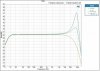
http://www.parts-express.com/2x250w-irs2092-class-d-amplifier-board--320-313 seems a little more of a safe bet to drive larger speakers, though judging from some of the comments to get it to perform correctly, a scope is needed to adjust the PWM clock. It's based on the reference design for this particular IC.

THD very low, has no issues driving low impedance speakers, lots of protection. Does require a bit meatier PSU though ^^
*edit* at 4 ohms freq. response is pretty good, but higher and it starts to get bright - don't think this would be a good one to use with high bitrate sources on 8 ohm speakers as it will emphasize high frequencies..
 

Attachments

  • untitled.jpg
    untitled.jpg
    34.3 KB · Views: 8
Last edited:
Agreed. I now use a Hypex Ncore amp in the garage system. While still not as refined at the top as the VTLs upstairs, it's midrange response (which is what I find most important) is excellent. And its top end sins are that of omission.
 
Back
Top Bottom