• The move to the new server is done. There are some software and database maintenance updates in process. This has us passing the hat around to help out. We appreciate any donations. Seriously, even a dollar helps. The payment page may be found here - https://www.audiokarma.org/support.html

Are you impressed with late model domestic vehicles?

That's not something you know...... The lack of battery technology has been a big part of the hold up for electric vehicles for all manufactures. How can the necessary infrastructure for supply be in place when the technology hasn't even been hammered out completely?

Correct. Rechargeable battery technology / reliability still has it's bugs. Just for starters, do a poll to see how many people really think their laptop's battery held up as well as they'd like. Good results can be achieved, such as the (rather amazingly still working) Mars Rovers, but nobody would want to pay for THOSE batteries. :no:

We also have to come up with the ELECTRICITY if electric cars start selling in a big way. Auto's use a LOT* of energy and current safety standards, etc., have increased that requirement over the years. (I remember reading somewhere that Honda did a study and found an '84 CRX 1.3 could not presently be legally produced in the U.S., for under $50,000, due to the exotic materials that would be required to meet the mileage target and safety requirements.)

*I am leaving out specialized "vehicles" like those Mars Rovers, of course! :)
 
Goodwill are you just a GM fanboy?

I think your concerns are a bit overkill. All manufacturers use aluminum and plastic and have lots of electronics, and I haven't heard of specific vehicles with transmissions that don't allow for a fluid change. Dexcool is controversial, but I beleive if it was indeed causing problems GM would cease to use it.

His concerns are not overkill, All manufactures may use the same materials within a car, but GM and the other domestics tend to use alot of plastic for engine parts and that is just a terrible thing to do. GM also loves to mismatch metal types used in the engine so that they expand and contract and very different rates, any idiot can see that that is a very poor idea. And Yes there are alot of new domestics with sealed trannys, very poor design......unless you account for the fact that they are designing them to fail, but only after the warranty runs out. Plus they are making the government cover the warranty's now anyhow. Dexcool is a terrible terrible coolant period, it does become very corrosive.

They aren't taking your tax dollars...... The govt made that decision, and it's a loan..... the idea is that they'll pay it back.

Yes they pretty much are! If you look back into the 70's when the government bailed out Ford they made them give back a product, they didn't just hand them assloads of money. I'm not even going to get started on this one......


The fact is all auto companies are not good, just the domestics are downright terrible. Everything is engineered to break, after the warranty runs out, and most of the time fails before that. The Government isn't helping any with all the emission laws that absolutely kill gas millage, so in the end is worse for the environment since there is a ton more fuel consumption because of it. With the New Emissions demands for diesel its just stupid they have not worked that out well, well unless your a big oil company that is. Then all the money the government wasted in Hydrogen reachurch and funding, hmmmm that was a great idea spending so much money on this new "green" Idea were the fuel needs more energy to produce than it gives, and would require a very dangerous and large amount of fuel to be practical! The auto industry is just controled by money and big oil, I mean they have trillions of dollars invested in our economy and they have sway so why shouldn't it be that way?
 
Goodwill are you just a GM fanboy?

I'm a Michigan born US citizen that supports my fellow countryman and Canadians by purchasing the products they build for the US based companies they work for. You?

His concerns are not overkill, All manufactures may use the same materials within a car, but GM and the other domestics tend to use alot of plastic for engine parts and that is just a terrible thing to do. GM also loves to mismatch metal types used in the engine so that they expand and contract and very different rates, any idiot can see that that is a very poor idea.

What plastic parts does GM put on engines that other companies don't?

GM is not the only one to run aluminum heads on iron blocks.

And Yes there are alot of new domestics with sealed trannys, very poor design......unless you account for the fact that they are designing them to fail, but only after the warranty runs out. Plus they are making the government cover the warranty's now anyhow. Dexcool is a terrible terrible coolant period, it does become very corrosive.

No company is going to design there product to fail..... not when other companies building comparable products don't..... we aren't talking Walmart level DVD players.

Yes they pretty much are! If you look back into the 70's when the government bailed out Ford they made them give back a product, they didn't just hand them assloads of money. I'm not even going to get started on this one......

What do you mean hand back a product? I don't know anything about Ford getting money in the 70's. Chrysler did in the 80's and paid the money back early.

The fact is all auto companies are not good, just the domestics are downright terrible. Everything is engineered to break, after the warranty runs out, and most of the time fails before that.

Uh Huh... sure. That's why I've got 190K miles on my truck..... because GM engineered it to be break. The transfer case broke at about 20K miles..... they replaced it.... big deal.

The Government isn't helping any with all the emission laws that absolutely kill gas millage, so in the end is worse for the environment since there is a ton more fuel consumption because of it. With the New Emissions demands for diesel its just stupid they have not worked that out well, well unless your a big oil company that is. Then all the money the government wasted in Hydrogen reachurch and funding, hmmmm that was a great idea spending so much money on this new "green" Idea were the fuel needs more energy to produce than it gives, and would require a very dangerous and large amount of fuel to be practical! The auto industry is just controled by money and big oil, I mean they have trillions of dollars invested in our economy and they have sway so why shouldn't it be that way?

And all that has what, to do with domestic auto companies? You argue from feeling, not actuality.
 
"Think with your dipstick, Jimmy!"

That's another peeve of mine: transmissions with no dipstick. Most recent automatics are like this to save a buck and amp up dealer profits. People somehow think no dipstick = maintenance free.

IIRC some GMs now are _totally_ sealed - you can't even check / add fluid by any means. Must be great when the converter seal goes, which is a question "when" not "If" on most cars...

My GM truck has a dipstick for the tranny. Otoh, the past 4 new vehicles I've owned be they foreign or domestic have had plastic valve covers and radiator tanks. Never had one leak.

Btw, the name of the survival game for any company that manufactures a product today is cutting cost. The catch phrase being thrown around for the past few years where I work is "Lean Manufacturing". And no, it does not mean to make a cheaper product. It means adding value to the product by reducing the cost of everything involved in making that product. Companies that don't "get it" are'nt going to survive in todays economy.
 

Attachments

  • castrol-use-your-dipstick.jpg
    castrol-use-your-dipstick.jpg
    32.1 KB · Views: 7
I think your concerns are a bit overkill. All manufacturers use aluminum and plastic and have lots of electronics, and I haven't heard of specific vehicles with transmissions that don't allow for a fluid change. Dexcool is controversial, but I beleive if it was indeed causing problems GM would cease to use it.

Oh I know that **** causes problems. Right around the 3 year mark, when it's supposed to last for five years. The sludge starts forming, and it starts eating through the plastic stuff. If anything, my concerns are underkill. There's all kinds of things on these GM vehicles just waiting to **** your wallet. Ball joints, transmission, engine computer, air conditioning system, and oh do they love to eat brake pads and rotors. Their stuff might have improved by now, but it's too little, too late. Way too late.

My dad told me about a recent GM built engine that the coolant likes to eat through. Specifically it eats through some plastic part, and the coolant starts going out the exhaust pipe, and eventually the engine fails.
 
Horse hockey, our Impalas are eight years old, never had the transmission oil changed and never had the dealer suggest it should be changed as the cars only are in the 40,000 mile range. The ball joints are fine and the engines are fine. Sounds to me like more effing Japanese propoganda. I changed the front pads at 45,000 miles the rear are still original.
 
MRX: I'm pretty sure the plastic problem your Dad referred to is the infamous upper intake plenum on 3800 V6s. It happens on Series I & II engines...the soon-to-be discontinued Series III uses an aluminum plenum. Not every engine suffers that fate, but, once repaired (with evidently an upgraded part) you're pretty much set for 300,000 miles. $3-400 job, IIRC.
I WILL agree that Dexcool is some nasty crap...I've seen many cars with what looked like rotten chocolate pudding in the overflow tank. Just flush the system with a good cleaner and go back to good ol' green.
 
My dad told me about...

Come on guys, his dad told him!

I can tell you this... If kooky conspiracy theories and lemming behavior can kill an industry, you are witnessing it now. How much of this BS is rooted in late-60s hippie-think?

The auto industry is just controled by money and big oil,

(I'm in charge of hiding the 200 mpg carburetors, shhhh....)

Or just random opinion based on nothing?

but GM and the other domestics tend to use alot of plastic for engine parts and that is just a terrible thing to do.

Really? Have any other baseless, broad stereotypes you'd care to post? Maybe you don't realize this, but when you say things that are laughably ignorant to engineers...
GM also loves to mismatch metal types used in the engine so that they expand and contract and very different rates, any idiot can see that that is a very poor idea.

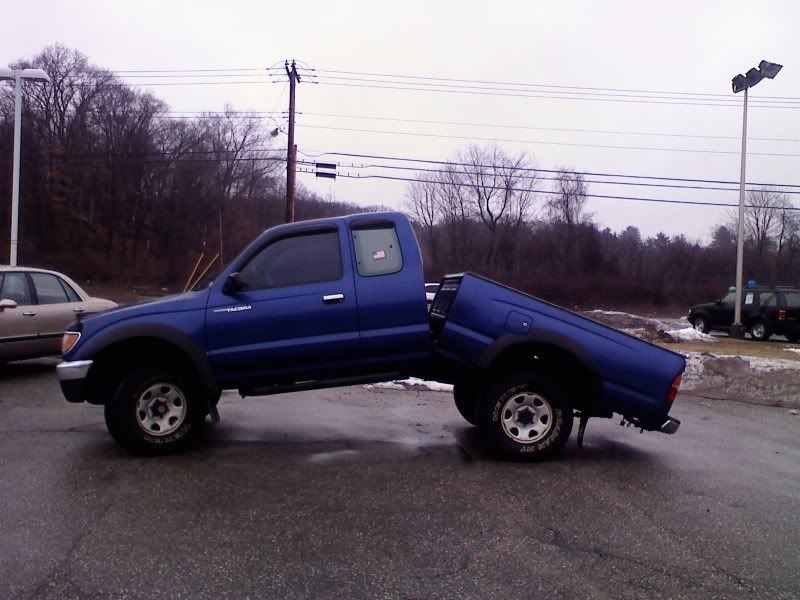
... it shoots your credibility straight to hell. Seriously, do you know how long ALL manufacturers have been using differing alloys in engine construction? Yet this becomes a cornerstone of your argument? You could have avoided rusted doors in your 2002 Dodge buy purchasing a 2002 Toyota instead, the doors look pretty good on this one...

rustytacoma.jpg


Google "Toyota frame rust". Or you know what? Google "Toyota engine sludge", "Toyota bed-bounce", or "Honda trans failure". Then research which automaker's executives actually went to jail for a 20-year history of hiding safety defects... Here's a hint, rhymes with "Mitsubishi".

I was going to say that Consumers Reports ratings ARE flawed, from a purely mathematical standpoint, but then I found this fun quote below the line. You can't (or at least shouldn't) take sample data from differently sized groups and give them all the same weight in a survey. In other words, if not many CR subscribers drive a Ford Mustang, (likely) then that data will be less accurate than a large sample of Toyota Camry owners. In fact a lot of this data is flawed mathematically, but at least a company like JD Powers isn't choosing data from "their own" pool of responders.

------------------------------------------

For the second year in a row, European automakers did not have even one entry on CR's list of models with the best-predicted reliability ratings. Four models from Nissan -- the Quest, Armada, Titan and the Infiniti QX56 -- are on Consumer Reports' list of 2006 models with the worst predicted reliability.... ..."The message to consumers is clear: You can't gauge reliability based only on a nameplate."

Now I'm sure you'll accuse me of being a Detroit shill, or Japan bashing... That was not the intent of my post. The purpose was to point out the silliness of blindly accepting any of these stereotypes. If you only knew the amount of cross-pollination between foreign manufacturers and domestic, you would find such arguments as foolish (and offensive) as I do.

This group: http://fairimage.org is just getting started in the Detroit area, and I have attended several of their Saturday morning coffee meetings. You might learn something by poking around the website.

 
Sounds to me like more effing Japanese propoganda.

Nope. Just a dad whose been fixing both domestic and import cars for damn near 30 years. He's still surprised by that 14 year old Honda that came in for new brakes. 136,000 miles, oil was clean, the rear differential still had its original oil, and it was clean too. Tranny fluid was getting dirty but not bad yet.

To be fair, the Japanese produce some **** too. Hyundai has some horror stories. I think Kia is Korean, but they have some horror stories too.
 
Well just don't hit anything with your precious Hondas, that Reynolds Wrap does not hold up too well. 1990 Probe damage $235 1993 Civic in excess of $1400, glad I was driving the Probe. Ford Body Mazda drive train Oh BTW it also had a plastic upper bell on the rad, started leaking at 70,000 ran to 135,000 on StopLeak. When I replaced it with a 3.8l Impala I was getting the same gas mileage as its 2.2l. Main oil seal went on the 2.2l at about 100,000.

When my wife was teaching English to executives in Japan they told her some strange stories about how WW II was started. They also told her that while they lost the shooting war they would bury us in the financial war. Seems like they have done it with our help. How many American cars do you imagine that you will see in Japan or Korea? And do you remember the first Nissans, Toyotas and Honda to hit our shores? The Civic rusted to rat chit inside of a year. Companies made money selling fiberglass front fenders for Nissans. The first Camry must have been hit with an ugly stick as it came off the assembly lines. Where do you think most of their styling is done these days?

Hyundai and Kia are both Korean.
 
Last edited:
Merrylander: Your Impala must have been built on a Wednesday. :)

Not all GM cars are bad, but a lot of them are. It's taken more then propaganda to push GM to the edge of bankruptcy. My brother's S 10 pickup might be one reason. Rust... Ended up getting tickets because the Y pipe rusted off, and oh did that little engine love to eat oil.

But, many of you probably have a Ford or GM or even a Chrysler that's treated you well, and you'll defend it, and that's okay. It just proves that every automaker out there can make good and ****ing awful cars.
 
I purchased a 2005 Ford Mustang new and have to say it's never needed anything. Still have the original tires on it with over 50,000 miles on it. I drive it all winter long with traction control in Michigan.

Outside of oil and air filter changes I haven't done anything to it. Very reliable car...
 
Mmm, add potential engine fires to the list...

http://www.msnbc.msn.com/id/30198296/?GT1=43001

This can't be good for GM...

You do read below the headlines, right?

GM says there have been no reports of any fires or injuries.

Some of the recalled vehicles are no longer in production. The recall includes the 1998-1999 Oldsmobile Intrigue, the 1997-2003 Pontiac Grand Prix, 1997-2003 Buick Regal, and the 1998-2003 Chevrolet Lumina, Monte Carlo and Impala.

The government says drops of oil could fall into the exhaust system and cause a fire in the engine.

GM spokesman Kerry Christopher says it was a precautionary measure for consumers.

Of course why should your reading comprehension be any better than the professional writers at MSNBC who don't realize that:

1) Any vehicle last available in 2003 is no longer in production, not just "some".

2) Drops of oil may fall "on" to the exhaust system, but unless the car is upside-down and you're standing over the tailpipe with an open oil can, there isn't much chance it will fall "into" the system.

So what this boils down to is that any engine that develops a valve-cover gasket leak could combust oil on the exhaust manifold. I don't know how the the government is justifying a safety recall based on fires that haven't occurred, but rather a theory that would apply to most any car with overhead valves (virtually all after 1960).
 
Nope. Just a dad whose been fixing both domestic and import cars for damn near 30 years. He's still surprised by that 14 year old Honda that came in for new brakes. 136,000 miles, oil was clean, the rear differential still had its original oil, and it was clean too. Tranny fluid was getting dirty but not bad yet.

To be fair, the Japanese produce some **** too. Hyundai has some horror stories. I think Kia is Korean, but they have some horror stories too.

Ask your dad which 14-year old Honda has a rear differential. Ol' dad is truly surprised a 14-year old car needs new brakes? Put him on the keyboard, I gotta read this from the source. Clean oil doesn't impress me either, unless you want us to believe it went 136K between changes. :D

Why don't you just admit this isn't your strong subject, and stop recycling dad's opinions? You're mixing stuff up, and it's sad. :no: My mother computed taxes for multi-million dollar companies, for 28-years, but it hardly makes me H.R. Block.
 
Last edited:
That's not something you know...... The lack of battery technology has been a big part of the hold up for electric vehicles for all manufactures. How can the necessary infrastructure for supply be in place when the technology hasn't even been hammered out completely?

That is something I do know, I'm an engineer and I worked for General Motors Saturn division for a short period. There is no battery shortage and they are cheaper to build and service than carbon fueled engined vehicles. So many companies bombard resellers with their lithium batteries that they have to turn them down.

A friend of my neighbor is a professor and one of his colleagues worked in developing Li-Polymer. Now with nanowire batteries and 8+ times the capacity of Lipo there is no excuse for shortages or low capacity. If anything its like fuel, companies working with car manufacturers will slow and control production to dictate a market. All these "shortages" haven't affected ZENN or Telsa and this would otherwise leave me wondering why the big companies have such trouble making electric cars.

Lithium Shortage Fallacy: http://gas2.org/2008/10/13/lithium-counterpoint-no-shortage-for-electric-cars/
 
Last edited:
Ask your dad which 14-year old Honda has a rear differential. Ol' dad is truly surprised a 14-year old car needs new brakes? Put him on the keyboard, I gotta read this from the source. Clean oil doesn't impress me either, unless you want us to believe it went 136K between changes. :D

Why don't you just admit this isn't your strong subject, and stop recycling dad's opinions? You're mixing stuff up, and it's sad. :no: My mother computed taxes for multi-million dollar companies, for 28-years, but it hardly makes me H.R. Block.

No, he wasn't surprised that it needed brakes. :P he was surprised that it didn't need anything else. And I may have mixed up the brand name, but it was one of those Japanese cars.

Cars might not be my strongest subject, but it's a powerful message when a foreign car is in better shape then a domestic of the same age, especally when both have spent their lives in the rust belt.

Like I said before, even foreign automakers make junk. They just seem to make less of it. But whatever. You have your beliefs and I have mine. To each his own I say.
 
And I may have mixed up the brand name, but it was one of those Japanese cars.

Cars might not be my strongest subject, but it's a powerful message when a foreign car is in better shape then a domestic of the same age...

You have your beliefs and I have mine. To each his own I say.

Pardon me if I don't think it's that simple... You've not only mixed-up brands, but you've made admittedly incorrect statements, and used these as the basis of your argument. You have no credibility.

You further reinforce that lack of credibility with "it was one of those Japanese cars" (God help the accused if you ever need to give criminal testimony.) Life is pretty simple for you I'll bet. Japanese good, US bad, I can't remember which cars are Korean, so I'll err on the side of good since they're both Asian.

Amazing. Are there any other groups you'd care to lump together today?

And as long as we are talking anecdotal nonsense, Here is my 17-year old salt-belt car that had 206,000 miles on it when I sold it last October for $1100. (Mostly because I was sick of driving the same car)

SU1HMDAxNjYuanBn.jpg

SU1HMDAxNjkuanBn.jpg


I'd hazard a guess it was not only as roadworthy as the Honda your father was impressed with at 136,000 miles, but a hell of a lot more comfortable, and returned 27 MPG on the expressway.
 
...unless you account for the fact that they are designing them to fail...

Designing them to fail? That's a pretty strong accusation.

So I take it if something isn't designed to last indefinitely, that means it's designed to fail?

I guess that's probably true, but IMO, it's a fairly extreme/radical way to look at it since there are few things, if any, designed to last forever...at least that I can think of.
 
Back
Top Bottom