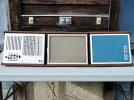
Yeah, it's an interesting contraption, if more than a bit obtuse in its operation. Unlike a typical synthesizer, there's no way to make it play an actual song (or a pre-written composition of your own) unless you're
*REALLY* lucky with the switch settings. Rather, it's supposed to supply a series of quasi-random beeps and boops meant to give you ideas for your own compositions. The light show module added an element of sight to the device, and the amplfiied speaker gave clearer output than the built-in one, but you were still limited to simple square wave sounds (some additional envelopes or other effects could've worked wonders, IMO).
Anyway, the Muse was introduced around the same time as a similar device called the "
Psych-Tone", which was published as a project in the
February 1971 issue of Popular Electronics magazine, and sold as a kit by a company called
SWTPC as seen in their
1972 catalog. Development on the Muse had started earlier, and it was sold as fully assembled, but the price of $300 probably scared many potential buyers away (also, they supposedly limited their advertising to prestigious outlets like Playboy, though I haven't found proof of that as of yet). Even so, it did find its way into the hands of (mostly avant-garde) musicians who appreciated and understood its utility, and Muse music found its way onto certain recordings; the best example I know of is the debut album by the progressive rock supergroup
U.K., where it can best be heard in the middle "By the Light of Day" section of the opening "In the Dead of Night" suite, starting around the 5:28 mark of this video:



 And that's with AlNiCo magnets which I really think makes digital sound less stark, "FROZEN" as Bob Dylan would say.