• The move to the new server is done. There are some software and database maintenance updates in process. This has us passing the hat around to help out. We appreciate any donations. Seriously, even a dollar helps. The payment page may be found here - https://www.audiokarma.org/support.html

Asking for help in modeling a cabinet and port size.

SBB4 alignment should get plenty low for that driver. Aligning the cabinet tuning frequency with the driver's Fs also looks to squash group delay.

 
Chat GPT will likely give you more misdirection than good information. It doesn't know anything inherently, it just scrapes the intertubes and regurgitates what it finds, without regard to accuracy. Stop subcontracting your cognitive function to the Billionaire's Plagiarism Machine®.
Gotcha. What is the recommended process to determine tuning frequency?
 
The driver has an fs of 33hz, which is a good target to aim for in WinISD or HornResp and as Dirty E commented, tuning at the driver fs should Squash group delay.
 
Qts .4 or under, I might lean towards the SBB4, over .4, the subChebyshev alignment will give you some deeper extension. box size can get ridiculous, though. Season to taste.

For this woofer, Mike's 45L tuned to 27 or the 52L I posted (also tuned to 27) gets you about as deep as it's going to get. That's not a ridiculously big box for that much bass, even if the 89dB will want more power.
 
Last edited:
SBB4 alignment should get plenty low for that driver. Aligning the cabinet tuning frequency with the driver's Fs also looks to squash group delay.
What determines if I should choose QB3, SBB4, SC4, EB3 or EB6 "Alignment"? Does choosing one of these just ultimately effect cabinet size, frequency response and SPL at certain frequencies? Or is there an underlying assumption that high and low pass filters will be implemented?
 
Enclosure tuning at Fs is not the goal. It is tuning to Fb that yields maximum results. Anything below Fb will increase Group Delay no matter what.
 
Enclosure tuning at Fs is not the goal. It is tuning to Fb that yields maximum results. Anything below Fb will increase Group Delay no matter what.
I don't quite understand the response. When you say, "Anything below Fb will increase Group Delay no matter what", did you mean to say Fs instead of Fb? I cannot grasp the meaning of the sentence when referring to Fb in the sentence.
 
Sorry for the abbreviated reply. I was quick to answer without time to expand.

Fb and Fs are independent and not necessarily the same value when an enclosure alignment is chosen. SBB4 and the other alignment’s are chosen based on particular mathematical models of the T/S parameters. They each have a different response such as frequency, Group Delay, Passband Ripple, etc. In other words they will each sound differently.

When you chose an alignment such as QB3 and change one parameter, it is now a custom alignment, which is not a bad thing, it is just different than the one chosen by the software.

You typically want a passband with no ripple (no peaking) and smooth roll off on the bottom end. A lot of alignments have a port frequency (Fb) below Fs. However Fs and Fb can be the same, just depends on many factors.

If you have a port/box frequency of 30Hz, then filters such as a high pass at 20Hz will contribute to Group Delay. Adding EQ/PEQ below 30Hz will also add Group Delay.

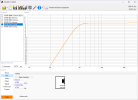
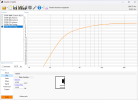
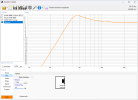
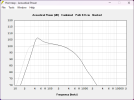
Peaks (Ripple) like the one illustrated below you typically want to avoid unless the peak is benificial to your specific application.

There is no harm in experimenting with port length and tuning, this is how we gain trust in hardware/software and soon, you might be able to predict what an enclosure may sound like before you leave the computer.

Wavecor Peak Example.png
 
Last edited:
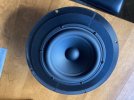
Woofer arrived last night and fits perfectly in my adapter. Now to mount inside my Heresy 1 cabinet. Will test with the 4" port first. Instead of printing a 14" port I'm going to print two 7" ports. One will be exactly like the current one, but with a 51.5 sq cm area. The other half will screw on from the front, sticking out of the cabinet. This will be easier to print than a curved port that will fit inside the cabinet.

I miss the days when swapping parts wasn't as brutal on the old back :(

646f21ff-52ec-49a7-bd79-e21ea1bb1d24.jpg
 
@DLStryker, below are some more simulations to help clarify box tuning and how the tuning frequency and EQ/PEQ work together to give you the desired frequency response curve. The goal in selecting the box size and port tuning is to yield a flat response and low F3 (-3dB point) with as little EQ/PEQ needed.

4.5cu ft/47Hz Tuning, -3dB point is 46Hz.
3070E 4.5cuft_47 Hz Tuning.png

4.5cu ft/35Hz Tuning, very droopy, -3dB point is 60Hz.
3070E 4.5cuft_35 Hz Tuning.png

47Hz compared to 35Hz Tuning. PEQ applied to 35Hz Tuning.
-3dB of 35Hz tuning is now 32Hz.
3070E 4.5cuft_Compare 35 to 47 Hz Tuning with EQ-PEQ.png
 
Will test with the 4" port first. Instead of printing a 14" port I'm going to print two 7" ports. One will be exactly like the current one, but with a 51.5 sq cm area. The other half will screw on from the front, sticking out of the cabinet. This will be easier to print than a curved port that will fit inside the cabinet.
Why not just roll some card stock into a port tube and save on the printer filament for testing purposes?
 
Why not just roll some card stock into a port tube and save on the printer filament for testing purposes?
Have done this, it works well (enough). lots of gigging with black construction paper port extenders in a 4x12. (don't worry about it, ALL the physics was wrong with that cab, but it still got me paid).
 
@DLStryker Don't hesitate to kick me off your thread!

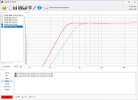
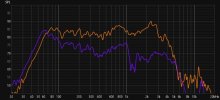
At first, I was REALLY disappointed. Orange is the 3012HO, Purple is the Wavecore. Then I decided to rerun Hornresp with the shorter port. The dark plot shows a similar plot.
Sensitivity is an issue.

WEVCORE.jpg

Screenshot 2026-04-28 111229.png
 
@winglet I tried using poster board but could not get it right. Went ahead and printed a new one overnight and measured.

@DLStryker I'm not sure what you are asking for. The Hornresp plot is the light gray one in post #33.

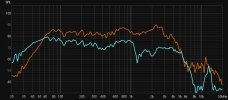
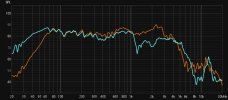
In both images the 3012HO is orange and the Wavecore is blue. In the second image I added 8db to the Wavecore to somewhat match the 3012HO.

With a little boost in the 400Hz area this can easily go to 1khz. This turned out to be a fun learning experience.

WEVCORE.jpg

WEVCORE II.jpg
 
@mboxler would you say that Hornresp was not very accurate at all in simulating the actual results of the Wavecor driver in the Heresy cabinet?

If I understand post 33 correctly, it seems the driver was simulated to be fairly flat to 30Hz. I don't believe the actual results were anywhere near that.

Seems like the Wavecor should not be driven anything above 1K Hz. Doesn't the Heresy woofer to mid cross over somewhere around 800Hz?

Would you say, disregarding the efficiency issue of the Wavecor, the Wavecor performed better than the 3012HO? I realize in your setup, you cannot ignore the efficiency issue. I am driving two Wavecors with a separate sub amp. So, I can compensate.

I still need to build my box and do a listen test. I would be interested in buying your Wavecor if my two sound well. I know consumer shipping prices can often make purchase price plus shipping make the total cost be above the value though.
 
Last edited:
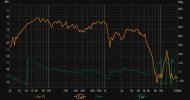
@mboxler, have you confirmed the port tuning frequency? You can use REW for this. Run a sweep with "SPL & Phase" instead of just SPL. The phase will change 180 degrees at the port tuning frequency. It is very easy to see.

Make sure there is no EQ or other filters turned on when measuring this.

Also, can you confirm your port diameter? You have one port 14" long, but I don't see a diameter.
 
Last edited:
@mboxler, have you confirmed the port tuning frequency? You can use REW for this. Run a sweep with "SPL & Phase" instead of just SPL. The phase will change 180 degrees at the port tuning frequency. It is very easy to see.

Make sure there is no EQ or other filters turned on when measuring this.

Also, can you confirm your port diameter? You have one port 14" long, but I don't see a diameter.

Measurement was straight from my amp. However, it's a small class d and there's a chance the 4-ohm woofer requires more current.

Port length is actually 37.26 cm (14.67"). Inside port is 13.4 cm by 4.9 cm. Outside port is 14 cm by 5.68 cm. 18.63 cm of port is inside the cabinet; the rest is outside. If I had printed it orange it would look like Daffy Duck.

Please verify that my port area is 51.50 sq cm. There's always a chance I screwed this up.

I'll measure the actual cabinet later and subtract the area of the port that's inside the cabinet. I'll plug that into Hornresp.


Wavecore III.jpg
 
Port length is actually 37.26 cm (14.67"). Inside port is 13.4 cm by 4.9 cm. Outside port is 14 cm by 5.68 cm. 18.63 cm of port is inside the cabinet; the rest is outside. If I had printed it orange it would look like Daffy Duck.

Please verify that my port area is 51.50 sq cm. There's always a chance I screwed this up.

The math doesn’t math to me

I assume the 4.9cm and 5.68cm is the RADIUS of each port end? (~4” diameter)

Area = pi R^2

4.9 cm end is 75.4 cm^2
5.68 cm end is 101.3 cm^2

An 8 cm DIAMETER port (~3”) will give you your ~51.5 cm^2 area
 
Last edited:
Back
Top Bottom