• The move to the new server is done. There are some software and database maintenance updates in process. This has us passing the hat around to help out. We appreciate any donations. Seriously, even a dollar helps. The payment page may be found here - https://www.audiokarma.org/support.html

Asking for the truth. 6v6gt amp run EL-34 , 6l6GC , 6V6GT

I keep hearing that some of the new Chinese 6sn7 sound pretty good but I can’t get over their price! 12sn7 and even 7n7 are still much better priced. I just got a handful of Brimar 13d1 for $10 a piece from a dealer. Those are 25v *sn7 tubes, the equivalent Brimar 6sn7 (13d2) will be north of 1k if you can find them at all. I’m afraid I’m not a big fan of the current Tung Sol 6sn7 but I wasn’t a huge fan of the RCA either lol. I’m a sucker for early Sylvanias and British 6sn7s.

IF you go down that path just be careful. I have done so quite a few times. Got burned over 50% of the time with tube failures, greatly imbalanced triode sections, etc. For the prices these "premium" chinese tubes are selling at, a person would think their testing and quality criteria would be much tighter than the standard product, but that is not the case.
 
“Serious” audio engineers dumped tubes as soon as they could.
Only because of cost and marketing considerations. I was there when the transition was taking place. Again, you're characterization of vacuum tube audio is incorrect and unsuited to a legitimate discussion in a forum like this. As someone else noted, it wouldn't be wrong to refer to your comments as trolling.
I am all for amps optimized for how they sound as opposed to raw technical performance.
That's the oxymoron of the year. Tube amps become more transparent when they are optimized first for their measured electrical performance. What you're really saying is that you prefer to degrade performance in ways that create distortion or response characteristics that you prefer. That's fine, it's your system, but spinning this in order to claim it's the proper means to optimize an amplifier is dishonest. That's what you're doing.

Jack
 
Only anecdote I can offer here is that i own an amp that I designed the inverter around a 6cg7 tube. The pinout is compatible with a 7au7 or a 6gu7. Ive tried both, it doesn't sound nearly as good with the 6gu7 being the worse of the two. The other amp with the same setup didn't seem to care as much but it was slightly worse with the tubes it wasn't designed for.

A 6gu7 is a 6v 12bh7. 7au7 is a 7v 12au7. 12bh7 are often suggested as a sub for a 12au7. I tried that once too and thought it also sounded worse.
 
6GC7 is a nice, unloved tube. A good current drive.

Just out of curiosity, was the phase inverter a long-tail pair type?

Thanks!
 
Last edited:
Yes, on both amps.

maybe sometime I'll design one specifically around the 6GU7 to see how that comes out. I expect I can get better performance with it biased right, and I also suspect a 6CG7 wouldn't sound as good in that circuit. I got the 6GU7 and the 7AU7 for a dollar each so they'd be nice to come up with a properly good use for.
 
"Optimize" is a word that seems to start forum arguments no matter the subject. Over the years I've been on motorcycle, guitar and bass, photography and forums like this one. If you want to start a argument, toss the word optimize in to a controversial subject.

I personally don't understand amps that claim to be able to use multiple families of power tubes. With my limited experience in building a few amps, I feel the work that goes in to developing a circuit around a particular tube for it to be in its best operating point seems to automatically discount anything that would claim to use multiple tube families with any success. I realize some of these amps have ways to adjust particular parameters, but still, how can a single circuit truly put an EL34 and a KT88 it its best operating point? Output transformers, B+, various associated caps and resistors, feedback. Seems like too much variation.

My first build / rescue was a basket case ST70. Went crazy adding everything that was optional. Ultra linear / Triode switch was one of those things. I tried it a few times and never really understood why people thought anything of triode amps. It sounded much better in UL. Then I built a SET 2A3 amp. It sounds fantastic. My current favorite. The ST70/EL34 in Triode mode does not even come close. It's a waste of a switch and a bunch of extra wiring for nothing. I took it out. I have tried 6L6GC, KT88 and 6550 in my ST70. Sure they all play music reasonably well, but the EL34 / KT77, hands down, sounds the best. It sounds "right", dare I say optimized...

Jack of all trades, master of none comes to mind.
 
The 7AU7 is pretty close to the 12AU7 in electrical characteristics. Right?

I have zero experience with the 6GU7.
 
Yes, on both amps.

maybe sometime I'll design one specifically around the 6GU7 to see how that comes out. I expect I can get better performance with it biased right, and I also suspect a 6CG7 wouldn't sound as good in that circuit. I got the 6GU7 and the 7AU7 for a dollar each so they'd be nice to come up with a properly good use for.
The 7AU7 is pretty close to the 12AU7 in electrical characteristics. Right?

I have zero experience with the 6GU7.
 
I personally don't understand amps that claim to be able to use multiple families of power tubes. With my limited experience in building a few amps, I feel the work that goes in to developing a circuit around a particular tube for it to be in its best operating point seems to automatically discount anything that would claim to use multiple tube families with any success. I realize some of these amps have ways to adjust particular parameters, but still, how can a single circuit truly put an EL34 and a KT88 it its best operating point? Output transformers, B+, various associated caps and resistors, feedback. Seems like too much variation.
Yes! There is more to tube amps than just tubes.

1931a3af-8d80-4ee5-ada9-409a1ad06fe7.gif
 
The 7AU7 is pretty close to the 12AU7 in electrical characteristics. Right?
Identical other than the heater. 3.5v or 7v vs 6.3 or 12.6. Same center tapped heater arrangement, just power it on 4 and 5 and its in 7v mode. 7v will run just fine on a 6.3v supply.

I have zero experience with the 6GU7.
Its a 12BH7 that only runs on 6.3v. Heater wiring is pin 4 and 5, rather than the 12BH7 / 12A*7 setup where its 4, 5, and a center tap on 9.
 
May be I missed the point, but I built an Elekit amp just so I could roll various output tubes. It can handle a wide variety of tubes and sounds good doing it. Auto bias handles everything, just plug'em in and enjoy. Not a cheap kit but very well done with great instructions. This was paramount for me because I do not know circuit analysis much. With this amp I finally heard a EL34. It can handle pretty much any of the KT big bottles, EL34, 6l6, 6v6, etc.
 
IF you go down that path just be careful. I have done so quite a few times. Got burned over 50% of the time with tube failures, greatly imbalanced triode sections, etc. For the prices these "premium" chinese tubes are selling at, a person would think their testing and quality criteria would be much tighter than the standard product, but that is not the case.
Vivatubes tests all the Psvane tubes and gives a 1 year warranty. That moved me to finally buy a Chinese tube.
 
Is it a guitar amp or a hifi amp?
It can be done if you add a transformer to heat the big bottles, or redesign the power transformer but it is not worth the trouble. The 6V6 is a nice sounding tube.
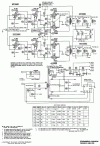
it is a HI-FI stereo p/pl amp this is a very clear schematic thank you for reply
 

Attachments

  • S-C_ASR-120_schem.gif
    S-C_ASR-120_schem.gif
    112.8 KB · Views: 6
if it was specifically designed for the heater current it might work, but an amp designed for a 6V6 is not going to be happy about running the other types.

6V6 needs 0.45 amps to light
6L6 needs 0.9 amps
EL34 needs 1.5 amps

so EL34 tubes will need 3X the heater current just to light, 6L6 need double the current to light.

6V6 tends to run around 300 volts and into about a 10K load. The other tubes generally run more voltage and a lower load. They will work at lower voltages and a higher load but they won't make any more power than a 6V6 did, and may make even less. Kind of a waste really.

Drive signal may be an issue, both an EL34 and a 6L6 will need more voltage to the grid in order to hit full power even at lower voltage

TL;DR, I'll go with probably not.
thank you i had read that it will work but there was no more information . thanks for the reply
 
This topic has come up multiple times. There are basically two camps, either they are imperfect wastes of time or they are a fun way to change the sound of your system. I am firmly in the latter camp.

I have two amps made specifically for rolling different kinds of tubes. Both allow manipulation of b+ to account for tubes as different as 6f6 to kt88. The first amp I got was a Dennis Had Inspire KT88 Firebottle. It is a single ended pentode amp with a regulated screen supply as well as a regulated b+ for the dual triode driver. You can adjust the b+ for the output tubes by using different rectifiers. Use a 5y3 for something like a 6v6 and a 5ar4 or solid state diode for the bigger output tubes. I usually have some sort of 6l6-oid in there (currently a pair of 6ar6) and I use a 5u4gt. I think the maximum b+ you can get with this sort of setup is shy of 350v so you’ll never get the power out of the likes of el34 or kt88 that you could otherwise. Single ended amps aren’t really good for high power in any case IMO.

My other amp is a custom differential push pull that was built for me. No sane person would ever sell an amp like this to the general public but I’m very happy that this madman met a crazy Amp Designer/builder. It uses solid state rectification via a Maidia 21st century regulator. There is a pot allowing me to adjust the b+ between 250v-400v. It is manual bias with individual adjustments for each output tube. In addition I have banana jacks on the back that allow me to use external supplies for the heaters so I can take advantage of all of the cheaper, odd voltage tubes especially for the driver tubes. It uses Monolithic Magnetics 8k output transformers which allow both triode and ultra linear operation.

I am not privy to the feedback mechanisms used in each amp. I’m pretty sure Dennis Had is just a wizard. Single ended pentode operation is tricky in any case but he has made an amazing machine. I am seriously considering getting his parallel SEP version that uses oa3 and the like for regulation duties.

I have never understood why people are hung up on “optimizing” tube amps. Optimizing for what? Max power, lowest distortion, perfect square waves, lowest output impedance? Why are you messing with tube amps at all if those are the kinds of things you’re looking for? The only reason to use tube amps at all is because you like how they sound despite not being optimal amplifiers.

And this is where amps made specifically for rolling tubes shine. What happens when you buy an ST-70 or a Mac and your system sounds worse than before? You’d have to change an entire component of the system to rectify it. Worse still, what if you wanted your system to sound different for different kinds of music? Commence pearl clutching and mumbling that there is only one true way for a stereo system to be enjoyed… Never mind that there are loads of “optimized” amps that sound very different driving different speakers. Which optimized sound do you prefer? Conrad Johnson, Audio Research, Quad, McIntosh? It is so much easier to have one amp you can get different sounds out of.

Most importantly it is just fun to play with different tubes. It is a different way of enjoying the equipment. It is akin to cooking really. It is all done to taste. Tune rolling is an active way to interact with your system. If you like the idea of that then amps made for rolling will give you a lot of enjoyment.

so right you are i have 4 Stromberg Carlson ASR-120 7408 or any 6v6gt family of tubes. they actuality sound great through my Altec Lansing frankestined three way speaker that can handle 100 watts, funny i have used before with only 6v6gta and WOW they can force ya out of the house..now I have a Stromberg Carlson ap-437 Tung-Sol 6550 3225904 40 watts normal- 100 watts instantaneous.... thank you for your valued reply.
 
Last edited:
Only because of cost and marketing considerations. I was there when the transition was taking place. Again, you're characterization of vacuum tube audio is incorrect and unsuited to a legitimate discussion in a forum like this. As someone else noted, it wouldn't be wrong to refer to your comments as trolling.

That's the oxymoron of the year. Tube amps become more transparent when they are optimized first for their measured electrical performance. What you're really saying is that you prefer to degrade performance in ways that create distortion or response characteristics that you prefer. That's fine, it's your system, but spinning this in order to claim it's the proper means to optimize an amplifier is dishonest. That's what you're doing.

Jack
Again, you seem to be missing the point of my posts. I will be as plain as I can. I love tube amps. I prefer the ones that do not try to “optimize” for technical performance. I dislike most of the Macs I have heard in addition to the Quad II, ST-70, a handful of Conrad Johnson, and Audio Research. These are the kind of amps I think of when I think of tube amps that are engineered for technical excellence. Peter Walker claimed that he never listened to the Quad II during development but only relied on measurements. I believe him lol. Despite all of them being well engineered and optimized for technical performance they all sounded different.

To be clear, I don’t think amps made for tube rolling are required to get good sound. I have really enjoyed multiple parallel single ended amps. The Golden Tube Audio SE-40, a set of Audio Mirror amps that used 6as7 outputs, and a cute little 6bl7 output amp all sounded great and could not use other tubes. None of them will ever be held up as examples of ideal technical performance. I guess you can say that they “optimized” their design along some other criteria than perfect square waves and distortion measurements. That is what I mean by optimized for sound quality instead of measurements.

I have never claimed what the “proper” way to optimize a tube amp is and think that people should enjoy what they enjoy. The reason I responded to this topic is because the responses were, as usual, rather one sided. Amps made for tube rolling are simply a different way of enjoying the hi-fi hobby. In addition, I think they present the flexibility to fine tune the sound to compensate for different speakers, rooms, and yes, personal taste. If you like the idea of a flexible system and if you think you’d have fun trying different tubes then getting an amp made for tube rolling can be very enjoyable. If you think that’s stupid then you definitely shouldn’t get one.
 
Only because of cost and marketing considerations. I was there when the transition was taking place.
I will defer to your experience but those McIntosh engineers made it quite clear to me that they were happy to leave the world of tubes behind in order to make better (in their estimation) amplifiers. I have a lot of respect for Mac as a company and Gordon Gow as someone that never compromised on his vision of technical excellence. Their products aren’t my cup of tea but I think they have always been as good as you can get for that kind of amplifier. My only experience with the amp industry was that interaction. The trends of the industry were in line with the attitude I got so I extrapolated that experience to the entire industry. I’d be curious to hear from engineers from the time that wished that the companies would have kept going with tubes.
 
McIntosh still makes tube gear, ya? Tube equipment was kind of the bench mark. When transistors came along some like Marantz, and McIntosh waited a bit before switching to SS until transistor technology got better than the Germanium transistors that were first available. Transistor equipmant had to be able to sound as good as tube equipment. Properly designed tube equipment can sound every bit as good as SS equipment. One of the reasons I prefer tube gear is being able to taylor the overall sound of a preamp or amp somewhat to your personal liking just by using certain brands of a certain tube, or it's equivalent.
 
Back
Top Bottom