

You are using an out of date browser. It may not display this or other websites correctly.
You should upgrade or use an alternative browser.
You should upgrade or use an alternative browser.
Astonishing Sony XDRF1HD Tuner
- Thread starter pbda
- Start date


pbda
Super Member
I've been doing a great deal of listening to this tuner, and have been A/B'ing it against the tuner section in my CR-2040. I've concluded that the Yamaha does have a slight but perceptible edge in sound.
However, even living close to Boston, as I do, there are very few stations that I receive without some noise. The Sony simply has no noise. Thus, whatever advantage my CR-2040 has in terms of sound quality is submerged by the lack of noise on the Sony.
I don't listen to FM for that last tiny bit of sound quality. Lack of noise is vastly more important to me. And on that, the XDRF1HD delivers. It has become "the" tuner in my primary system.
However, even living close to Boston, as I do, there are very few stations that I receive without some noise. The Sony simply has no noise. Thus, whatever advantage my CR-2040 has in terms of sound quality is submerged by the lack of noise on the Sony.
I don't listen to FM for that last tiny bit of sound quality. Lack of noise is vastly more important to me. And on that, the XDRF1HD delivers. It has become "the" tuner in my primary system.

Butchthetiger
Active Member
Sound quality improves with antenna quality just like any other tuna. The HD signal is very small so a better antenna will allow more info and higher quality.
Certainly this is the best sounding $100 tuner of all time and is a good demonstration of the power of DSP tuning.
High end tuners using this technology will shock and amaze many very soon. Don't ask how I know that!
Thanks,
Ron-C
Unfortunately the Sony tuner is not availale in Canada. Hopefully McIntosh will incorporate DSP tuning in it's next tuner model.
Bill

Sir MLS
Active Member
Here is mine in it's new home. No more noisy FM for me. The house I am building is some what visible through the window.
Job site trailer using my DIY tube pre-amp Accurian based integrated and matching semi DIY monitors utilizing Boston Acoustic in wall speakers from a previous remodel for this same client.
Job site trailer using my DIY tube pre-amp Accurian based integrated and matching semi DIY monitors utilizing Boston Acoustic in wall speakers from a previous remodel for this same client.
Last edited:

Hepcat
Well-Known Member
Here is mine in it's new home. No more noisy FM for me. The house I am building is some what visible through the window.
Job site trailer using my DIY tube pre-amp Accurian based integrated and matching semi DIY monitors utilizing Boston Acoustic in wall speakers from a previous remodel for this same client.
Very neat system.
My "travel bag" system is now the Sony tuner, Sonic Impact amp, XM Inno, a 10$ Walmart CD portable, and a Radio Shack tape switcher. Various speakers - including the folding Sonic Impact cardboard speakers if I'm flying somewhere. (Sales flyer from Parts Express now has the SI amp and speakers for under $50.)

chathamdad
Piano Trios Rule
I got mine as a gift from the lovely bride last month and hooked it up Sunday. I have not stopped listening to it since then. Amazing little unit, especially since we have some very good HD stations in the Philly area (commercial-free B-channel content for the most part). I hooked it up to the NAD 3020 that has been subbing for my MAC1500 receiver while it has been out for service. Now I'm in a quandary, as the Mac got back today, and I'm really not in much of a hurry to hook it back up; I'm enjoying the Sony too much, and don't miss the Mac's tuner. Embarrassment of riches, I suppose.

MrIgotNomoney
Well-Known Member
I cant stand it any more...Ordered a Sony XDRF1HD tuner.
My favorite words "out for delivery"
bob
My favorite words "out for delivery"
bob

musichal
poet emeritus
Well, mine came in a few hours ago, and I am delighted with it. Of course, it helped a lot having so much input on AK and knowing what to expect. More than that, AK is where I heard of this little Sony gem, and learned something about HD radio. So thanks to all you guys for spreading the word about this, and describing its functions so well.
My impressions: AM is crappy, but I don't really care. It's an FM RF champ for ninety bucks delivered, and that's just the analog performance. Sensitivity and selectivity are truly awesome. What I've found is that I now have more jazz to listen to in Beaumont thanks to KVLU's 2nd digital broadcast, plus they have some rock on 3. KVLU is a college/NPR station. On top of that, I'm getting more classical via an analogue station in Houston (about ninety miles away - the town, I don't know the station's location), that just isn't there on my other tuners. There are some other distant stations that are listenable as well, of which I had been unaware.
Sound quality is actually very good, and more dependent upon RF performance and broadcast/compression issues than with the output of the unit itself. That said, however, there is some room for improvement, which makes me curious about some of the various modifications that have been pointed out in previous posts.
All the above is based upon the Sony's performance using the included dipole antenna taped to the wall in the only spot I'm willing to put it, behind a bookcase. Therefore, it's doing a pretty darn good job with no optimization of placement of a very modest antenna. Hard to fault.
In addition to previously noted issues such as power back-up, inability to force analogue, ultimate sound quality issues, etc...I wish Sony had made the forty presets assignable to either band rather than 20/20. However, I don't feel cheated at all for the price I paid; I have paid a lot more in years past for tuners that won't do what this one does analogue-wise, and can't do the digital. Get one!
My impressions: AM is crappy, but I don't really care. It's an FM RF champ for ninety bucks delivered, and that's just the analog performance. Sensitivity and selectivity are truly awesome. What I've found is that I now have more jazz to listen to in Beaumont thanks to KVLU's 2nd digital broadcast, plus they have some rock on 3. KVLU is a college/NPR station. On top of that, I'm getting more classical via an analogue station in Houston (about ninety miles away - the town, I don't know the station's location), that just isn't there on my other tuners. There are some other distant stations that are listenable as well, of which I had been unaware.
Sound quality is actually very good, and more dependent upon RF performance and broadcast/compression issues than with the output of the unit itself. That said, however, there is some room for improvement, which makes me curious about some of the various modifications that have been pointed out in previous posts.
All the above is based upon the Sony's performance using the included dipole antenna taped to the wall in the only spot I'm willing to put it, behind a bookcase. Therefore, it's doing a pretty darn good job with no optimization of placement of a very modest antenna. Hard to fault.
In addition to previously noted issues such as power back-up, inability to force analogue, ultimate sound quality issues, etc...I wish Sony had made the forty presets assignable to either band rather than 20/20. However, I don't feel cheated at all for the price I paid; I have paid a lot more in years past for tuners that won't do what this one does analogue-wise, and can't do the digital. Get one!
chathamdad
Piano Trios Rule
I think they are going to sell a bazillion of these things.


crooner
Tube Marantzed
LOL!
Sony must be surprised with the demand.
They are probably kicking themselves for not marking it $200 or more instead.
I wouldn't be surprised if they release the "ES" version of it this year.
It's BPC, but heats up nicely like a tube amp!!
(the odor BTW, disappears after a few hours of use)
Sony must be surprised with the demand.
They are probably kicking themselves for not marking it $200 or more instead.
I wouldn't be surprised if they release the "ES" version of it this year.
It's BPC, but heats up nicely like a tube amp!!
(the odor BTW, disappears after a few hours of use)
pbda
Super Member
The power of word of mouth! Are you guys all working for Sony? Why all the hype for this bpc? (I' m not sure it's black).
1. No.
2. Because it's cheap and it performs freaking well.
3. Sadly, it is black, but then there's always spray paint.

pbda
Super Member
I just got mine and while I do like it, especially for the money, I don't think it outperforms my Marantz 2245.
That surprises me. In terms of selectivity, sensitivity and lack of noise, the Sony outperforms my 2270, 2385 and 2600 tuners, all of which have been serviced in the past year by techs whom I trust.

dnewma04
The Healer
That surprises me. In terms of selectivity, sensitivity and lack of noise, the Sony outperforms my 2270, 2385 and 2600 tuners, all of which have been serviced in the past year by techs whom I trust.
Agreed. In those areas, it outperformed a Crown FM1, Kenwood KT-9900, Sansui TU-717, Sanyo Plus T55, ADS T2, Mcintosh MX-114, and a Soundstream T1. Each of which are better in those areas than any receivers I've owned including SX-1010s, G-9700s, Technics SA-5770 (best tuner i've found in a receiver to date), amongst a few others including a 2270. If someone came in with a Sansui TU-X1 or a Kenwood L-02T with the same claims, I'd lean slightly towards believing them.

Mod and compare
Mod time.
I went over to my buddy Walter's house today. Walter is a no BS highend audio engineer. Most of his gear is home brewed, in fact he used to perform custom services for people designing and building various components.
His main system has 3 Bryston amps triamped with home brew speakers. The preamp is also of his own design.
After hearing my Sony HD tuner he was intrigued so he bought one for himself. Then he proceeded to perform some of the mods described at:
http://www.ham-radio.com/k6sti/xdr-f1hd.htm.
Today's mission was to compare his modded Sony to my stock one.
His had two major mods - tweaking the bias on the output transistors so they operated at a slightly higher voltage and the removal of 4 capacitors (C11, C12, C21, C22) whose function is described here from the original article:
Right away we could detect a difference. Not night and day but a noticeable difference. It sounded like the stock unit was duller, like a veil was over the speakers. He described it like looking out of a slightly dirty window; I thought it sounded like after drinking a beer (out of a slighty dirty glass). No surprise since the capacitor removal mod as describe results in a restoration of the treble frequencies as shown in the graph below:

Into the shop we went with my stock unit to remove the 4 caps. These are quite small but not a problem to remove with a small tipped iron (we left the 100 watt gun on the shelf) and a solder sucker. The locations (and labels) are shown in the picture below:
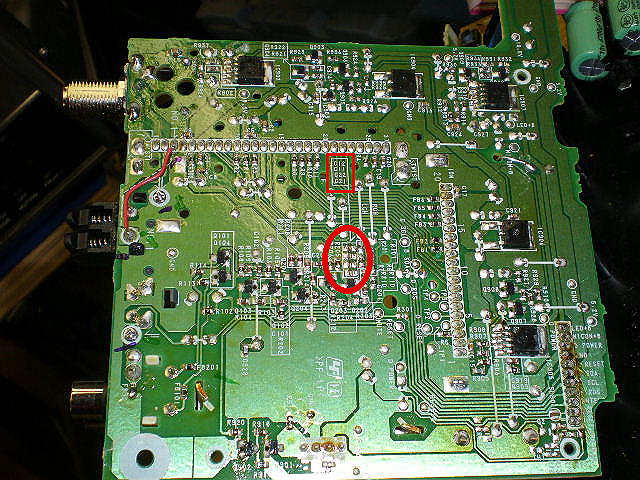
After that mod we went back to the listening room to compare. At this point we noticed that my unit sounded essentially the equal of his unit. Also my unit now had a similar output level. Not quite identical, but very close. I still thought that his sounded a little better but wasn't sure if it was a result of the other mods or because the levels were slightly different. Generally the louder unit will sound better and I'm guessing that his mods resulted in the slight difference.
Bottom line is that if you have the skills, tools and inclination I heartily recommend the removal of the 4 caps.
JimB
Mod time.
I went over to my buddy Walter's house today. Walter is a no BS highend audio engineer. Most of his gear is home brewed, in fact he used to perform custom services for people designing and building various components.
His main system has 3 Bryston amps triamped with home brew speakers. The preamp is also of his own design.
After hearing my Sony HD tuner he was intrigued so he bought one for himself. Then he proceeded to perform some of the mods described at:
http://www.ham-radio.com/k6sti/xdr-f1hd.htm.
Today's mission was to compare his modded Sony to my stock one.
His had two major mods - tweaking the bias on the output transistors so they operated at a slightly higher voltage and the removal of 4 capacitors (C11, C12, C21, C22) whose function is described here from the original article:
Each D/A drives a ferrite bead and shunt capacitor within the tuner module. The module drives cascaded RC filters on the motherboard. The filters remove low-level (−47 dB) ultrasonic noise that extends to a few MHz, but they also cause the frequency response to droop within the audio passband. Disabling the filters by removing their capacitors flattens the response as shown above and causes no interference to AM or FM reception. The preceding photo identifies filter capacitors C11, C12, C21, and C22.
First thing we noticed was that the modded unit had a slightly lower output level so we had to compensate our comparison tests by adjust the level when we switched back and forth.Right away we could detect a difference. Not night and day but a noticeable difference. It sounded like the stock unit was duller, like a veil was over the speakers. He described it like looking out of a slightly dirty window; I thought it sounded like after drinking a beer (out of a slighty dirty glass). No surprise since the capacitor removal mod as describe results in a restoration of the treble frequencies as shown in the graph below:
Into the shop we went with my stock unit to remove the 4 caps. These are quite small but not a problem to remove with a small tipped iron (we left the 100 watt gun on the shelf) and a solder sucker. The locations (and labels) are shown in the picture below:
After that mod we went back to the listening room to compare. At this point we noticed that my unit sounded essentially the equal of his unit. Also my unit now had a similar output level. Not quite identical, but very close. I still thought that his sounded a little better but wasn't sure if it was a result of the other mods or because the levels were slightly different. Generally the louder unit will sound better and I'm guessing that his mods resulted in the slight difference.
Bottom line is that if you have the skills, tools and inclination I heartily recommend the removal of the 4 caps.
JimB

Agreed. In those areas, it outperformed a Crown FM1, Kenwood KT-9900, Sansui TU-717, Sanyo Plus T55, ADS T2, Mcintosh MX-114, and a Soundstream T1. Each of which are better in those areas than any receivers I've owned including SX-1010s, G-9700s, Technics SA-5770 (best tuner i've found in a receiver to date), amongst a few others including a 2270. If someone came in with a Sansui TU-X1 or a Kenwood L-02T with the same claims, I'd lean slightly towards believing them.
I've got a TU-X1 and the Sony. Plus many other tuners coming through here all the time. The Sony is very quiet, desent fidelity, very good selectivity. Senitivity is decent. In real world test with my APS 13. I had the same or worse issue with the Sony trying to get my DX'ing test stations. I've had better DX'ers. An for fidelity it's no TU-X1. However at its price, it's a no brainer.
chathamdad
Piano Trios Rule
I think I'll stick with internet radio for now, the stations I listen to are 128, 160 and 256 Kpbs...
Its certainly hard to argue with that observation, at least as far as the bitstream is concerned. But sonically, the Sony HD tuner produces sound that is, to my ears, less fatiguing, less edgy and more ambient than the music I stream over internet radio. Maybe I'm imagining it. No question that internet radio certainly affords more variety, but there is something about pulling in sound this good over the free airwaves that makes it seem like more of an accomplishment.