• The move to the new server is done. There are some software and database maintenance updates in process. This has us passing the hat around to help out. We appreciate any donations. Seriously, even a dollar helps. The payment page may be found here - https://www.audiokarma.org/support.html

Au-717: left channel clips just before full power

Ray Gianelli

AK Subscriber
Subscriber
I took in an AU-717 to do the Leestereo upgrade on. Preliminary testing revealed that the left channel clipped before full power:
Clipping.jpg

I thought that the rebuild would cure this issue, but it remained even after doing the filter caps and output modules.

After doing some comparison between the properly functioning right channel and the malfunctioning left it appeared that the DC was sagging more in the left than the right.

I discovered that one of the fuses on the secondaries was blown. Replaced it and powered up on the DBT, which glowed brightly. Power off resistance testing finally revealed one of the diodes for the output stage was shorted:
PR diode pack.jpg

It's amazing how well this stuff can work with a failure like this. I mean, it could have been like this for years and no one would notice!

Now to find a suitable replacement. Think I'll replace its brother too, since it may have been stressed by supplying all the load.
 
Register to hide this ad
That's an unusual failure - but well found! - 'top hat', plate mounted rectifiers like that are unobtanium I think, thankfully there are alternatives. ;)
 
That's an unusual failure - but well found! - 'top hat', plate mounted rectifiers like that are unobtanium I think, thankfully there are alternatives. ;)
John what would you recommend? I'm thinking 1,000V 5A diodes, but I'm certainly open to suggestions.
 
I think the originals are something like 200V @5A - no need for them to be 1000V - there are plenty of choices for 200V 6A wire ended rectifier diodes (source - Mouser).
OR,
You could mount stud rectifiers on the original plate (after removing the old ones), but the clearance may be a bit tight for the height of a stud rectifier.
OR,
You could find a TO-220 dual rectifier (of the correct polarity configuration) and mount that on the plate? (something like MUR1620CTG and MUR1620CTRG but these are 16A = overkill & - Mouser = nil stock at present).

I would be inclined to replace the whole bridge (4 rectifiers) with whatever you settle on.

Just a few ideas to think about. ;)
 
Last edited:
I think the originals are something like 200V @5A - no need for them to be 1000V - there are plenty of choices for 200V 6A wire ended rectifier diodes (source - Mouser).
OR,
You could mount stud rectifiers on the original plate (after removing the old ones), but the clearance may be a bit tight for the height of a stud rectifier.
OR,
You could find a TO-220 dual rectifier (of the correct polarity configuration) and mount that on the plate? (something like MUR1620CTG and MUR1620CTRG but these are 16A = overkill & - Mouser = nil stock at present).

I would be inclined to replace the whole bridge (4 rectifiers) with whatever you settle on.

Just a few ideas to think about. ;)
Thanks John. I did some more research since posting, and I came up with a post that Echowars answered. Glenn recommended 600V 5A diodes, and did confirm that the SS-03 is 200V but 3.5A:

D601 and D602? My manual says SS5N and SS5R for D607 and D608, and SS3N and SS3R for D601 and D602. The SS3 is rated at 3.5A continuous, and the SS5 is rated for 5A continuous. Both are rated for 200V.

You can replace with individual diodes, but I'd want them rated for 5A. And you'll have to run an appropriately sized wire from cathode-to-cathode on D601 and anode-to-anode on D602 (to replace the conduction path lost when you pull the big dual-diode assembly from the board).

Can use the STTH5L06RL 5A 600V diode from Mouser. Part number 511-STTH5L06RL. Do not mount flush...leave some room for cooling.


I did plan on replacing all 4; that's what I meant when I said I'd replace its brother too. I was referring to the other dual diode. I thought I'd used the 1,000V ones simply because I think I have some.
 
Last edited:
Hi I successfully used PR6005-T (DigiKey has them) those are 6A 600V. May be there is a way to use existing frame with your new diodes. Just cut the existing diodes from the arch drill the hole to fit the lead of your new install and solder it to the frame. This way it would retain original look ?? Nice diagnosis by the way. But i am surprised that it worked at all as the fuse should have been blown every time
 
Last edited:
Hi I successfully used PR6005-T (DigiKey has them) those are 6A 600V. May be there is a way to use existing frame with your new diodes. Just cut the existing diodes from the arch drill the hole to fit the lead of your new install and solder it to the frame. This way it would retain original look ?? Nice diagnosis by the way. But i am surprised that it worked at all as the fuse should have been blown every time
I wondered how it was working too. Looks like it was functioning with half wave rectification on one side. But it clipped symmetrically, which doesn't make sense to me.

I didn't have a chance to check the other 2 diodes yet, although they looked OK in circuit. I discovered this right before I had to leave for work.

EDIT: the other 2 were fine.
 
Last edited:
Hi I successfully used PR6005-T (DigiKey has them) those are 6A 600V. May be there is a way to use existing frame with your new diodes. Just cut the existing diodes from the arch drill the hole to fit the lead of your new install and solder it to the frame. This way it would retain original look ?? Nice diagnosis by the way. But i am surprised that it worked at all as the fuse should have been blown every time
I thought using the old frame was a good idea. At least I did until I had to drill out the old diodes. That was a real pain, so much so that I finally bit the bullet and bought an inexpensive drill press from Harbor Freight. Long overdue.

I got 400V 6A diodes from Mouser and put them in the old frames, one common anode and one common cathode. They looked like this when mounted:
20201014_181257.jpg
Diodes were cheap enough, about 33 cents a piece when you buy 10. Fuses were over 2 bucks! Gotta find a better source for fuses.

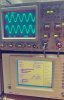
New diodes fixed the left channel clipping issue:
20201014_204010.jpg

Baby cranks out 100 watts/channel, albeit with higher distortion. But that distortion would still be inaudible, well below 1%.

One of the things I enjoy about working on this stuff is no matter how long you've been doing it you can still be surprised. Like by this trouble. Helps keep it fresh and keeps me on my toes!
 
I thought using the old frame was a good idea. At least I did until I had to drill out the old diodes. That was a real pain, so much so that I finally bit the bullet and bought an inexpensive drill press from Harbor Freight. Long overdue.

I got 400V 6A diodes from Mouser and put them in the old frames, one common anode and one common cathode. They looked like this when mounted:
View attachment 2007745
Diodes were cheap enough, about 33 cents a piece when you buy 10. Fuses were over 2 bucks! Gotta find a better source for fuses.

New diodes fixed the left channel clipping issue:
View attachment 2007746

Baby cranks out 100 watts/channel, albeit with higher distortion. But that distortion would still be inaudible, well below 1%.

One of the things I enjoy about working on this stuff is no matter how long you've been doing it you can still be surprised. Like by this trouble. Helps keep it fresh and keeps me on my toes!
So here's a coda to this story. After replacing all 4 bridge diodes it tested good. A few days later I was running it up to full output again after rebuilding another board in this unit, and the damn thing clipped again on the repaired channel. I couldn't believe it... the diodes I replaced are rated at 6 amps, the originals were 3.5.

I powered it down and checked the diodes, which were fine. Then I checked the fuses, and one of them was, well, not blown but not good. I remembered that I didn't have any more 7 amp fuses, so I robbed one out of a particularly grungy unit I'd bought for rebuild. The fuse had corrosion on the end caps. I'd received 7A fuses with my last Mouser order and popped one in. That was it.

Funny it worked at first, but corrosion can do funny things that way.
 
I know this is an old thread, but I’m working on a Layfsyette LR 5555 right now with a similar issue. I cleaned it thoroughly and decided to try it while I waited for my replacement power supply caps. It worked ok but seemed a bit anemic. I replaced the caps yesterday and then checked the voltage on the rails afterwards. I had -42vdc and +52vdc. So after disconnecting everything from the power supply I rechecked with the same voltage readings. I pulled the SS5 and SS5R rectifiers and tested them with my meter. They didn’t show bad but with a mere 2-3 V for testing it can’t catch leaking at higher voltage levels. I ordered a couple replacement kits from eBay.
 

Attachments

  • IMG_6232.png
    IMG_6232.png
    131.2 KB · Views: 11
Back
Top Bottom