Either of the TO3p options is fine. The ON parts are in stock here:
https://www.arrow.com/en/products/search?cat=&q=njw3281&r=true
https://www.arrow.com/en/products/njw1302g/on-semiconductor,
and Arrow still has the driver transistors 2SC4883A/2SA1859A (keep in mind that these have insulated tabs so it a bit more involved to use them in the AU-919 which uses the metal tab as a connection).
Digikey still has the Sanken pair 2C6145A/2SA2223A, if you want to use them as outputs. Please don't forget to ask them to sell you all Y rank or all O rank. Otherwise they may send you some Y and some O.
You may choose the 2SA1011/2SC2344 from Amplabs and the power transistors from either Arrow or Digikey, or you could go all with Arrow.
Important notes about mounting new outputs:
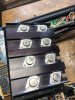
If you use the TO-3p parts in the AU-919, you will see that in order for them to fit in place you will have to saw a corner of the transistor tab. No big deal with this, as long as you cut with a saw and file the cut after. Please avoid clipping it with wire cutters as this will bend the metal tab of the transistor in detriment of a good thermal contact with the heat sink.
There is an issue with the leads and the socket type of the AU-919.
Echowars posted about this here, and mentioned about why one should care about insulating the E and B pins from the heatsink. Member
Ilimzn in a Croatian audio forum was the first to addapt the TO-3p parts in the AU-919.
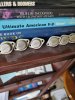
The B and E leads of the transistors could be bent into the holes, but you will have to insulate them very carefully (preferentially with a teflon sleeve). Alternatively, you can adapt pins and cut the legs like
Hyperion did when he used these transistors in a BA-F1. Note that the design of the heatsink in the BA-F1 is different and John did not need to cut the corner of the transistor tab.
There are other pins that you could use
(these, for example will fit snugly in the socket, but require an insulation), and drilling a hole in the wide part of the transistor lead, and passing through a pin, or a suitable copper wire, and using an insulation sleeve.