• The move to the new server is done. There are some software and database maintenance updates in process. This has us passing the hat around to help out. We appreciate any donations. Seriously, even a dollar helps. The payment page may be found here - https://www.audiokarma.org/support.html

Audio Technica AT-LP120-XUSB Review

knotscott

Super Member
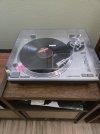
The AT-LP120XUSB is an updated 2017 offering of the former AT-LP120. Not exactly a revered high-end turntable in audiophile circles, but it does have some merit. Some feel that it's a cheapened plasticky version of the LP120, but it still weighs a respectable 17 pounds, and offers some significant upgrades over the original that lend themselves to better sound. The tonearm and drive method are unchanged, and are identical to those on the LP140XP. The most significant improvement is the built in phono preamp....it's been upgraded with a defeatable switch and is no longer an issue as was the preamp on the former LP120. It can still also be plugged into an outboard phono preamp of your choice, but now with no degradation of sound due to problems with the built in phono stage. Possibly of equal significance, is the new stock AT-VM95E elliptical cartridge. It's not only a nice upgrade from the former AT-95E, but there are three impressive full diamond shank ("nude") stylus upgrades that are plug and play replacements - 1. VMN95EN (nude elliptical- $99), 2. VMN95ML (nude microline- $149), 3. VMN95SH (nude shibata - $179). The stock VM95E is a great value in a very good cartridge, but the step up to either of the nude shank options is significant....especially the line contact ML or SH shapes, which should definitely be getting more discussion in audiophile circles. The LP120XUSB also includes the new AT-HS6 headshell. The problematic vertical tracking angle adjustment has been removed in the 120XUSB. It also offers a new lower torque motor that's quieter....not DJ material, but is a non-issue that's actually a plus for listening purposes. Other upgrades include external RCA jacks for easy removal and replacement with upgraded interconnects....another significant change. Add an outboard power supply, and the new AT-120XUSB has the makings to become a very respectable performer.

Years ago I sold my excellent AR-ES1 with Premier MMT tonearm and Grado Signature 8 cartridge, and have been wanting to get back into vinyl ever since. I'd been researching most of the usual suspects in the sub-$500 price range (Fluance, Rega, U-Turn, Project, A/T, used, etc. ). My Lazarus Cascade Basic preamplifier was acting a bit finicky so I wanted built in phono pre-amp "just in case". I also liked the idea of ripping files from vinyl, so the USB output had some appeal. A removable headshell was a must. I was a bit skeptical about going with a direct drive table, but read several convincing articles that it would not pose an audible problem (and it didn't). Flush with some birthday cash from my kids, an open box deal on the AT-LP120X for $140 prompted me to take the leap. My first move was to add the wonderful AT-VM95SH nude shibata stylus upgrade. Next was a new set of decent RCA interconnect cables. Then I added a cork/rubber slip mat to replace the flimsy stock felt mat, and a Brutus record clamp/weight. Always wanting to optimize my system, I sprayed several heavy coatings of flex seal under the platter to add mass and help dampen vibration....it's not necessarily a recommended move, but it takes the AT-120XUSB a step closer to the AT-140XP, which comes with a factory applied undercoating. I also added some lead grip tape around the counterweight to move it's mass closer to the pivot point, then added some orthodontia rubber bands along the arm to help reduce any resonances. My AT-120XUSB now had the bones to be a top notch performer in a fairly evolved audio system. Once a turntable reaches a level where it can spin the platter at a constant speed, isolate vibration and noise, and allow the cartridge to transmit information accurately and cleanly through the tonearm, there's not a lot more it needs to do, but get out of the way.

In a nutshell, this humble turntable and cartridge have far exceeded expectations and sounds amazing. The features are great and function exactly as they should. The built in preamp is acceptably good for those with only line level inputs, but is no match for my freshened up Lazarus preamp phono stage, and likely many other good after market phono stages. The VM95SH shibata stylus is top notch for it's price range, and I continue to be awestruck at the level of performance I'm getting from it. Every upgrade Audio Technica made to the LP120XUSB is a nice improvement that offers the opportunity to make it sound better. The stock cartridge and configuration is really good, and should satisfy most people perfectly well. The low price point allows for some pretty significant stylus upgrades that ultimately offer "next level" performance. A few of the aforementioned tweaks and accessories, and you've got yourself a very low cost hot rodded setup. I've been fortunate to have owned and been exposed to some outstanding (and expensive) turntable based audio systems. There are certainly "better" more prestigious tables and cartridges on the market, but they tend to cost A LOT more money, and offer diminishing performance returns. The LP120XUSB offers a lot of performance for ~ $250, and even more with every incremental stylus upgrade. The tweaks are optional, but I'd at least spring for the cork/rubber mat and preferably a record weight too.

I flat out love the sound I'm getting with VM95SH, and couldn't be more pleased with my expenditure.

For those interested, here's a blog from Audio Technica about the differences and similarities of the LP120USB, LP120XUSB, and LP140XP. https://blog.audio-technica.com/aud...hat-are-the-differences-between-these-models/
 

Attachments

  • 000_3583.2.jpg
    000_3583.2.jpg
    276.2 KB · Views: 54
Last edited:
Register to hide this ad
I got a really good deal on a LP-1240 and have been happy with it so far.
I do like the VTA adjustment. I might have gone for the LP-120 back then if the new changes had been made then. I just wish I could find an auto lift that would fit these decks that aren't so $$.
 
I bought an AT-LP120XUSB last August mainly to add 78 rpm play to my system. I, too, have been pleasantly surprised by the sound I'm getting from this modestly-priced turntable even with lp's. I think it's a fine-sounding player without doing any modifications, though I also did a stylus change right away, switching to the VMN95C conical stylus. It sounds great, and I'm more comfortable using a conical instead of an elliptical at 2 grams or more tracking force. Also, the arm is not level when playing a record with the stock cartridge body and mat, sloping down a bit from the arm mount to the headshell. Conical styli are more forgiving of slight errors in alignment, SRA, and azimuth than the more advanced shapes are.

Out of curiosity I recently mounted up a Sumiko Oyster cartridge (also a .6 mil conical) that had been lying around in a drawer for the last five years and am finding it a nice upgrade (dynamics, resolution, timbre). I now use the stock cartridge with a 78 rpm stylus and the Oyster on another headshell for lp's and 45's.
 
... Also, the arm is not level when playing a record with the stock cartridge body and mat, sloping down a bit from the arm mount to the headshell. Conical styli are more forgiving of slight errors in alignment, SRA, and azimuth than the more advanced shapes are. ...

Adding a slightly thicker cork/rubber mat seemed to help dial in the angle on mine. The stock felt mat is pretty thin and doesn't offer much damping or static resistance. Happy listening!
 
. . . Happy listening!
Listening has been getting quite happy indeed with the inexpensive LP120XUSB. Since mounting up the Sumiko Oyster, and when time permits, I've had a number of sessions where I happily spin one record after another for several hours at a stretch, always anxious to explore what the next album has to offer--to me, that's a sign that a source component is doing all I can expect of it. Pace, rhythm, dynamics, resolution even of low-level background singers and instruments, and separation of instrumental lines are all done at a surprisingly high level by this cheap combination.

The genre doesn't seem to matter. This morning I've enjoyed such varied musical fare as Wandering with the Obernkirchen Children's Choir, the Jean Redpath album Frae My Ain Countrie, Al Hirt's Horn A-Plenty (arranged and conducted by Billy May), and Bach's violin concerto in G minor, and only a telephoned invitation from friends has put an end to today's listening session.
 
then added some orthodontia rubber bands along the arm to help reduce any resonances.

I am curious to know how you spaced these rubber bands and how many you used per space. Also, did you happen to notice any improvements in the sound? I'm generally curious about this approach but don't know enough about it.
 
There are maybe 7 or 8 rubber bands on there. It wasn't very scientific....just spaced a few in random places. Around the same time I added the rubber bands, I also made a few other minor enhancements. I highly doubt a small change such as just the rubber bands would be very audible by itself, but as part of several steps, it can definitely be audible. All told, I upgraded the cables, added a cork/rubber mat, added weighted grip tape to the counterweight so I could move it closer to the pivot point. I also coated the underside of the platter with Flex-seal, lined the inside of the plinth with plasticine, added a record weight, and set the whole thing on sorbothane feet. These tweaks combined help damp resonances and isolate vibration to bring a modest TT up a notch or two. None of them are ground shaking improvements, but for SQ, doing them is better than not doing them (sort of like removing water spots from glass....how many does it take to make a notable improvement?). I will say that these mods combined don't make as significant of a difference as upgrading the stylus to the VMN95SH shibata, but considering the modest cost and effort required, I'm glad I pursued them.
 
Last edited:
There are maybe 7 or 8 rubber bands on there. It wasn't very scientific....just spaced a few in random places. Around the same time I added the rubber bands, I also made a few other minor enhancements. I highly doubt a small change such as just the rubber bands would be very audible by itself, but as part of several steps, it can definitely be audible. All told, I upgraded the cables, added a cork/rubber mat, added weighted grip tape to the counterweight so I could move it closer to the pivot point. I also coated the underside of the platter with Flex-seal, lined the inside of the plinth with plasticine, added a record weight, and set the whole thing on sorbothane feet. These tweaks combined help damp resonances and isolate vibration to bring a modest TT up a notch or two. None of them are ground shaking improvements, but for SQ, doing them is better than not doing them (sort of like removing water spots from glass....how many does it take to make a notable improvement?). I will say that these mods combined don't make as significant of a difference as upgrading the stylus to the VMN95SH shibata, but considering the modest cost and effort required, I'm glad I pursued them.

Thanks for the quick reply! And as @Wolverine said, thank you for the detailed review -- super helpful. I've been upgrading my lp120xusb as well based on various advice on here (upgraded to a rubber mat and a VMN95ml stylus for starters). Lately, I've been getting stuck on some of the minor details (e.g., like how to properly set anti-skate, equal to VTF or not). One big one for me lately is VTA. The rubber mat I bought is 2.3mm thick, and I think the felt mat is 2.7mm, so I got curious about the tonearm angle and it seems like it's really pointed downwards. I've been wondering if I should stack two rubber mats to fix this or just ignore it. I got in touch with AT and they said that I shouldn't go much thicker than 2.3, which I felt was surprising. So, I don't know.
 
Last edited:
Thanks for the quick reply! And as @Wolverine said, thank you for the detailed review -- super helpful. I've been upgrading my lp120xusb as well based on various advice on here (upgraded to a rubber mat and a VMN95ml stylus for starters). Lately, I've been getting stuck on some of the minor details (e.g., like how to properly set anti-skate, equal to VTF or not). One big one for me lately is VTA. The rubber mat I bought is 2.3mm thick, and I think the felt mat is 2.7mm, so I got curious about the tonearm angle and it seems like it's really pointed downwards. I've been wondering if I should stack two rubber mats to fix this or just ignore it. I got in touch with AT and they said that I should go much thicker than 2.3, which I felt was surprising. So, I don't know.

Trust your ears for VTA. 0.4mm is pretty small difference, but that doesn't mean it's not audible. VTA is more critical with the ML and SH profiles. You can always use something as a shim to vary the mat thickness, or you can literally shim the cartridge to adjust the angle.
 
Thanks for the quick reply! And as @Wolverine said, thank you for the detailed review -- super helpful. I've been upgrading my lp120xusb as well based on various advice on here (upgraded to a rubber mat and a VMN95ml stylus for starters). Lately, I've been getting stuck on some of the minor details (e.g., like how to properly set anti-skate, equal to VTF or not). One big one for me lately is VTA. The rubber mat I bought is 2.3mm thick, and I think the felt mat is 2.7mm, so I got curious about the tonearm angle and it seems like it's really pointed downwards. I've been wondering if I should stack two rubber mats to fix this or just ignore it. I got in touch with AT and they said that I shouldn't go much thicker than 2.3, which I felt was surprising. So, I don't know.
For antiskate, I follow Soundsmith's advice to use the wide space in the groove at the runout area of a record, and set anti-skate so that the arm moves slowly toward the spindle (until, of course, the groove wall catches up with the stylus and drives it quickly toward the spindle). On my sample of the LP120XUSB, this resulted in an anti-skate setting of 0.75 for a 2.1 gram downforce with the AT-VM95C cartridge (preferring conical styli, I bought a VMN95C stylus at the same time as the turntable and never used the stock VMN95E). For the Sumiko Oyster cartridge I switched to, antiskate is just shy of 1.0 for the recommended 2.3 gram VTF.

https://www.sound-smith.com/faq/how-do-i-adjust-anti-skating-my-cartridge

Other than the cartridge change, my LP120XUSB is still stock, though I've always had it placed on an isolation platform from Custom Woodwork and Design (bought in 1985 from my Linn dealer), and I use the phono stage in my Audio by Van Alstine preamp.

I mentioned what the Oyster upgrade did for me earlier in the thread, but got to re-live it recently when I had to wait six weeks for a new shipment of Oyster styli to arrive. While I wasn't unhappy playing the VM95C again, the Oyster makes quite a difference, with tighter, better defined and more tuneful bass, improved dynamics (both the impact of crescendos and the resolution of subtle dynamic contrasts), and making low-level background instruments and vocalists much easier to identify and follow. Music is more compelling because it's easier to hear what all the performers are doing.

For those of you who have experimented with rubber bands, mats, etc., can you describe what kinds of sonic changes you heard?
 
I bought an AT-LP120XUSB last August mainly to add 78 rpm play to my system. I, too, have been pleasantly surprised by the sound I'm getting from this modestly-priced turntable even with lp's. I think it's a fine-sounding player without doing any modifications, though I also did a stylus change right away, switching to the VMN95C conical stylus.
Apologies for intruding on an old thread for my first post, but I just bought this turntable myself along with the AT-VM95SP/H Turntable Headshell/Cartridge Combo Kit because I am also going to use it primarily (well, probably entirely!) for 78s. My main turntable for modern records is a Sony PS-X75 with an Audio-Technica AT-440MLa.

I think that anyone just looking to play 78s is going to be very happy with this turntable, but I want to digitize my collection, which includes some older discs that run at oddball speeds, and I have a related concern with this deck. While the built-in stroboscope shows the 78 speed to be pretty solid (so it's doing what it's built to do), multiple stroboscopic discs show that it's not quite running at the official 78.26 speed that's standard in 60Hz regions. It's just a tiny bit slow.

So I'm wondering if anyone knows what this model's 78 speed really is down to two decimal places. I used the Android RPM app running on a Pixel 6a, which measured 78 as bouncing between 77.8 and 77.9, but I have no idea if that app or the phone are up to the task, though that test does line up with the slight slowness that the stroboscopic disc shows.

Does anyone out there know exactly what speed to two decimal places 78 really is on this thing? For the purposes of digitization, I'm more interested in consistency than accuracy. That is, as long as the quartz lock is really locking onto a particular speed, I'm perfectly happy to make fine adjustments in software as part of my process. I normally do that anyway for some of the older records that need 76.59 or 80.

I did a test run yesterday with a Victor acoustic that theoretically should play at 76.59. Based on what the above-mentioned app seemed to be telling me, I played the record on the 78 setting, then in software assumed it was really running at 77.9 and adjusted it downward to 76.59. To my ears, the results matched a transfer of the same record I did 12 years ago on a lower-end deck that could actually be set to 76.59 but had no quartz lock. But I'm really obsessing about this because it's one of those things that I just want to get right, even if whatever little differences may exist on paper aren't really audible. In other words, I'm well aware that I'm nuts, but I'm used to that after 65 years of being me. :p

I wrote to A-T's customer support but have yet to hear back. So, once again, does anyone know the EXACT speed of this turntable when set to 78?

Thank you!
 
I have it’s older s
The AT-LP120XUSB is an updated 2017 offering of the former AT-LP120. Not exactly a revered high-end turntable in audiophile circles, but it does have some merit. Some feel that it's a cheapened plasticky version of the LP120, but it still weighs a respectable 17 pounds, and offers some significant upgrades over the original that lend themselves to better sound. The tonearm and drive method are unchanged, and are identical to those on the LP140XP. The most significant improvement is the built in phono preamp....it's been upgraded with a defeatable switch and is no longer an issue as was the preamp on the former LP120. It can still also be plugged into an outboard phono preamp of your choice, but now with no degradation of sound due to problems with the built in phono stage. Possibly of equal significance, is the new stock AT-VM95E elliptical cartridge. It's not only a nice upgrade from the former AT-95E, but there are three impressive full diamond shank ("nude") stylus upgrades that are plug and play replacements - 1. VMN95EN (nude elliptical- $99), 2. VMN95ML (nude microline- $149), 3. VMN95SH (nude shibata - $179). The stock VM95E is a great value in a very good cartridge, but the step up to either of the nude shank options is significant....especially the line contact ML or SH shapes, which should definitely be getting more discussion in audiophile circles. The LP120XUSB also includes the new AT-HS6 headshell. The problematic vertical tracking angle adjustment has been removed in the 120XUSB. It also offers a new lower torque motor that's quieter....not DJ material, but is a non-issue that's actually a plus for listening purposes. Other upgrades include external RCA jacks for easy removal and replacement with upgraded interconnects....another significant change. Add an outboard power supply, and the new AT-120XUSB has the makings to become a very respectable performer.

Years ago I sold my excellent AR-ES1 with Premier MMT tonearm and Grado Signature 8 cartridge, and have been wanting to get back into vinyl ever since. I'd been researching most of the usual suspects in the sub-$500 price range (Fluance, Rega, U-Turn, Project, A/T, used, etc. ). My Lazarus Cascade Basic preamplifier was acting a bit finicky so I wanted built in phono pre-amp "just in case". I also liked the idea of ripping files from vinyl, so the USB output had some appeal. A removable headshell was a must. I was a bit skeptical about going with a direct drive table, but read several convincing articles that it would not pose an audible problem (and it didn't). Flush with some birthday cash from my kids, an open box deal on the AT-LP120X for $140 prompted me to take the leap. My first move was to add the wonderful AT-VM95SH nude shibata stylus upgrade. Next was a new set of decent RCA interconnect cables. Then I added a cork/rubber slip mat to replace the flimsy stock felt mat, and a Brutus record clamp/weight. Always wanting to optimize my system, I sprayed several heavy coatings of flex seal under the platter to add mass and help dampen vibration....it's not necessarily a recommended move, but it takes the AT-120XUSB a step closer to the AT-140XP, which comes with a factory applied undercoating. I also added some lead grip tape around the counterweight to move it's mass closer to the pivot point, then added some orthodontia rubber bands along the arm to help reduce any resonances. My AT-120XUSB now had the bones to be a top notch performer in a fairly evolved audio system. Once a turntable reaches a level where it can spin the platter at a constant speed, isolate vibration and noise, and allow the cartridge to transmit information accurately and cleanly through the tonearm, there's not a lot more it needs to do, but get out of the way.

In a nutshell, this humble turntable and cartridge have far exceeded expectations and sounds amazing. The features are great and function exactly as they should. The built in preamp is acceptably good for those with only line level inputs, but is no match for my freshened up Lazarus preamp phono stage, and likely many other good after market phono stages. The VM95SH shibata stylus is top notch for it's price range, and I continue to be awestruck at the level of performance I'm getting from it. Every upgrade Audio Technica made to the LP120XUSB is a nice improvement that offers the opportunity to make it sound better. The stock cartridge and configuration is really good, and should satisfy most people perfectly well. The low price point allows for some pretty significant stylus upgrades that ultimately offer "next level" performance. A few of the aforementioned tweaks and accessories, and you've got yourself a very low cost hot rodded setup. I've been fortunate to have owned and been exposed to some outstanding (and expensive) turntable based audio systems. There are certainly "better" more prestigious tables and cartridges on the market, but they tend to cost A LOT more money, and offer diminishing performance returns. The LP120XUSB offers a lot of performance for ~ $250, and even more with every incremental stylus upgrade. The tweaks are optional, but I'd at least spring for the cork/rubber mat and preferably a record weight too.

I flat out love the sound I'm getting with VM95SH, and couldn't be more pleased with my expenditure.

For those interested, here's a blog from Audio Technica about the differences and similarities of the LP120USB, LP120XUSB, and LP140XP. https://blog.audio-technica.com/aud...hat-are-the-differences-between-these-models/
I have its older sibling the PL120 and with a bit of tweaking it’s a nice table , first these left the factory with a weak spring which meant a non working antiskate but with the revised spring installed it worked great ! same revised spring the lp120 takes . Added an acrylic pad and a rubber one quieted down the table and corrected the vta , then changed the cartidge to a Sumiko Pearl works very nice on this table and and not to expensive ! I like this table and the speed is always dead on ! Not a technics but still a nice table for the money !
 
Bumping this thread. Just got one at an estate sale for a fair price (?) as my Pioneer PL-707 just went kaput. Cheaper to buy this than repair the Pioneer afyer lookingat the bill. Don't get me wrong I absolutely liked my Pioneer but cost to benefit ratio was not there. So after 6 mo ths I found something I liked.
Tears for Fears spinning right now.
 

Attachments

  • 20250313_122239.jpg
    20250313_122239.jpg
    105 KB · Views: 9
  • 20250313_122055.jpg
    20250313_122055.jpg
    110.4 KB · Views: 9
Bumping this thread. Just got one at an estate sale for a fair price (?) as my Pioneer PL-707 just went kaput. Cheaper to buy this than repair the Pioneer afyer lookingat the bill. Don't get me wrong I absolutely liked my Pioneer but cost to benefit ratio was not there. So after 6 mo ths I found something I liked.
Tears for Fears spinning right now.
Check anti skate there is a revised spring available some were to weak , arm height a little off used a thick rubber Matt and a acrylic Matt to correct other than that a very decent table with accurate speed ! I have it’s older sibling the pl120
 

Attachments

  • IMG_1423.jpeg
    IMG_1423.jpeg
    75 KB · Views: 3
Check anti skate there is a revised spring available some were to weak , arm height a little off used a thick rubber Matt and a acrylic Matt to correct other than that a very decent table with accurate speed ! I have it’s older sibling the pl120
Wait, there's an older version of this one? I thought this was the older version with the black one (x) being the newer one? Oh, thanks for the tip!
 
Wait, there's an older version of this one? I thought this was the older version with the black one (x) being the newer one? Oh, thanks for the tip!
Yes on mine the switch to bypass the preamp is under the mat , had to add silicon to the dampened tone arm drop , replace the antiskate spring ( thanks Dr Audio ) added a old technics rubber mat and a acrylic mat which was very useful for checking anti skate and correcting the tone arm height and a Sumiko Pearl cartridge . That said I got the table in mint condition very cheap and well worth the upgrades ! Always dead on for speed and a quiet table for direct drive !
 
The LP120XUSB I mentioned earlier in this thread was given away in late 2021, along with all my other hifi gear and music collection, in an economy-driven move to Texas. This past Christmas, I took advantage of the sale price of $249 to buy another LP120XUSB, plugging it into a Bose Wave music system in my bedroom. Mainly seeking better headphone listening (the Bose's weakest area), I recently replaced the Bose with a Sony STR-DH190 receiver and a pair of Cambridge Audio SX-50 speakers. Instead of using a Sumiko Oyster in place of the VM95E like I did before, I opted to try the stock cartridge body with an ATN-XP3 stylus.

I'm very pleased with this budget bedroom setup (love having balance and tone controls again) and just wanted to add that I'm finding the LP120XUSB's built-in phono stage markedly better than the one in the Sony receiver. The biggest thing I noticed is that I lost much of my engagement with the music using the Sony's phono input. One of Linn's recommended questions to ask when judging a hifi is "Are you responding to the music--for example, tapping in time or singing along (in your head if too self-conscious to do so aloud)?" Vinyl through the Sony, while tonally pleasant, just didn't hold my interest and couldn't generate any kind of "tapping in time" response to what I was hearing. With the AT's built-in phono stage music is compelling, with plenty of drama and dynamics.
 
Back
Top Bottom