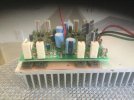
Can anyone offer any advice on the best method to detach and reattached the MOSFET transistors from this aluminum heat sink on a B&K ST-1400M Mono amplifier. I would like to recap the board since the electrolytic capacitors are 30 years old…but can’t desolder the caps without separating the MOSFET transistors from the heat sink. Then I have to consider what I need to properly reattach them. See photos.


You are using an out of date browser. It may not display this or other websites correctly.
You should upgrade or use an alternative browser.
You should upgrade or use an alternative browser.
B&K ST-1400M Mono Amp Board: Separating MOSFET Transistors from Heat Sink to Recap
- Thread starter Stoddrob
- Start date

Register to hide this ad

RVT1K
Super Member
I was expecting to see hardware in the holes??
I've only ever seen them mounted to a heatsink with screws and nuts with some sort of insulator between like a sil-pad or mica insulator.
You may hear from someone who's seen this but have you looked for a service manual to see if there is any info there?
I've only ever seen them mounted to a heatsink with screws and nuts with some sort of insulator between like a sil-pad or mica insulator.
You may hear from someone who's seen this but have you looked for a service manual to see if there is any info there?
RVT1K
Super Member
Are the legs of the transistors sticking up through the board and soldered on top, if so desolder them.
It looks like you're right -and posted while I was typing-.
I think that would work.
Yes, there are screws holding the MOSFET transistors (and by connection, the board) to the heat sink. I can unscrew them…but the transistors won’t “lift-off” the heat sink — at least not so easily. I didn’t try to push my luck. I suppose they will lift off — but probably not without damaging the gasket. So then, what to replace it with? And the transistors are probably not something you want to try to lift-off with a metal tool like a screwdriver (so what to use?). The “separator” gasket appears to be glued down…so its tough to get under it without tearing or damaging it. Yes, it lifted off in-between sets of transistors.
Yes, the legs of the transistors are sticking up through the board…but there is a pretty good volcanic solder seal on the bottom side of the board…so I has hesitant to attempt to desolder them. It would be pretty hard to get them as good as they are now as the transistors were soldered in the holes on both sides before the board before the transistors were mounted on the heat sink with the separator or gasket.
I’m just trying to make sure I don’t make a mess of things by doing the wrong thing. Better to ask someone for advice.
The reason for recapping the amplifier is that the amplifier will play perfectly…but then the sound will cutout (with no noise). The LED on the amp does not flicker and it stays on. So power doesn’t seem to be the problem. I have checked all the cables and connectors and they all seem fine. I can turn the system off, and come back and turn it back on and it will play fine again. Then it can go an hour without a problem…or another time sound from speaker may cutout after only a few minutes. Its not the preamp (I checked and swapped preamps and it does it on both). My thought was maybe it is a bad capacitor. It that a possibility? OR could it even be a bad MOSFET?
My idea was to recap the electrolytic capacitors and see if that clears-up the problem. But then I ran into the removing the MOSFET transistors from the heat sink which I didn’t want to do but may not have any choice.
Thank you for providing guidance and expertise. Better to ask someone than to do something wrong!
Yes, the legs of the transistors are sticking up through the board…but there is a pretty good volcanic solder seal on the bottom side of the board…so I has hesitant to attempt to desolder them. It would be pretty hard to get them as good as they are now as the transistors were soldered in the holes on both sides before the board before the transistors were mounted on the heat sink with the separator or gasket.
I’m just trying to make sure I don’t make a mess of things by doing the wrong thing. Better to ask someone for advice.
The reason for recapping the amplifier is that the amplifier will play perfectly…but then the sound will cutout (with no noise). The LED on the amp does not flicker and it stays on. So power doesn’t seem to be the problem. I have checked all the cables and connectors and they all seem fine. I can turn the system off, and come back and turn it back on and it will play fine again. Then it can go an hour without a problem…or another time sound from speaker may cutout after only a few minutes. Its not the preamp (I checked and swapped preamps and it does it on both). My thought was maybe it is a bad capacitor. It that a possibility? OR could it even be a bad MOSFET?
My idea was to recap the electrolytic capacitors and see if that clears-up the problem. But then I ran into the removing the MOSFET transistors from the heat sink which I didn’t want to do but may not have any choice.
Thank you for providing guidance and expertise. Better to ask someone than to do something wrong!
Thanks for the additional info,
I doubt a clean cutoff in sound is caused by capacitors, so it's amplifier diagnostic time there may be sticky threads on this.
Is there a protection circuit usually operated by relays, do you hear a click at turn on, has it clicked out when it fails.
Is there a break in signal, check cables, connectors, tap components.
Is anything getting hot.
Is the power supply still supplying volts. Are there any test points you can check probably indicated on the circuit diagram or pcb.
Trace the signal back to the point of origin as best you can, at the very least you'll need a multimeter on ac volts.
Lookup heatsink thermal pads for replacing the pad it probably is the place to separate, it might come apart intact perhaps with some iso, or might rip or loose adhesion, or you might need a setting thermal compound to reapply.
I doubt a clean cutoff in sound is caused by capacitors, so it's amplifier diagnostic time there may be sticky threads on this.
Is there a protection circuit usually operated by relays, do you hear a click at turn on, has it clicked out when it fails.
Is there a break in signal, check cables, connectors, tap components.
Is anything getting hot.
Is the power supply still supplying volts. Are there any test points you can check probably indicated on the circuit diagram or pcb.
Trace the signal back to the point of origin as best you can, at the very least you'll need a multimeter on ac volts.
Lookup heatsink thermal pads for replacing the pad it probably is the place to separate, it might come apart intact perhaps with some iso, or might rip or loose adhesion, or you might need a setting thermal compound to reapply.
Last edited:

I wouldn't worry about damaging the pad, as individual transistor insulator pads are readily available on Amazon. Granted, a single large pad would be much easier, but the individual pads could be held on with heat sink compound while reassembling. As to what to use to pry them loose, I'd try a plasic putty knife (beneath the insulator). You may get lucky and the whole thing comes off easily. If not, use the individual pads to reinstall.
Once removed, I'd replace the caps, and re solder all joints as the problem could be a cold solder joint.
Once removed, I'd replace the caps, and re solder all joints as the problem could be a cold solder joint.
I want to thank everyone who commented. The amplifier problem has been traced to the Adcom ACE 515 power enhancer. I switched to a plain power strip — and the problem resolved. I took the cover off the Adcom unit and found a couple of somewhat loose connectors — one to the plug for the amplifier. After tinkering for a few minutes, I put it back into service and found no more problems. Its actually a nice unit with dual protection relays that shut-off the amplifiers first then the accessory plugs-in 10 seconds later — thereby eliminating any power discharge speaker “pop.” The dual mono amps sound great with the recapped B&K Pro 10MC preamp with balanced connectors to each amp. I’m rethinking recapping for now. At least I know what I’m up against when I decided to do it. Thanks again!