My suggestion, before exploring any further, is to go ahead and dismantle your switch and see what the problem might be.
Dismantling any of these "sealed" switches can make you squeamish, but if it is not functioning properly then there is not much to lose. Usually any advice for our switches involves thorough DEOxit treatment and cycling the switches, but this switch mechanism is not particularly robust and my concern would be potentially bending one of the internal parts.
I recently had one apart on a BAF1 project, so I have a couple of photos that might be helpful.
Disassembly is basically by bending back the four securing tabs:
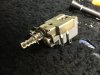
The switch is essentially in two halves, the pushbutton mechanism:
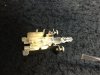
and the sliding contacts:

Of course, I was not as thorough in my picture taking as I should have been, so I don't have a shot of the spring placement, but as you will see upon disassembly, the wire armature is inserted into the housing, runs through the flat spring, and the elbow section is captive in a slot on the pushbutton, which is captive in the housing. The foot of the pushbutton is set into the slide for the contacts when the two halves are re-assembled.

Please note, the photo above does not represent the parts placement, just the delicate components. Assembled, the armature wire elbow that is hidden by the spring would be inserted through the small hole on the left and the spring would be lying on the flat part of the housing.
Assuming that there are not contacts burned beyond salvage and that the spring and armature are not bent or broken, then a thorough cleaning (I have very good luck with an ultrasonic parts cleaner), lubrication, and reassembly should give you a switch that will be of service indefinitely.
Sorry my photos aren't more complete, but if you can overcome the initial trepidation of opening up the switch, things will be revealed to be pretty straightforward.

