• The move to the new server is done. There are some software and database maintenance updates in process. This has us passing the hat around to help out. We appreciate any donations. Seriously, even a dollar helps. The payment page may be found here - https://www.audiokarma.org/support.html

Basic Question about DC OFFSET and BIAS for the SX-737

pa_200

Well-Known Member
This subject has been discussed so many times, but there is one information missing I like to find the answer.

Every reply covering DC Offset and BIAS points to a millivoltage range with 20mVDC for Bias and DC Offset close to 0 mVDC.

BUT sometimes it’s very hard to get the DC Offset close to 0 mVDC and if we do a recheck with the Service Manual page 17 point 4, it says “Adjust VR** until voltmeter indicates 0V” not 0mV!!

Is that “0V” a misprint as well or are we just trying to find a more precise voltage? Even the SX-838 SM says only “Adjustment should be made to bring the voltage to zero.” And the SX-636 doesn’t even got a trim pot to adjust it.

Don’t get me wrong, reaching 0mV is still the best, BUT what can be a good OFFSET tolerance if one can’t get it down to that range?
 
Register to hide this ad
Pretty much depends on how neurotic one is. :biggrin: Some people prefer to fit multiturn potentiometers to make getting to 0mV easier. To clarify, at least in my book. 0V = 0mV.

However in terms of tolerance, Echowars did a post some years ago about DC offset. He indicated there that anything under 16mV was good enough. In my experience its relatively easy to get any DC adjustable amplifier down to under +/-5mV but by that point it isn't critical unless your really trying to push the amp to the very edge of its total output power.IF you use the amp for everyday listening - a generous average output of 1-3W per channel - I doubt you'd hear the difference between 20mV and 0mV.

Here's Echowar's original posting:
0 - 15mV: Damn good!! If you read '0V', you may have a capacitor output, or your meter is set wrong

16mV - 50mV: An acceptable value, especially at the lower end of this range. 2nd harmonic distortion is probably twice to four times what manufacturer's spec calls for at higher frequencies. Probably not audible, as the distortion is mostly in the upper octaves. At the upper end of this range I begin to raise an eyebrow. :saywhat:

50 - 85mV: Something is certainly amiss, and while this is not enough to put your speakers or equipment in jeopardy, the amp is running nowhere near where it should. I'd venture to guess that most of the DC-coupled amps that are in use by forum members here fall into this range.

100mV to ?: A high enough voltage will cause the DC protection to kick in. This happens at a level determined by the designer, but is usually equivalent to about a diode drop (600mV)or so. Needless to say, if you are listening to an amp with 100mV or more of DC offset, you have no idea what the amp really is supposed to sound like. Indeed, some amps without a differential input are actually designed to have a bit of DC at the outputs, but this is triple-rare, and I don't think anyone here owns one. (in my book it's piss-poor design, but if you can sell it WTH..)

...and a link to the full thread: https://audiokarma.org/forums/index.php?threads/amplifier-distortion-dc-offset-and-you.5634/
 
Also. The protection circuit can cause trouble depending on the offset.
It’s not about what you feel about zero volts but what the electrons feel. :D
Zero < mv’s is a huge measurement in electronics.
 
Last edited:
As Qsilver alluded to, getting to 0V on the offset can be an exercise in futility at times. Sometimes you have to muscle the pot to get a reading change, and sometimes just the thought of a muscle twitch can move it 100mv or more. Multi-turn pots can make this a lot easier, but come with added cost. And I'm NOT advocating single turns in this case. Your meter may not resolve down to 4 decimal places, but that doesn't mean it won't resolve a 1mv to ZERO VOLT Change. It may read 0V or 0mV. Same thing. I put the same series pots in my 939 as my 737 (from the same purchase). Guess which one is harder to center up and get biased. The 939 I can center up(0V +/-1mv) and bias in under 5 minutes. The 737 took 20-30 minutes of back and forth twitching (just breathe lightly on it and it would change) on offset and bias. And one other thing. It doesn't matter if the value is POS(+) or NEG(-) if you can't hit Zero. It's the number that counts. Use Echowars guide above.

The S.M. was written with assy line workers in mind for initial adjustments with brand new units and lots of specialized testing equipment. And they didn't anticipate 50 years down the road that people would really be tearing their work apart, rebuilding, rehabbing or restoring the unit to get another 40-50 years out of it, doing it as a hobby. Go figure!!!
 
Thank you, that was the kind of reply I was hoping for and it makes totally sense, keeping the engineering and manufacturing years in mind as well as the accepted tolerance of the used parts at that time.

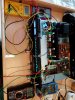
Made a last recheck today and watched the values for about 20 minutes, without adjusting in between. To control both channel and all 4 values at once, I use 4 DMM at a time, all set to mV.

The BIAS started at 13mV and slowly climbed up to a stable 20mV.
The DC offset was quite opposite. It started with initially over +50mV, then quick went down to zero and over to -10mV. With the rise on the bias the DC Offset voltage came slowly back to below -1 mV.

You are absolutely right, the parts controlling the DC Offset are very sensitive. Made the test with just a slight breath on it, and the value immediately went up over 40mV but came slowly down again while swiftly moving in an area of +/- 1mV.

My final experience with the SX-737 on this. Starting with the initial voltage close to the advised values, just wait at least 10 minutes. If you don’t wait, you will find yourself adjusting the VR3 and VR4 back and forth all the time.

Going back to my first question with 0Volt vs 0mVolt. One should keep in mind,
0.8 mV is on a 3 digit Voltmeter 0.000 Volt and 1.0 mV is 0.001 Volt

Finally, it hope it will help everyone else, if we use Echowars guide above.
Bias and DC Offset SX_737.jpg
 
Last edited:
Back
Top Bottom