• The move to the new server is done. There are some software and database maintenance updates in process. This has us passing the hat around to help out. We appreciate any donations. Seriously, even a dollar helps. The payment page may be found here - https://www.audiokarma.org/support.html

Bastardizing a pair of Epicure M50

62vauxhall

Addicted Member
I have not owned these speakers for a terribly long time, maybe 10 years or so. I bought them on a whim and paid too much for them. I realized that after I had them home where I was able to do an evaluation. The woofers had been given a botched up repair or restoration job and once I removed them, the enclosures's interior just reeked a musty, mildewey smell. The grille cloth and grille frame also stank badly.

The woofers, I replaced with a pair bought off eBay. The tinsel wire of one tweeter had become detached from it's solder lug so that was fixed at a shop specializing in speaker repair.

I am unsure what environment the speakers were kept in but I am sure it was warm and moist.

When the time came to put them to use, it was only to listen to AM news and traffic in the mornings before I left for work. And so it went with them for a few years. But several years ago I moved cities and they were shelved until recently. I set up a small system in 2nd bedroom where I engage in this hobby and I put the Epicure M50 back in service.

Immediately I noticed that the sound I was hearing was raspy. At first I thought the culprit was the receiver I was using, then the cassette deck, then the turntable. Eventually I clued in that the common denominator was the speakers.

My suspicion is that the tweeters have at last succumed to damage done by the high humidity they endured for who knows how long and one or both voice coils have delaminated.

I realize there are re-built EPI tweeters available but the cost to obtain a pair in Canada makes them cost prohibive, The difference in currency and shipping would probably mean close to $300CAD for two of them.

But I happen to have two Philips AD0160/T8 tweeters.

Provided I can replicate something the same size as the Masonite mounting board incorporated by the original inverted dome tweeters, I think I can fasten the Philips tweeters in the place occupied by the Epicure tweeters.

The Philips data I've seen for their AD0160 tweeters shows a frequency response of 1,500hz ro 22,000hz with a recommended crossover point of 1,600hz.

Specs for Epicure M50's say their tweeter is crossed over at 1,800hz so electrically speaking, it seems to me the Philips tweeter could be a succcessful substitute for an M50's stock tweeter.

Below is the Epicure M50 crossover schematic courtesy of Human Speakers.

I could be wrong but I don't think ir would be necessary to alter the capacitor. The resistor though, I am not sure about.
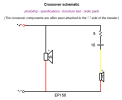
Epicure M50 crossover schematic.PNG
 
Register to hide this ad
Used EPI/Epicure tweeters used to be pretty plentiful on eBay. I'm not going to discourage you from trying the Philips tweeters, but I would recommend against any modifications to the cabinets that can't be reversed. Not sure if you already knew this, but most Epicure speakers were built using a "module"; a woofer and tweeter that were designed to work together (this is probably explained on the Human site). That's how they were able to get away with just using a single capacitor (and, in this case, a resistor, presumably to pad down the tweeter's output to match that of the woofer's) for a crossover (which wasn't uncommon in cheap speakers, but these aren't meant to be "cheap speakers"). So try it, but I'd keep an eye out for someone in Canada selling the correct tweeters. If it turns out the Philips tweeter isn't loud enough for the woofer, you can remove the resistor; if it ends up being too harsh, then try a larger (or a second resistor in series). And yes, you should probably replace the capacitors, since these are probably 50 years old.
 
Yeah, if the treble still sounds raspy, suspect failing 10mF capacitors.
And yes, you should probably replace the capacitors, since these are probably 50 years old.

It has been some time since I had these M50's opened up to replace the woofers. It is possible that I replaced their capacitors at that time. I honestly cannot precisely recall having done so. I will learn that when I have the opportunity to work on them again. There is a larger pair of speakers ahead of the M50's that take up what little space I have to do these things.


I'm not going to discourage you from trying the Philips tweeters, but I would recommend against any modifications to the cabinets that can't be reversed.

No, that is something I would not do.

Not sure if you already knew this, but most Epicure speakers were built using a "module"; a woofer and tweeter that were designed to work together (this is probably explained on the Human site). That's how they were able to get away with just using a single capacitor (and, in this case, a resistor, presumably to pad down the tweeter's output to match that of the woofer's)

I was not aware of that bit of background history. It is a good explanation.

If it turns out the Philips tweeter isn't loud enough for the woofer, you can remove the resistor; if it ends up being too harsh, then try a larger (or a second resistor in series).

That is a good piece of information. And one I will bear in mind when I do get to perform the tweeter substitution. Unless something keeps me from it, that will be within the next week.
 
Word of warning- the Philips AD0160 tweeter is NOT going to be happy with the very low frequency, low slope crossover in the EPI cabinets!

EPI tweeters, as mentioned, cross over at about 1800Hz- BUT- it's first order 6dB/oct.

The Philips, to be used at 1600 Hz, should be a MINIMUM of second order 12dB/oct. Preferably third order 18dB/oct., to limit excursion. Even then, the power handling is VERY limited (Philips said 20 watts).

For first order 6dB/oct. crossover- the Philips is NOT going to be happy going below about 3500Hz crossover point!

Regards,
Gordon.
 
I have a pair of M50's. They're original and sound fantastic, I've yet to change the capacitor, but I'm not in a hurry they sound so good. Not too many of these M50's around. I second Swechsier's suggestion. Be patient and pick up some originals. I like these better than the 100's which I also have, so much sound from such a small package.
 
Word of warning- the Philips AD0160 tweeter is NOT going to be happy with the very low frequency, low slope crossover in the EPI cabinets!

EPI tweeters, as mentioned, cross over at about 1800Hz- BUT- it's first order 6dB/oct.

The Philips, to be used at 1600 Hz, should be a MINIMUM of second order 12dB/oct. Preferably third order 18dB/oct., to limit excursion. Even then, the power handling is VERY limited (Philips said 20 watts).

For first order 6dB/oct. crossover- the Philips is NOT going to be happy going below about 3500Hz crossover point!

Regards,
Gordon.

That does change things then. I do not have the knowledge to determine what components would comprise the crossovers you suggest. Nor can I envision how it would be assembled.

It is unlikely a pair of working Epicure tweeters will cross my path and I don't really have the drive or the funds anymore to make a mission of finding some. Ironically, a few years ago, I traded a Shure V15 IV to a friend for a pair of the exact same EPI/Epicure tweeters. I used them to replace CTS phenolic ring tweeters in a pair of speakers I thought were overly bright.

I think I still have those CTS tweeters but I doubt they would work at all well in M50's. I think they would overwhelm such a small woofer.
 
I have some M50s out in the garage that I picked up somewhere. We are in the middle of a minor ice storm, so I don't dare go out to grab them. But it would be interesting to take some measurements and sim up a crossover with a decent, budget tweeter like the Dayton silkie Gordan proposed. I'm quite curious to see if the rolloff of the woofer is smooth enough to work with no LP network.
 
This tweeter should work. It will handle the EPI crossover fine. Some cap value tweaks may be needed to make it perfect, but it will do the job:

Dayton DC28F:


Regards,
Gordon.

Your tag line makes me think that you know of what you speak. So I ordered a pair of those Dayton tweeters.

EDIT: I will likely advertise those Philips tweeters on Canuck/US Audio Mart to maybe recover some of the cost.
 
After a considerable number of weeks, those Dayton DC28F tweeters finally arrived.

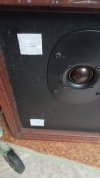
Sizing up how to install them had me replicate a 5" Masonite ring to match the diameter of the original Masonite tweeter. The inside hole is 3" in diameter to account for the round magnet of the Dayton tweeter. The original Epicure Masonite tweeter has a square magnet therefore the baffle cutout is square. To ensure a proper seal, I used plumber's putty on both the front baffle side of the new ring and the tweeter side of the new ring

When the new tweeter was fitted, I observed that the silk dome of the new tweeter protrudes too far and comes in contact with the grille cloth. This could be overcome I suppose by fabricating a new grille frame using 1" thick material and covering it with new grille cloth. This does not appeal to me as I do not have access to a woodworking shop with the needed equipment and I am terrible at installing grille cloth.

So I looked again at the original tweeters and discovered something I had not noticed before.

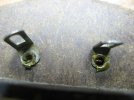
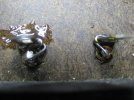
The terminal tabs use press fit rivets to hold things together and one of them is loose. The terminal tab can rotate side to side so contact with that end of the voice coil wire is intermittent.

The voice coil itself has continuity.

My initial thought to rectify this was to use a small hole punch to spread out the flanges of the rivet and hopefully snug up the connection with the connection tab. But I also wondered if solder is possibly a better option. My concern with solder is how hot the metal of the rivet and the metal of the connection tab must be before solder will bond or if it will bond. And will that heat damage the voice coil?

Has anyone had to make a similar repair to an EPI/Epicure original Masonite tweeter?

IMG_5560.JPGIMG_5561.JPG
 
That looks like bare steel. Rivets are probably steel as well. I doubt they'll stick to solder. However, another option might be to solder a longer wire to the VC leads and then wrap it several times around the terminal to hold it in place. I'd also epoxy the terminals in place so they can't rotate and break the wire. As long there is some distance between the end of the wire and the voice coil itself, heat shouldn't be an issue. You shouldn't need to hold the iron on that wire very long to get it hot enough to take solder.
 
another option might be to solder a longer wire to the VC leads and then wrap it several times around the terminal to hold it in place. I'd also epoxy the terminals in place so they can't rotate and break the wire.

Thanks that was a good suggestion and it seems to have been successful.

Thinking back to when I got these speakers in 2018, they were a comp;ete mess internally. A similar repair was made to the tweeter in the other cabinet. I removed that one and took it to a specialty speaker repair shop. The cost I believe was $50 to fix it.
 
I do now.

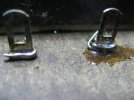
Adding the wire was done to both terminals. Only the loose terninal tab got the glue.
 

Attachments

  • IMG_5564.JPG
    IMG_5564.JPG
    112.7 KB · Views: 11
  • IMG_5565.JPG
    IMG_5565.JPG
    83.6 KB · Views: 11
I was going to also recommend the DC28 from PE, but looks like you solved it.

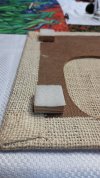
Here's what I did for a pair of Zenith Allegro speakers that I repurposed with new Jamo drivers, the tweeter also being a dome. I made new masonite grill covers as the originals got trashed removing them since they were stapled to the front baffle. I cut out small squares of plywood which got glued and stapled to the grill before covering with burlap. Velcro got stapled to these standoffs and the front baffle, and a little ribbon was glued to the reverse of the grill as a pull tab. The speakers are used on a mobile stereo cart for when we're having firepits or otherwise staying out on the back deck.

IMG_20250128_121507648.jpgIMG_20250128_121528143.jpgIMG_20250128_121602978.jpgIMG_20250128_121630029.jpg
 
Using standoffs as indicated above to elevate the grille so to achieve clearance between the cloth and the tweeter dome was my first thought. But...

....I too had to make new grille frames right after getting these M50's in 2018.

The frame, the cloth and the interior of the enclosures absolutely reeked of mildew. The speakers must have spent a goodly amount of time in a humid environment. Humid enough and long enough for the original grille frame material to become soft and somewhat crumbly in addition to having a profound stink.

For grille cloth, I re-used what material I had on hand which happened to be a piece that I salvaged from a one only speaker from the early 1970's. My skill at installing grille cloth is poor so If I were to elevate the grilles with standoffs, the grille's edges would be exposed and my bad "upholstering" would be in full view.

That was why I re-visited the original tweeters. Because then no need for standoffs so the grille's edges would be hidden.
 
Last edited:
Yesterday I put the M50's back together using the original tweeters. After fixing that loose connector tab, all was well. The bugger is, I now have that pair of Dayton DC28F tweeters and no use for them at present.

Since the speaker boxes were empty, I installed a new Dayton film cap plus a replacement resistor and some new binding posts so as to use banana plugs. I probably did not need the Dayton film cap as when I first had these speakers apart after acquiring them in 2018, I installed a Solen BP electrolytic. And I replaced all the wires.

The original yellow fiberglass insulation was reused and augmented with some Polyester pillow stuffing. The yellow stuff had become clumped up so not exactly in pristine condition. It did not howerver stink of mildew anywhere nearly as bad as it did in 2018.

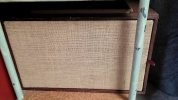
The last photo is one of the M50's showing the grille cloth I used which was salvaged and kept from from a different pair of speakers I refurbished around 2006.

I listened fo some music on the M50's last night. When I was able to listen to them previously, it was to hear a news/wheather/traffic station on morning AM radio. I tried using them more recently in a small 2nd bedroom in which I do my tinkering and was when I realized that the they had a problem.

The M50's were more satisfying music reproducers than I was expecting. I think I prefer them over the Polk Monitor 5B speakers that they are sitting on top of.

IMG_5575.JPGIMG_5576.JPGIMG_5577.JPG
 
Last edited:
Back
Top Bottom