• The move to the new server is done. There are some software and database maintenance updates in process. This has us passing the hat around to help out. We appreciate any donations. Seriously, even a dollar helps. The payment page may be found here - https://www.audiokarma.org/support.html

Battle of the Titans: Pioneer SX-1980 vs Sansui G-22000

mattsd

Super Member
I decided to compare my two monsters head to head and see which one would come out on top. I love both of them, definitely the two biggest pieces of audio I own. Both have been meticulously restored and fully recapped.

You can see the restorations threads below:

SX-1980: http://www.audiokarma.org/forums/in...-sx-1980-recap-and-restoration-thread.440844/

G-22000: http://audiokarma.org/forums/index.php?threads/sansui-g-22000-restoration-upgrade-thread.843144/

We will start out by using a DAC for the first round. For my speakers I will be using recapped ADS L1230. Source is a heavily modded Hifiberry DAC+ Pro with a Raspberry Pi running Moode Audio 4.4. Both receivers were matched within 1dB using a 1KHz test tone. I will be doing one receiver at a time with several songs to get a feel for the overall sound as well as the nuances of each receiver. Both receivers were allowed to warm up for 20 minutes.

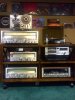
Here they are ready to go!

tfnf0UP.jpg
 
Register to hide this ad
The songs I'll be using:

Nils Lofgrin, Some Must Dream (from the Acoustic Live album). Amazing live acoustic recording, the quality is insanely good. Lots of microdetail and nuances that can get covered over by less detailed systems.
Al Somma, They All Laughed. Excellent jazz male vocal recording, a lot of detail and excellent soundstage.
Rebecca Pidgeon, Spanish Harlem. An audiophile classic, her voice on the right system will sound real, as if she's standing in front of you. One of the hardest songs I've found to get to sound right.
Infected Mushroom, Demons of Pain. Fast electronic song, the speed of your amp will affect how the pacing of the song sounds. Very detailed and well recorded.
City and Colour, The Grand Optimist. Very well recorded indie/alternative rock song. Lots of reverb and feeling of space.
Joe Bonamassa, High Water Everywhere (From the Live at the Royal Albert Hall album). Big concert hall feel, two drumsets with lots of reverb off the side and back walls of the venue that can be heard, but certain systems can make the song seem 2D.
Tsuyoshi Yamamoto Trio, Smoke Gets in Your Eyes (from the What a Wonderful Trio DXD album). Excellent piano recording, lots of little details that stand out on very detailed systems.

Note, this is just my opinion on both of these receivers and very subjective. I like to listen as an audiophile, so I enjoy amps that are very detailed and revealing and present a recording like you are there where it was recorded.


We will start with the SX-1980:

Some Must Dream: Good soundstage presentation, strings sound slightly muddy and the sharp snap when picked sounds smoothed, like a sawtooth waveform with the points rounded off. Bass and midbass strings are warm and slightly loose
They All Laughed: Excellent central image, good soundstaging, slightly lacking in definition. Warm bass with a slight smear, doesn't give the impression of accuracy. Overall presentation is slightly veiled as if listening through a curtain.
Spanish Harlem: Excellent central image, slightly lacking in definition but with excellent presentation. Standup bass is warm and full sounding, but lacking some definition. Slight "veil" effect noted again.
Demons Of Pain: Good soundstaging, song pacing seems "slow". Bass is warm and very strong, it makes it difficult to pick out the vocals in spots.
The Grand Optimist: Excellent soundstage presentation, good central image. Nice reverb and depth to the soundstage. Still has a veiled overall sound
High Water Everywhere: Wide soundstage, good depth and central image. Guitar and vocals are slightly veiled, bass is also muddy sounding and is somewhat difficult to pick out the different drums.
Smoke Gets in Your Eyes: Good soundstage and depth. Keys are slightly dull sounding and the fine details are difficult to distinguish. Overall piano presentation sounds rolled off.

Overall impression: The 1980 definitely hits a ceiling when playing very high quality recordings. The sound has a slight veil that is noticeable in all the songs I played, especially in the highs. It does tend towards the warm side of neutral in the bass department and lacks some snap in cymbals and plucked strings. It does however image well and the soundstaging is nicely spaced without sounding artificial. Not a bad sounding amp at all, but I have heard all of the above songs on systems costing many, many times what even the 1980 is worth, so I know what they can sound like.

Now for the G-22000

Some Must Dream: Good soundstage presentation, strings have excellent snap and definition, a lot of fine details that the 1980 covered show through clearly here. Bass and midbass has a pleasing definition and tightness, I feel more like I'm actually watching the concert in person vs listening to a recording.
They All Laughed: Amazing central image, much tighter and more focused. If I close my eyes I can actually picture him standing in front of me. Very tight and accurate sounding bass, extremely pleasing to listen to. One odd note, his voice with the 22000 has an almost sibilant like quality, though it might be the recording.
Spanish Harlem: This one made my jaw drop a little. Vocal is holographic, I felt like I was in the recording studio listening to it live. I was noticing fine details that I did not notice with the 1980. Standup bass sounded amazing, excellent definition and it was easier to pick out the individual strings.
Demons Of Pain: Much better bass balance, I was easily able to pick out the vocal from the synth bass. Bass is tight and much "faster" sounding, gave the song better pacing.
The Grand Optimist: Much better clarity and definition, very easy to imagine the band sitting in front of you. Reverb and depth is about the same, though with more definition.
High Water Everywhere: Wide soundstage, slightly better depth and central image. Better clarity and definition in the drums, the head of the kickdrum pedal sounds like it's hitting a drumhead vs the 1980 which was more smeared and dead sounding. You can more easily tell the individual drums apart as well.
Smoke Gets in Your Eyes: No comparison. The 22000 is miles ahead in this track, the piano has an excellent attack and decay on the keys and notes, details such as the sustain pedal coming on and letting off is easily heard, the drums and cymbals that start in the latter half sound much more realistic.

Overall impression: Much more pleasing to listen to, the transparency and detail is amazing and the speed difference between the two amps is very noticeable, especially in the low bass and the cymbals. With the 1980 I found it hard to get involved with the songs, but the 22000 made me want to listen to the song in depth, and even repeat it. Another note was the background seems "blacker" on the 22000, especially on the more intimate recordings. I would actually be willing to put this up against modern audiophile amps.

Next will be a test of the phono sections, once I get my turntable up and running again.

 
Last edited:
. I love both of them, definitely the two biggest pieces of audio I own.

If big is what you want, you could get a nice Krell amp. Some of those just need a top cover to be coffee tables. But then that isn't the goal of this discussion, I just thought the size discussion was interesting in your post. Looking forward to seeing what you say about these two. Do you agree with the general concensus of the sound of the SX-1980 wrt to the some other Pioneer receivers? Just getting a baseline with that question, if you have compared the 1980 to the 1250 1050, 1010 or 1280.
 
Last edited:
If big is what you want, you could get a nice Krell amp some of those just need to top cover to be coffee tables. But then that isn't the goal of this discussion, I just thought the size discussion was interesting in your post. Looking forward to seeing what you say about these two. Do you agree with the general concensus of the sound of the SX-1980 wrt to the some other Pioneer receivers? Just getting a baseline with that question, if you have compared the 1980 to the 1250 1050, 1010 or 1280.

See the above post I just edited. I have a SX-1250 as well, and I find that the 1980 tends to be slightly more neutral than the 1250, but the 1250 is more "musical". That might be my next comparison, since there's a lot of people that say to go for the 1250 over the 1980 for a variety of reasons. I mentioned size as a matter of fact statement, but I know very well size doesn't always mean better. My recently recapped AU-919 will probably beat out the 22000 if compared head to head..
 
I found the same general sound signatures, the SX-**80 more veiled and the G series more accurate, comparing my SX-680 and G-9000. Admittedly not an apples to apples comparison like yours, but the result was the same.
 
The songs I'll be using:

Nils Lofgrin, Some Must Dream (from the Acoustic Live album). Amazing live acoustic recording, the quality is insanely good. Lots of microdetail and nuances that can get covered over by less detailed systems.
Al Somma, They All Laughed. Excellent jazz male vocal recording, a lot of detail and excellent soundstage.
Rebecca Pidgeon, Spanish Harlem. An audiophile classic, her voice on the right system will sound real, as if she's standing in front of you. One of the hardest songs I've found to get to sound right.
Infected Mushroom, Demons of Pain. Fast electronic song, the speed of your amp will affect how the pacing of the song sounds. Very detailed and well recorded.
City and Colour, The Grand Optimist. Very well recorded indie/alternative rock song. Lots of reverb and feeling of space.
Joe Bonamassa, High Water Everywhere (From the Live at the Royal Albert Hall album). Big concert hall feel, two drumsets with lots of reverb off the side and back walls of the venue that can be heard, but certain systems can make the song seem 2D.
Tsuyoshi Yamamoto Trio, Smoke Gets in Your Eyes (from the What a Wonderful Trio DXD album). Excellent piano recording, lots of little details that stand out on very detailed systems.

Note, this is just my opinion on both of these receivers and very subjective. I like to listen as an audiophile, so I enjoy amps that are very detailed and revealing and present a recording like you are there where it was reocrded.


We will start with the SX-1980:

Some Must Dream: Good soundstage presentation, strings sound slightly muddy and the sharp snap when picked sounds smoothed, like a sawtooth waveform with the points rounded off. Bass and midbass strings are warm and slightly loose
They All Laughed: Excellent central image, good soundstaging, slightly lacking in definition. Warm bass with a slight smear, doesn't give the impression of accuracy. Overall presentation is slightly veiled as if listening through a curtain.
Spanish Harlem: Excellent central image, slightly lacking in definition but with excellent presentation. Standup bass is warm and full sounding, but lacking some definition. Slight "veil" effect noted again.
Demons Of Pain: Good soundstaging, song pacing seems "slow". Bass is warm and very strong, it makes it difficult to pick out the vocals in spots.
The Grand Optimist: Excellent soundstage presentation, good central image. Nice reverb and depth to the soundstage. Still has a veiled overall sound
High Water Everywhere: Wide soundstage, good depth and central image. Guitar and vocals are slightly veiled, bass is also muddy sounding and is somewhat difficult to pick out the different drums.
Smoke Gets in Your Eyes: Good soundstage and depth. Keys are slightly dull sounding and the fine details are difficult to distinguish. Overall piano presentation sounds rolled off.

Overall impression: The 1980 definitely hits a ceiling when playing very high quality recordings. The sound has a slight veil that is noticeable in all the songs I played, especially in the highs. It does tend towards the warm side of neutral in the bass department and lacks some snap in cymbals and plucked strings. It does however image well and the soundstaging is nicely spaced without sounding artificial. Not a bad sounding amp at all, but I have heard all of the above songs on systems costing many, many times what even the 1980 is worth, so I know what they can sound like.

Now for the G-22000

Some Must Dream: Good soundstage presentation, strings have excellent snap and definition, a lot of fine details that the 1980 covered show through clearly here. Bass and midbass has a pleasing definition and tightness, I feel more like I'm actually watching the concert in person vs listening to a recording.
They All Laughed: Amazing central image, much tighter and more focused. If I close my eyes I can actually picture him standing in front of me. Very tight and accurate sounding bass, extremely pleasing to listen to. One odd note, his voice with the 22000 has an almost sibilant like quality, though it might be the recording.
Spanish Harlem: This one made my jaw drop a little. Vocal is holographic, I felt like I was in the recording studio listening to it live. I was noticing fine details that I did not notice with the 1980. Standup bass sounded amazing, excellent definition and it was easier to pick out the individual strings.
Demons Of Pain: Much better bass balance, I was easily able to pick out the vocal from the synth bass. Bass is tight and much "faster" sounding, gave the song better pacing.
The Grand Optimist: Much better clarity and definition, very easy to imagine the band sitting in front of you. Reverb and depth is about the same, though with more definition.
High Water Everywhere: Wide soundstage, slightly better depth and central image. Better clarity and definition in the drums, the head of the kickdrum pedal sounds like it's hitting a drumhead vs the 1980 which was more smeared and dead sounding. You can more easily tell the individual drums apart as well.
Smoke Gets in Your Eyes: No comparison. The 22000 is miles ahead in this track, the piano has an excellent attack and decay on the keys and notes, details such as the sustain pedal coming on and letting off is easily heard, the drums and cymbals that start in the latter half sound much more realistic.

Overall impression: Much more pleasing to listen to, the transparency and detail is amazing and the speed difference between the two amps is very noticeable, especially in the low bass and the cymbals. With the 1980 I found it hard to get involved with the songs, but the 22000 made me want to listen to the song in depth, and even repeat it. Another note was the background seems "blacker" on the 22000, especially on the more intimate recordings. I would actually be willing to put this up against modern audiophile amps.

Next will be a test of the phono sections, once I get my turntable up and running again.
I really enjoyed your in depth review. Thanks for taking the time to do this. It should be very helpful to those looking for a good vintage receiver. Both are gorgeous pieces.
Cheers, Glenn
 
Nice comparo. I agree with your impressions although I have not heard a G22k but I have heard a G33k. The SX-1980 makes sense only with HPM speakers like the 100 or 150. Otherwise, it is dull.
 
I love these threads, but always remember that with vintage, you will get a lot of variation from unit to unit. Another pair of the same models might yield different results. (I had some ADS L1290's for example that were the muddiest speakers I've ever owned, but they needed a recap I'm sure)

I couldn't disagree more about the SX-1980 being dull. Maybe it's just an exceptional match for my JBL's, or the fact that mine is a pristine/untouched example I got it from the original owner since 1978 without a fleck of rust or issues anywhere. I'm still in true awe of how good it sounds and I don't impress easily.

Current setup: Lossless formats through USB > Brooklyn DAC+ > SX-1980 > JBL 250TI and it's a dream. Analog is Technics SP-15 w/AT20SS MM cart into the 1980's full featured phono stage and It's amazing as well.

I can't stand too bright (headaches, fatigue) or too muddy (boring and dull) and this setup is dead accurate without any tweaking. It's everything I could ever want in a receiver, though I would love to own a monster Sansui G-22000 or G-33000.

As I understand it, HPM's were built by JBL engineers that Pioneer hired to take on the JBL L100's so I suppose it stands to reason that I'd be happy with the flagship 250TI's and this amazing monster.

Great comparison, thanks.
 
Great comparison! I own a g22k g9k g5700 g5500 g3000 and the old faithful 9090. Never have owned a Pioneer SX series, but a beautiful looking they are!
I’m always playing around with my 22k on two pairs of JBL L112’s, TT is a Oracle MK1, Magnepan Unitrac 1 Tone arm and a Nagaoka MP150 cartridge, best setting so far is no loudness on with all three bass, mid, treble on 0. What a true studio sound it presents.
 

Attachments

  • D2A6F7E8-D013-4F6A-9584-7B4639AE2C51.jpeg
    D2A6F7E8-D013-4F6A-9584-7B4639AE2C51.jpeg
    72.9 KB · Views: 23
  • 6BF1350A-C4F4-4A97-93CC-EC31EF87777F.jpeg
    6BF1350A-C4F4-4A97-93CC-EC31EF87777F.jpeg
    41.7 KB · Views: 22
  • E1AD1670-82DD-4F15-AEC2-9B723489F00A.jpeg
    E1AD1670-82DD-4F15-AEC2-9B723489F00A.jpeg
    56.9 KB · Views: 27
  • A1F2D8BD-92A2-4480-A003-FFB3D0382D61.jpeg
    A1F2D8BD-92A2-4480-A003-FFB3D0382D61.jpeg
    52.1 KB · Views: 21
  • 65095624-B146-4460-BFB2-8762670EA76D.jpeg
    65095624-B146-4460-BFB2-8762670EA76D.jpeg
    47.2 KB · Views: 21
  • 66EC1ECE-88BD-4ECB-B06E-E0C778C9A26D.jpeg
    66EC1ECE-88BD-4ECB-B06E-E0C778C9A26D.jpeg
    39.1 KB · Views: 19
Great write up, mattsd. I'm an SX-1250 fan, and I agree with your statement about the 1250 being more "musical" than the 1980. I am in the process of doing the same test with a 1250 and a G-9000 after servicing them both. I can tell already that the G-9000 has quite a sound stage.
 
Back
Top Bottom