• The move to the new server is done. There are some software and database maintenance updates in process. This has us passing the hat around to help out. We appreciate any donations. Seriously, even a dollar helps. The payment page may be found here - https://www.audiokarma.org/support.html

Best DIY/Repair Friendly Headphone Amps for Analog Setups

Lt_Cable

New Member
I've been looking at many types of headphone amps (including those from Schiit, JDS Labs, etc.) and though they look good on paper, I noticed that many of them use SMD components instead of being discrete or using designs involving simple op-amps. I service a lot of equipment, and always prefer to buy audio gear that's fully serviceable (usually older) though I know dedicated headphone gear is a newer phenomenon.

I'm looking for an "audiophile" quality amp that I can either build from scratch or one that can be easily serviced that mostly uses through-hole and off-the-shelf components. I know the Bottlehead Crack sounds ideal to fit into this situation, but for me it is a bit expensive, bulky, and I prefer solid state. I've also looked at a cMoy-style solution, though I've heard that they can lead to some distortion issues, and are very sensitive. I also would rather have a desktop solution as I'd just use a DAP for portable listening.

I'm mostly looking to use this to drive my 250 ohm DT 990s, though if possible I'd like an amp that has flexibility in what I can drive as I have many pairs of headphones and IEMs. I would likely use this with a phono preamp to have a nice vinyl listening setup that doesn't involve speakers (I am in a much too tight space to have a decent pair).
 
Last edited:
Register to hide this ad
I've been looking at many types of headphone amps (including those from Schiit, JDS Labs, etc.) and though they look good on paper, I noticed that many of them use SMD components instead of being discrete or using designs involving simple op-amps. I service a lot of equipment, and always prefer to buy audio gear that's fully serviceable (usually older) though I know dedicated headphone gear is a newer phenomenon.

I'm looking for an "audiophile" quality amp that I can either build from scratch or one that can be easily serviced that mostly uses through-hole and off-the-shelf components. I know the Bottlehead Crack sounds ideal to fit into this situation, but for me it is a bit expensive, bulky, and I prefer solid state. I've also looked at a cMoy-style solution, though I've heard that they can lead to some distortion issues, and are very sensitive. I also would rather have a desktop solution as I'd just use a DAP for portable listening.

I'm mostly looking to use this to drive my 250 ohm DT 990s, though if possible I'd like an amp that has flexibility in what I can drive as I have many pairs of headphones and IEMs. I would likely use this with a phono preamp to have a nice vinyl listening setup that doesn't involve speakers (I am in a much too tight space to have a decent pair).

SMD is a double edge sword- The tiny footprint is excellent for minimizing noise, especially with multi-layer boards with ground planes and excellent shielded layouts- however the SMD capacitors are usually ceramic, and can't be upgraded to poly. If you can find one that lets you roll the op-amps, that is a plus, as they rarely ship from the factory with decent parts. Building through-hole yourself has always been my preference, but then you take on the quality of performance yourself, and final result will depend upon your design and construction skill, which may not be a problem if you have service experience.

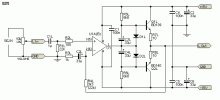
I chose DIY direction, because I have pretty good skills, and was looking for the flattest, most accurate headphone amp (with no harmonic tube sauce) with enough power to easily drive my 32 ohm SHP-9500 and my 50 ohm Sennheisers. The best and most simple design I found is from Rod Elliott's ESP website, project #113 Headphone Amplifier. You can roll the op-amp to be whatever part you desire, the parts are all readily available. It has enough power to drive bookshelf speakers should you choose in the future, and can easily drive any headphone either directly with extremely low output impedance, or through 120 ohm resistors which was the historical fashion. It's flat from 10 to 100K, and the distortion is below measurement. The gain is very easily adjustable to your preference with adjustments to R4 feedback resistor (I suggest following his advice for lower gain). As designed it uses +/-15V supply and has no output coupling capacitor. The only capacitor in the audio path is C1, which if it's a good poly will have minimal impact. There are many variations on this theme, and more complex versions of this basic idea, but this simple design performs so well I don't think they offer any real improvement. You used to be able to order PCB's for this, but no longer due to the tariff situation. I built mine on perf board. If you choose to go this route I can give you tons of information and even a drawing of the layout I used which functions wonderfully.


1761506851153.gif
 
Wow this looks like what I need, and seems pretty simple. I'd love more information on this. I'm willing to build anything that's through hole, and would likely do it on perfboard. I see in the site it mentions that the schematic is one channel, so does that mean I'd need to build 2 like they're tone boards?
 
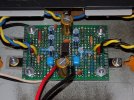
If you want stereo, yes. I built mine on one piece of perf board, and it's pretty compact. You will want to decide a heatsink solution, as the four output transistors need a heatsink of some kind, but does not need to be very beefy- I believe he mentions that in the writeup. I built my prototype as a test amplifier in a repurposed router box. Because it was flat, I mounted the transistors so they could all heatsink to a flat plate using mica insulators. (If you use individual heat sinks you can get away without mica so long as they don't touch each other or ground. I used a machine socket so I can swap op-amps, but I really only use a genuine TI NE5532 and it has never disappointed. If you are interested in my layout I can scan in the drawing and take some more photos. I did a pretty compact build but arranged components so I never had any oscillation and the performance is excellent. The power supply for this amp does need to be regulated for low noise and best performance. (more on that later).

When I want to use my prototype with headphones, I use an amplifier to headphone adapter, Project #100 Headphone Adapter which I also use to listen to my vintage germanium and tube amps that don't have a headphone output. It provides a 120 ohm output impedance and the performance is excellent even with my 32 ohm SHP-9500 headphones. The adapter uses loading/dropping resistors that you chose based upon the power output range of the amplifiers you expect to use with it. If you build this headphone amp, it has so much power you can install the 120 ohm resistors as an option and see if you like them or not.

DSCN3491.JPG DSCN3492.JPG

Actually, I really love the projects on Rod's ESP site, as I also built the most excellent two dual op-amp Project #06 RIAA phono pre-amp (shown below) and have never heard any better, but I have only had 3-4 others to compare against it. I also intend in the future to build the Project #88 High Quality Audio Pre-Amp, with source selection and tone controls, and eventually the Project #232 Distortion Measurement System, which is basically a very useful hardware input/output wrapper around a high quality USB audio interface like the Behringer UCA202 or the like.

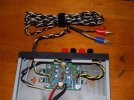
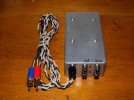
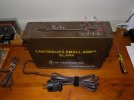
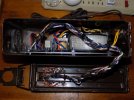
Since I want to build and use so many op-amp based designs, and did not want to build the same power supply over and over, I built a separate +/-15V @ 1A power supply in an old ammo can that uses RCA connectors, red ones for +15V and ground, and black for -15V and ground, and braid the three wire power leads together for each project. This is basically ESP Project #05d Pre-Amp Power Supply with a really good power transformer and big aluminum heat sink plate. You certainly don't need to go nearly so gonzo on the power supply if you just want the headphone amp, and +/-12V will work just fine, and a pretty low current rating. You can buy pre-made regulated power supply modules pretty cheap and they would be fine.

DSCN3493.JPG DSCN3495.JPG

DSCN3498.JPG
 
That is very cool. So do you mostly use this for mono listening? What do you use as outputs? Would having two of these be a balanced connection with two mini-XLR breakaway cables?
 
The headphone amp is one piece of perfboard, with both left and right channels built on the board. Each channel uses one half of the dual op-amp and two transistors. Currently the outputs are binding terminals/banana jacks for test speakers when I use it as a test amp, or my headphone adapter that I linked to when I listen to headphones. Each channel has a single ended input (signal and ground) using RCA connector. You could design this to use balanced inputs, but there is really no reason to.
 
The headphone amp is one piece of perfboard, with both left and right channels built on the board. Each channel uses one half of the dual op-amp and two transistors. Currently the outputs are binding terminals/banana jacks for test speakers when I use it as a test amp, or my headphone adapter that I linked to when I listen to headphones. Each channel has a single ended input (signal and ground) using RCA connector. You could design this to use balanced inputs, but there is really no reason to.
Interesting. Maybe I'll try this.
 
Sorry I'm so late seeing this. So this is a preamp that has a full integrated amp for headphones only?

Not quite. It's a preamp that has a smaller amp inside to drive headphones. The NAD 1020 is not alone in this respect, a lot of preamps have this feature. What makes this one so special is the musicality of it. I was listening to one just last night with my vintage Sennheiser headphones, and it sounded amazing.
 
Not quite. It's a preamp that has a smaller amp inside to drive headphones. The NAD 1020 is not alone in this respect, a lot of preamps have this feature. What makes this one so special is the musicality of it. I was listening to one just last night with my vintage Sennheiser headphones, and it sounded amazing.
I didn't know that about preamps. I know that many integrated amps have this, but they are very noisy without a headphone attenuator.
 
There is a reason that dedicated headphone amplifiers are a thing- While it's considered "easy" to drive headphones, it is actually difficult to do it right. Most devices that drive headphones use op-amp based outputs, because they are running on battery voltages, or are very compact, but that is good enough for your typical high impedance phones. Op-amps are very current limited, and are really only good down to about 100 ohms or so. If the only headphones you want to drive are higher impedance, like your 250 ohm set, you can use almost anything. But, if you have a range as you say, some go as low as 32 ohms or even lower. It sucks trying to listen to my laptop, or media player or any other "standard" headphone driver with my 32 ohm headphones because I have to crank the volume to max to get any decent level out. They in general will sound "OK", but they are overloaded, and you are not getting the best performance by any measure.

The "dedicated" headphone amplifier circuit in most pre-amps is just a cheap op-amp based output, just as bad at driving lower impedance headphones as the others. I have not done a deep dive into the schematic of that particular pre-amp, but the fact that it is high quality is encouraging, but it's also a dinosaur from the 1980's that will be very large on your desk, expensive/difficult to find, and probably need recapping and restoration even if you do.

To drive headphones with a power amplifier, you will typically have resistor reduction network in the amp to help with some of the noise, and try to set a reasonable output level per volume knob position. I have built a really good passive resistive headphone adapter that I use to listen to vintage power amplifiers that do not offer a headphone output. It's based upon another Elliott Sound Products ESP Project #100. While this allows me to listen to and accurately evaluate the quality of a wide range of tube and transistor amplifiers, the very idea of spending the power, and introducing the distortion and noise to amplify a signal to drive power into large speakers, only to pinch it down at the end to very small and noise sensitive headphones is engineering lunacy, so I don't advocate this route for dedicated headphone listening.

The headphone amplifier that I recommended is perfect for this dedicated role- it has the speed and accuracy (and phenomenally low distortion) of the op-amp, but with a transistor output stage has the power to drive even small speakers. It has very low noise, and is very compact. For a DIY circuit you are looking to build, it will be very difficult to find any better with this level of simplicity. However, if you are looking to purchase a headphone amplifier, there are many excellent and compact ones out there- just make sure they brag about being good for low impedance phones- If they don't assert they excel in that area then it's probably your basic op-amp output and you can do better.
 
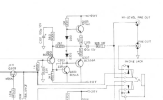
I just happened to find the schematic for the NAD 1020 in the Audiokarma database.

Since it is a pre-amp, driving a low level signal out, it uses the same amplifier for the pre-amp out to drive the headphones. Does the output circuit look familiar? It's almost exactly the same push-pull class AB NPN-PNP transistor output stage with diode biasing as the ESP headphone amp, except because it is not referenced to ground, it has to use a 100uF electrolytic coupling capacitor to drive the output. This will have excellent fidelity, but I'm betting the ESP amp will be even better. Notice they are using a 220 ohm 1W resistor in series with the output- This type of output will have so much power that you can do this and still drive 32 ohm and lower headphones with authority. Rod suggests using a 120 ohm resistor and the concept is confirmed here.

This is actually a pretty cool circuit- it would be fun to breadboard, and is a good alternative to the op-amp driven version if you wanted to experiment with all transistors. It uses only two flavors of transistors, which can be almost any small signal NPN PNP pair that are made to work together. The BD139/BD140 would work great, but there are others that I can recommend if you wanted to do this.


1763057080096.png
 
Last edited:
I just happened to find the schematic for the NAD 1020 in the Audiokarma database.

Since it is a pre-amp, driving a low level signal out, it uses the same amplifier for the pre-amp out to drive the headphones. Does the output circuit look familiar? It's almost exactly the same push-pull class AB NPN-PNP transistor output stage with diode biasing as the ESP headphone amp, except because it is not referenced to ground, it has to use a 100uF electrolytic coupling capacitor to drive the output. This will have excellent fidelity, but I'm betting the ESP amp will be even better. Notice they are using a 220 ohm 1W resistor in series with the output- This type of output will have so much power that you can do this and still drive 32 ohm and lower headphones with authority. Rod suggests using a 120 ohm resistor and the concept is confirmed here.

This is actually a pretty cool circuit- it would be fun to breadboard, and is a good alternative to the op-amp driven version if you wanted to experiment with all transistors. It uses only two flavors of transistors, which can be almost any small signal NPN PNP pair that are made to work together. The BD139/BD140 would work great, but there are others that I can recommend if you wanted to do this.


View attachment 3633363
Really cool analysis. Now to try and determine cost and performance of building vs buying a 1020. I am also looking at building a nice separates system and am thinking that NAD looks like it has a nice preamp. Of course, I'm sure there are many you can build. Whatever is cheapest and has the cleanest power output is my goal.
 
Checking 'fleabay the NAD 1020 is going for upwards of $150 - $200 unrestored, more if it's been gone through. I can build a LOT of headphone amps with the same or better circuit for that kind of scratch, but then I'm a scrounger with a big junk stash. It's also going to take up a lot of space on your desk just for a headphone amp.
 
In my dedicated headphone system, I used a Pro-Ject Headbox II into a Cary Audio SLP 50B tube preamp.
Pure clean music. At the time I was using Grado RS2.
It was a joy.
 
Nelson Pass's ACP+ headphone amp/preamp is just about ideal for this. It is easy to build. If you are into the steampunk look, you can run it without putting it in a case. It sounds excellent (class A) and makes a wonderful pre-amp.


I've built two and have used them every day for about three years.

The hardest part is putting them into a case. You could put them into a wooden box or metal. I've used Modushop cases, which were very affordable.

The only downside is the size. The pcb is larger than it needs to be.

If you can work with that, there is no downside. They are wonderful. The kit makes it easy, but you can also find a bill of materials on the big DIYAUDIO thread on the ACP+ and pick your own components.
 
That looks really outstanding- you really can't do any better than that performance. They are sold out right now. A bit pricey for me, but one could always just buy the PCB and go from there.
 
Back
Top Bottom