Yeah, on my rooftop antenna intalls, I've always used used grounding blocks running to a cold water pipe. Also did this when installing my satelite TV dish. Good thing, as just had a lightning strike, that took out my back yard maple tree. Also, for mention of satelite TV travel, quite common for people here in the Detroit, MI area to have cottages up north. Many just install a second dish up there, and take the box along when they go.


You are using an out of date browser. It may not display this or other websites correctly.
You should upgrade or use an alternative browser.
You should upgrade or use an alternative browser.
Best fm antenna to buy? Roof type.
- Thread starter KevinCorr
- Start date

Bubo
Super Member
Yeah, on my rooftop antenna intalls, I've always used used grounding blocks running to a cold water pipe. Also did this when installing my satelite TV dish. Good thing, as just had a lightning strike, that took out my back yard maple tree. Also, for mention of satelite TV travel, quite common for people here in the Detroit, MI area to have cottages up north. Many just install a second dish up there, and take the box along when they go.
Renzor, are you grounding to an indoor water pipe?
Walking around the house, I have:
* grounded to outside spigot by cable company
* Grounded to a grounding rod by the other cable company
* Yet anther cable company grounded to the box covering the electrical service access point.
* apparently undgrounded by Direct TV, nice grounding block connected to nothing, I guess the side of my house is the ground.
* By local code, the entire house has electric conduit, which is grounded.
Since my electrical skills end with the light bulb, its probably time to call in one of my EE friends; so I don't burn the house down. I fully expect to take a lightening hit, there have been many in my neighborhood, usually the cell antennas get hammered, but also the occasional house takes a direct hit. My neighbor who does repairs for the phone company tells me he regularly repairs phone POP junction boxes that are literally blown apart by the hit, but protected the phones inside.
In order of importance:
1. Don't fall off the roof
2. Don't burn the house down
3. Don't fry my nice audio equipment or plasma TV
4. Get great reception and cut the cable aka Direct TV
Yeah, my current satelite TV dish is grounded to a water pipe in the basement. Did the install myself, and seems to work quite well, as had a few lightning strikes around here lately. Know what you're saying though, as managing some commercial solar power projects lately, and the whole panel rack is grounded to two 4' copper plated rods, driven into the ground. Far as safety on the roof, I have a full body harness for work that's easy to use. Just put it on with a rope to the chimney, if not comfortable up there. Didn't think about this as a kid though, as helped install rooftop antennas up 20' on extension ladders, and amazingly never got hurt. More amazingly, my dad just let me do it, as was his ladder. Quite a change, as seems many parents wont even let their kids walk to school anymore.

KevinCorr
Super Member
I will be sure to have someone standing by with a video camera in case I can be on America's Dumbest...
Grounding to plumbing used to be a sure bet but now they are using a lot of plastic so be sure to follow the pipe all the way out to make sure there is not a section of plastic. Common to cut in a plastic repair section.
Grounding to plumbing used to be a sure bet but now they are using a lot of plastic so be sure to follow the pipe all the way out to make sure there is not a section of plastic. Common to cut in a plastic repair section.
Bubo
Super Member
I will be sure to have someone standing by with a video camera in case I can be on America's Dumbest...
Grounding to plumbing used to be a sure bet but now they are using a lot of plastic so be sure to follow the pipe all the way out to make sure there is not a section of plastic. Common to cut in a plastic repair section.
Good to know.
Maybe if the hit is strong enough, the lightning will arc around the plastic repair providing protection (LOL)
My neighbor did a walk around my house yesterday, who does this for a living, is going to ground the masts to the electrical meter cover box; and, the ungrounded-grounding block that Direct TV installed will be grounded to a 5' copper plated grounding rod. 8' feet minus 3' with a hacksaw, my friend believes this is adequate and we won't spend all day pounding the rod. This gets us a good clamp, the rods they sell for TV are too thin for the heavy duty $3 clamps.
Both FM antennas will have the approx zero loss lightning arrestor-baluns that sacrifice themselves if hit. The 4-1 Coax switch will be grounded to an electrical outlet, or a ground lug on my power conditioner if I can find one.
My TV antenna (Clearstream4) will be grounded at the soon to be grounded exterior grounding block, in addition I will be installing a grounded-fused-lightning-arrestor in the basement and grounding to a copper water pipe

If I don't fall off the roof.

Last edited:

RogerKulp
Super Member
I guess you might need a rooftop/external antenna,if you live way out in the boonies,have some nice vintage gear,and want to enjoy it,but otherwise I see no need for one.Good luck. This a gray area for some reason, almost intangible to me. I'm lucky I can pull in all the locals I want, and go to the net for the other-market stations. I'd like to get WSM Nashville on a good night without turning on my computer or causing a power shortage firing up some motor-operated apparatus. I'm probably exaggerating but it could be easier...
Seems like you've discovered the difference between highly sensitive/selective tuner front end sections. Years ago, was using a Dynaco AF6 tuner with rooftop rotor antenna. This set up is still highly regarded to this day. Biggest advantage of a rooftop rotor set up, is highly directional. You'll sometimes get two or three stations on the same frequency, by just moving it around. I used to keep a log book of this, that had a couple hundred stations in it. Atmospheric conditions have lot's to do with this, as sometimes couldn't get a distant station at all the next day, that was strong night before.
I know it's been said countless times,but any radio,or tuner,from the start of FM,mid to late 40s,up through the 70s,is going to blow any modern tuner out of the water,for sensitivity,selectivity,and the sheer number of stations you can bring in without an antenna,even the cheapest GE,Airline,or Sylvania tabletop from the tube era,will blow away any modern receiver.
KevinCorr
Super Member
"...any radio,or tuner,from the start of FM,mid to late 40s,up through the 70s,is going to blow any modern tuner out of the water,for sensitivity,selectivity,and the sheer number of stations you can bring in without an antenna,even the cheapest GE,Airline,or Sylvania tabletop from the tube era,will blow away any modern receiver..."
I would guess so since we never had big antennas years ago. The most sensitive radio I ever saw was my gramps 47 Buick.
I would guess so since we never had big antennas years ago. The most sensitive radio I ever saw was my gramps 47 Buick.


KevinCorr You suggest something I have done for years. I just so happens just about the best radio's ever put in a car especially for AM Broadcast reception were the WonderBar radios installed in Cadillac's in the early 1960's. These radios are sold state. Above is a WonderBar unit out of a 1964 Cadillac available on ebay for $59.95 as you can see it would not be to hard to built it into a metal case. Hook one of these to a good speaker and they sound just like an old console radio. A small ported speaker works great. Some how listening to bee bop on one of these radios just sounds right. My WonderBar is out of a 1967 Cadillac. The AM broadcast sensitivity unlike anything built today. The AM/FM units are fairly rare, and the very few units with FM stereo are rare and valuable.
Last edited:

KevinCorr You suggest something I have done for years. I just so happens just about the best radio's ever put in a car especially for AM Broadcast reception were the WonderBar radios installed in Cadillac's in the early 1960's. These radios are sold state. Above is a WonderBar unit out of a 1964 Cadillac available on ebay for $59.95 as you can see it would not be to hard to built it into a metal case. Hook one of these to a good speaker and they sound just like an old console radio. A small ported speaker works great. Some how listening to bee bop on one of these radios just sounds right. My WonderBar is out of a 1967 Cadillac. The AM broadcast sensitivity unlike anything built today. The AM/FM units are fairly rare, and the very few units with FM stereo are rare and valuable.
Ha! That's just like the one in my '62 Caddy which is a tube unit. The standard Cadillac AM radio became SS after 1964 I believe. The Wonderbar on mine keeps on seeking and never stops though. AM-FM units were SS only. FM-Stereo became available on '63 Cadillac due to insistence of the then-Cadillac General Manager, Harold Werner who was an audiophile himself! You're 100% correct, early Cadillac AM-FM units are very rare- even the mono version.
Incidentally, I just ordered the Magnum Dynalab ST-2 earlier today. Will post review when I get it all set up.
Last edited:
A friend of mine had a Philco console radio cabinet minus all of the electronics; beautiful wood he had one of these WonderBar radios so he built it into this cabinet. It looked great and sounded even better.
Last edited:
Caddy62, I have always liked the 1962 Cadillac, dual-coupling Hydramatic and the great 390cid V8. My Dad had the Fleetwood version The only year that had fins I thought looked better was the 1964. I know these cars just about down to the last nut and bolt. I have had several Cadillac's of the 1960's which is where I ran into the great WonderBar radio. If you want to get your radio functioning properly send it here http://www.wonderbarman.com/ he is highly recommended in vintage Caddy forums.
Last edited:
Bubo
Super Member
I finished my antenna project and this is what I learned:
10/3 Just finished a long info exchange with a former broadcast antenna installer or engineer, not sure which one but good info.
1. Use the cable, connectors and tools all from the same vendor, Belden solid copper conductor is where I ended up.
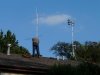
2. Like in the Diagram supplied with all equipment, everything has to be tied to ground and the grounds must all be connected together, the closer to the dirt the better. I ended up with 2 x 8 foot grounding rods on each side of the house tied to both masts, then connected the rods to the power line in box on the outside of the house forming a ring. A strike should divide with half going to each rod.
* Just learned that each coax will need an dedicated rod, so I have to add 4 more rods, then tie the 6 rods together.
3. A whole house surge protectors only costs $50 plus switches and should have been the first step in the project. A strike can travel though the ground and come back into the house via the electrical systems frying everything. This happened to a friend who is an EE, when his neighbor's house was hit. Un-grounded antenna arced through the house to the breaker box and fried fridges, tvs and lots of other appliances all over the development. My friend lost 5 appliances from 3 houses away.
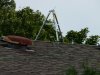
4. I hired a roofer who just finished installing a roof on a new build next to my house to install the tripods, 2x6 cross braces were installed by them in the attic and attached to the trusses. Paid $200, worth every penny. They also installed the ground wires on the tripods and eye rings to the roof. I handed them a bag full of 24 rings, unfortunately they installed every one of them during the 5 minutes I was away, then told me they thought it was too many? My ground wires on the roof aren't moving anywhere, hopefully the tar job they did won't leak all over the place either.
5. We installed 3 FM omni directional antennas, and one UHF aka HD tv antenna. The signal on all 3 is outstanding and IMHO the grounding actually improved the TV picture more than any of the over hyped power conditioners ever did. I am pulling in any decent FM signal within 35 miles of the house. Antennas are mounted approx 35 feet above ground, I am on high ground if there is such a thing in the Chicago area, there are river bottoms which would be insurmountable.
6. Total cost est $1000, $500 parts and $500 labor. $200 for the roofers, and $300 for a friend who installed roof antennas a long time ago. The entire job was probably close to 40 man hours. In addition to the joy of good FM, I cut the cable to Direct TV which will save me $1000 a year. The over the air picture and sound quality are superior to Direct TV to my eyes and ears.
7. If I did it again
A. Day one, Install a whole house surge protector first and have the systems grounding examined and brought up to code.
B. Install 2 grounding rods (one per mast away from electrical service) on each side of the house or at least a few feet apart and tie them to the electrical ground outdoors.
* Install 1 rod per coax.
C. Hire a roofer to install the tripod and cross brace with 2x6 inside the attic. Worth every penny.
D. Plan the house coax wiring like a commercial or military installation in 3 segments. Roof to ground block-rods (4 70 foot runs), from ground lugs to patch panel in basement (4 12 foot runs). On the patch panel install mil spec gas fuses on each line $20 ea. Patch panel to each room that you want antenna in (5 runs longest to attic then back down into a bedroom via the inside wall approx 60 feet). To get to the attic we used a return duct on the HVAC system.
E. Install the inside runs to the patch panel first. Install from the roof to the ground lugs (s) second, then from the lugs to the patch panel. Test the roof runs before attaching them to the grounding lugs, we pulled the wires into the LR via the sliding door and attached them to an FM receiver with signal strength meter and charted every station's reception side by side.
F. Mount the grounding lug in an outdoor attachable plastic enclosure, I used one intended for a pool timer. $20 on Amazon.
* I was told to attach to the lug where the coax is vertical since lightning likes to run strait line to the ground. So the lugs may be out in the weather and coated with pure silicone instead of in a box. Need to think this one through as I don't want water aka ice in the connectors.
G. Leave at least 6 feet of cable gently coiled at each attach point, base of antenna, a loop tied to the gutter downspout we attached to, a loop at the bottom next to the block and loops at the patch panel and plenty of slack in the rooms so you can move the wire around. Don't pull the cable tight anywhere, firmly attach to the mast with lots of high quality electrical tape. If you have to move something, replace an antenna or cable end or make a repair the loops will save you loads of heartburn.
* I may have been wrong on this one from a lightning strike point of view, as I now understand it, run the coax direct to dirt, insert grounding lug where coax is running vertical down the house and direct to a rod. Coax and ground wire running parallel or almost parallel and not exiting coax at 90 degrees as lightning may bypass lug and stay on coax.
* Where the coax enters the house add a drip loop at least one turn around your hand, and add a small piece of close fitting gas pipe into the loop to create more resistance, making it more attractive for the lightning to follow the ground wire and not the coax to your nice stereo.
H Use the best materials:
Channel Master tripods with tar patches for feet included, amazon $35 delivered. Very study.
Belden solid copper core 3x shielded coax and connectors and tools. 100 foot run has zero loss. 500ft $75, tool $90, 25 F conns $18. From http://www.tselectronic.com/
1 1/4 sae electrical conduit for your mast $9 for 10 feet and superior to any $30 antenna company mast. Buy at any home store.
Mil spec gas fuses can buy from HAM radio companies, I purchase some from L-com but should have gone for the MIL spec ones instead. I am sure both work fine. $20 ea. These are as good or better than any surge protector's coax fuses and you can replace the fuse yourself for $10.
Avoid splitters or amps for the FM signal, use multiple antennas and or a coax switch from a HAM store.
Attachments


Last edited:
KevinCorr
Super Member
Bubo- Great info.
When I get the roof, ceiling insulation finished I will give it a try.
My Dad had a 56 Caddy still when I got my license in '61. We drove that car to Alaska when I was 15. It had a great radio too.
Unrelated to FM, but speaking of Caddys:
In the winter of 1975/76 I was passing through the Ozarks, Arkansas and found a 1953 Caddy that had been converted into an "El Camino" look alike. A very good job, I was told it was done at the Army base in Little Rock. I drove it all the way back to Alaska. I had a few break downs but had great luck getting help on the way. It seems that car made guys sympathetic to get me home. It was black and had a separate bed from an international pickup. The radio had been changed to a cassette player and I had a good collection but it would have been nice to have the stock radio. One guy that helped me was "the Cadillac Man" in Kansas City. He had a junk yard of only Caddys. He had a beautifully restored model of almost every year. He said he would take care of me till I got home then I was on my own. Nice guy.
transmaster- I passed through Cheyenne on that trip too. I spent a few days near they on a sheep ranch where I had a friend.
When I get the roof, ceiling insulation finished I will give it a try.
My Dad had a 56 Caddy still when I got my license in '61. We drove that car to Alaska when I was 15. It had a great radio too.
Unrelated to FM, but speaking of Caddys:
In the winter of 1975/76 I was passing through the Ozarks, Arkansas and found a 1953 Caddy that had been converted into an "El Camino" look alike. A very good job, I was told it was done at the Army base in Little Rock. I drove it all the way back to Alaska. I had a few break downs but had great luck getting help on the way. It seems that car made guys sympathetic to get me home. It was black and had a separate bed from an international pickup. The radio had been changed to a cassette player and I had a good collection but it would have been nice to have the stock radio. One guy that helped me was "the Cadillac Man" in Kansas City. He had a junk yard of only Caddys. He had a beautifully restored model of almost every year. He said he would take care of me till I got home then I was on my own. Nice guy.
transmaster- I passed through Cheyenne on that trip too. I spent a few days near they on a sheep ranch where I had a friend.
Last edited: