• The move to the new server is done. There are some software and database maintenance updates in process. This has us passing the hat around to help out. We appreciate any donations. Seriously, even a dollar helps. The payment page may be found here - https://www.audiokarma.org/support.html

Best Isobarik and Transmission line designs?

thedelihaus

Nocturnal transmissions
Okay, folks, I'm interested in hearing opinions on what isobarik and what transmission line speakers you've heard, and loved.

Seems KEF and Linn are kings of isobarik design. And IMFs and later Irving's other inspired company, Fried, are the much-ballyhooed transmission lines.

But what about the other less-sung heroes? The Rega transmission lines? Or the transmission line inspired makes like DCM?

What isobariks and transmission lines have you heard, felt were successful, and loved?
 
Register to hide this ad
Rega Elas are TLs and my main speakers. I think it is a well executed design.
 
Paul

I might be wrong, but I never heard of any KEF Isobarik designs. In some models, like the great 104-2´s I once owned, they used a coupled cavity loading. This principle also uses two woofers in tandem, but they connect to the outside world via a large hole.

The Isobarik principle, as seen in Linn DMS / PMS ( which I also owned ) and Saras have two drivers in tandem, but one of them is inside the sealed speaker box.

As for transmission lines check out TDL. Never owned any, but listened to more than a few, and they sounded outright good.

Jorge
 
Iso is certainly great for saving space, but I've never noticed a great improve in sound because of it's use. Anybody heard an Iso design that sounded remarkable?
 
I seem to be drawn to transmission line designs. I loved the DCM Image Masters and the TimeFrames,. I've had a couple of pair of each over the years and now have remorse for letting them go.
My new favorite transmission line speaker is my Vandersteen 1C's.
If anyone knows where to find some Image Masters give me a PM please!!!
 
MY favorite TL was the economical Meadowlark Kestrel (Hot Rod version). Not the 2 but the original Hotrod. One of the most enjoyable speakers I have owned.

RC
 
One of the very best sounding speakers I've ever heard used an isobarik woofers setup. It was Induction Dynamics ID-1. The design has since changed but back in the late 90's/early 00's they used isobarik 15's in the bottom of the big guys and they sounded amazing.

As for TL's, I like these quite a bit but I'm biased. A few people heard them at the fest. Maybe somebody there will chime in.

I've heard Robie's Regas and they're very nice indeed.

Ray
 
Paul

I might be wrong, but I never heard of any KEF Isobarik designs. In some models, like the great 104-2´s I once owned, they used a coupled cavity loading. This principle also uses two woofers in tandem, but they connect to the outside world via a large hole.

The Isobarik principle, as seen in Linn DMS / PMS ( which I also owned ) and Saras have two drivers in tandem, but one of them is inside the sealed speaker box.

As for transmission lines check out TDL. Never owned any, but listened to more than a few, and they sounded outright good.

Jorge


Thanks for your input, Jorge.

I was under the impression Isobarik was more of a loading method than an enclosure type, positioning the woofers face to face, or coupled with the help of a small chamber.

Are you saying the enclosure needs to meet certain requirements as well?
 
I have a B&W subwoofer containing two 8" drivers. A discussion here showed a concensus that it is an isobaric design. It literally contains the two drivers, face to face, with one being in a sealed space and the second having a tunable vent on the top.

I think that the KEF 105 are classified as isobaric. I might be wrong.
 
Paul, I recommend checking out JMLabs "Daline 6.1"

The Daline is basically a tuned chamber coupled to a transmission line. The advantage as I understand it is that you can use it with a MTM arrangement, so that both mids have the same chamber, and that chamber then opens into a TL.
 
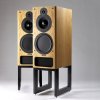
Another company well known for their TL enclosures is PMC. I heard a set of IB2's once and they knocked my socks off. If I had $16k to spend on a speaker, they would be on the short list. Absolutely stunning, real bass from cabinets half the size of my zero9's.
 

Attachments

  • imgResize.php.jpeg
    imgResize.php.jpeg
    115.7 KB · Views: 51
Odd you should mention this thread- I just made a post today regarding Toby brand transmission line type speakers- I am still a huge fan of his products, he does TL every bit as good as DCM, even better in my book!
DC
 
I think the standard isobarik design is two woofers with a sealed chamber between them, one facing the outer world, and the other in more or less and acoustic suspension enclosure. The idea is that the outer woofer doesn't have to work against changing pressure as it moves in and out, since the inner woofer is moving also, keeping the volume of the chamber unchanged. So response ought to be more linear, even at high volumes.
Distortion may be minimized by mounting the inner driver backwards so that the cone flexures etc are equal and opposite.
Not sure how the resonant modes of the inter driver chamber are dealt with.
I think the Linn Isobarik put the design on the map, though one of the companies named Royal claims to have marketing essentially an isobarik design in the early 60s.
Transmission lines are complicated, both to describe and to identify. On one hand, you have the disbelievers who think that they are actually just a very heavily damped cumbersome vented speaker, and they are not a seperate category at all. And then there are those, like DCM and at least one early Infinity design, that stretch the definition. The Infinity used dryer vent hose coiled up inside a regular size box that looked like a simple ported speaker. And the DCMs I've seen seem like a TL/port hybrid, having a short line with a port or ports that seems to emulate good TL behavior, without the size, weight, and expense. Fried's resistive line tunnels also behave somewhat like TLs with the same benefits (but more so, in terms of simplicity of construction).
Bailey invented the modern TL and John Wright etc at IMF made them successful (with Bud Fried's help). Lentec, Radford (sold in the use by Adionics), and Exposure also made successful standard type lines in England in the 70s. The premier ESS speaker used a TL, and Innotec made a small splash with their dual 5 1/4 line in the US, and several other companies tried their hands at them here, but only Fried really met with much success. Fried and TDL arose after IMF's parent company went bust, and Wright and Fried parted ways.
I don't think Kef has actually made TLs -- their drivers were almost ubiquitous in them for a while, but KEF was much more interested in alignments that were more quantifiable -- they were very early adaptors of computers and acoustic suspension speakers, and than passive radiators and bandpass enclosures are much easier to describe mathematically than TLS, which, supposedly, now can be modelled, but even so need tuning anyway.
 
The Bose radio is a transmission line. Does that count?

No. Not really.

Unless, according to the tenets I set up, you feel the radio meets these three crieria- you've heard them, felt it successful, and loved it.

Add to that it's a radio with built in speakers, and it's out by default.

The Bose radio is quite successful in sales- but as a full-range or close to full range speaker with heavenly sound, I'd say it's not successful at all.

Loved? Yes- in a way- many folk love the radio- for it's compact design, simpleton ease of use, unassuming (spouse-friendly) looks, and status symbol brand name.

But not as much loved by folk who embrace either an audiophile stance, or a hearty love of accurate and realistic musical reproduction. Mention of the name within many audio groups and prepare for a storm of negatives.

Heard? It's nearly impossible to NOT have heard one of these- they're ubiquitous.

But lastly, although it has a single speaker driver in it, it does not qualify, in my book, as a pair of speakers, or a speaker by it's lonesome, but a radio with a single driver in it.


I'm not knocking the radio- it serves it's purpose, and does it's basic job of delivering music- the ultimate end result.

I just prefer something a little more honest.
 
Is there any commercial TL speaker with Isobaric driver topology?

I have seen such designs on the net, mainly B139 based TL subwoofers, but I'm not sure anyone has produced a commercial version.
 
Its hard to see how the Bose is actually a transmission line -- the line isn't close to long enough, and its not damped as far as I know. I think it functions more like a variant of a ported speaker, with a very long port giving the equivalent of a larger enclosure -- that's just a guess.
As to the combining of TL and Isobarik, I think that's sort of gilding the lily -- part of the point of a TL is that there is little loading of the driver by the enclosed air.
 
I had a pair of Kef Transmission Line speakers, they used the flat B139 woofer, actually the same drivers and crossover as the KEF Concerto's.

They had a triangular internal design with a vent in the front at the bottom.

They sounded good but needed heaps of power, and I mean heaps. Then the Kef Tweeters were susceptible to burnout.

But the bass was magnificent.
 
I think my Rega Juras are TL. They are similar to Robie's Elas. They sound fantastic, and the bass out of such a small footprint is simply amazing. And it is very tight, tuneful bass. I've also heard IMFs, Timewindows, and own Timeframe 600s. The IMFs and Regas sounded better than the DCMs to me, but the DCMs weren't bad at all. The IMFs I heard at an estale sale, set up with Mac equipment, tuned to our local classical station playing opera. Simply amazing speakers. Too bad they were priced at what they were actually worth...
 
Back
Top Bottom