• The move to the new server is done. There are some software and database maintenance updates in process. This has us passing the hat around to help out. We appreciate any donations. Seriously, even a dollar helps. The payment page may be found here - https://www.audiokarma.org/support.html

Best loudness contour in the business?

McIntosh C-26 Pre Amp has a loudness knob that you can dial in as much as needed. It is great. Set the amp a little above your normal listening level. Then add the loudness to reduce the volume for lower listening levels. Much better than having it tied to your volume knob with a pre set taper.

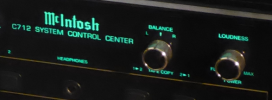
My C-712 preamp has a Loudness knob too :

1787931781175.png

I cleaned the pot, replaced the caps, but it is still scratchy...

My ARC SP3A1 also :

1787932002771.png

No worry on this, since repaired-modded.

I'll be honest : I barely use the loudness or tone controls, except at low volume and with small speakers... ;)

T
 
I'll be honest : I barely use the loudness or tone controls, except at low volume and with small speakers... ;)

T
That's what she said!

f28fd703-b80a-40a4-8238-76faba80fcdd.gif
 
I think the main reason "loudness" was used is because our ears are less sensitive to certain frequencies at lower volumes to maintain what would be considered a "flat" presentation as according to the human ear which does not perceive linear sound linearly, but instead perceives dips and peaks heard at certain frequencies from this linear information. Even new equipment measuring as perfectly flat/ linear can benefit from loudness as according to the Fletcher-Munson curves. At lower levels, it makes music sound more realistic, satisfying, and full. This, despite the fact it's technically a deviation or departure from true linearity many strive to achieve with their sound systems. At the same time, a truly high-end system often does not leave people "wanting" more or something better with a slightly different, non-linear FR curve, and that's ok too. It really just depends on what people like and prefer.

There are other methods to achieve something similar as mentioned using tone controls or an equalizer. I use a mastering processor/eq and target better [general] linearity first (within the listening room itself whose irregular shape and wall reflections also cause deviation from true linearity to begin with). This is done through room correction using rta. Then, I apply a very slight Fletcher-Munson curve on top of that. There are many different ways of achieving something similar.

This ^^ is exactly why most HiFi equipment had Loudness compensation.

Regardless of how accurate, flat, expensive a piece of audio equipment is, when the SPL deviates from the normal level of the music (typically much lower than concert-levels) the human ear is less sensitive to HF and LF and the midrange becomes more prevalent in what you hear. The Loudness Compensation is a direct result of this research by Fletcher & Munson (Bell Labs at the time IIRC) so that you can turn down the volume, and still hear all of the detail. Unlike dynamic compression that accomplishes a different goal for low-volume listening, this was not encoded into recordings and was therefore accomplished by the preamp section of a system.

Many (most) simply had a button/switch, which didn’t account for changes to the volume settings, some had a separate pot on the volume stack, even fewer had that and a variable control for the influence of the loudness contour. In my opinion only those with a variable AND a volume/gain connection were really very useful beyond simply boosting the bass and treble for sound preference.
 
I'm a team loudness guy, who also plays with his tone controls, even when people are watching.

I have a Nikko NR-819 with one of the most aggressive loudness buttons I've ever heard. With flat controls it sounds like a Yamaha of similar vintage. Nice, clean, natural sound.

Hit that loudness button and it completely changes the character of the sound. Blindfolded, you would swear it was a cap coupled receiver made in 1972.
 
I'm another who prefers the adjustable loudness contour control that both Vintage Marantz and McIntosh uses.
 
My wife says my loudness button is on all the time. I also enhance the signal with a parametric equalizer all the time. I listen most often at about 70-80db but up to 95db for short periods. All the same settings.
 
In the past I found the adjustable loudness on my Mcintosh c33 and 4100 to be among the better I've owned. I used to keep the eq flat and the loudness slightly below the half way point mainly because it was there to use.
Currently none of my 3 set ups have loudness and I don't feel like I'm missing anything.
 
I had to laugh this weekend. This thread made me want to try the loudness control on my Nikko receiver just for s&g. Back when I went through it I made sure it worked but I never use it. I was quite surprised to find that all of the buttons had been pressed. So hi and low filter, hi blend and loudness were all on and fm muting was off. Our son and daughter in law along with there two kids (the three year old loves to fiddle with grampas stereo) were here the last two weekends. So it’s likely it had been that way for the entire week and I never noticed!
Cheers………………….. Todd
 
Back
Top Bottom