Many years back I had of all brands a vector research F&F 3 head and used different tape but mostly SONY UX PRO and it recorded some great tapes that used to get me past the door man at rockafeller to see some great jazz shows and tower of power and such.But the door man said the tapes made his car stereo come to life.Most store bought tapes were so bad back then.


You are using an out of date browser. It may not display this or other websites correctly.
You should upgrade or use an alternative browser.
You should upgrade or use an alternative browser.
Best sounding/recording consumer cassette deck ever made?
- Thread starter jamiecantar
- Start date

Pay no attention to the HK CD491 at least until I can find myself a mint one at an affordable price.
They are damn near impossible to find in mint condition and when they do show up they bring top dollar.
I just can't bring myself to pay as much for a cassette deck that parts are damn hard to come by and techs to work on them even harder.
When for about the same money I can buy a Revox A-77 that parts units are plentiful and I have a tech that knows them like the back of his hand.
But they are amazing sounding decks with a strong following by those the know.
Cheers
PQ
They are damn near impossible to find in mint condition and when they do show up they bring top dollar.
I just can't bring myself to pay as much for a cassette deck that parts are damn hard to come by and techs to work on them even harder.
When for about the same money I can buy a Revox A-77 that parts units are plentiful and I have a tech that knows them like the back of his hand.
But they are amazing sounding decks with a strong following by those the know.
Cheers
PQ

MaxxVolume
Lunatic Member
I`ve owned several decks over the years, my personal favorites are the Pioneer CT-F1250 (completely rebuilt by a skilled tech), and a Teac R-888X (also had "hands-on" from a good tech). Both are capable of exceptional quality recordings, proving that cassettes are not a dead format....

danj
modern primitive

I think you're a smart guy. I have a pair of Sony PCM-7010F Digital Audio Tape Recorders. They were used for broadcast post production, radio commercial mastering, and DAT distribution for copy to broadcast cart. Interestingly enough, I also have a Sony TC-K950ES Compact Cassette Recorder which when loaded with Maxell UDXL IIs presents recordings pretty much indistinguishable from DAT recordings. Based on that experience, I'd say, since the Sony TC-K950ES was getting a best result, I could also say that the deck was the best; however, reality is there were/are other decks out there that are also as capable as my Sony, so I too don't think there is a declarable winner, and really, does it matter.
Didn't I say that best is in the ears of the beholder?
I agree, Danj, but would also add 'eyes of the beholder' too. After all, no cassette deck ever made can sound better than a decently recorded CD played on an under $100 CD player. However, who wouldn't like to have a Dragon to show off? I have a beautiful, mint JVC KD-85 deck that I play now and then, just for something to do. It sounds good except for the occasional drop-outs on the tapes, but I know it has the same limitations that all tape recorders have.Didn't I say that best is in the ears of the beholder?

twiiii
Lunatic Member
I would probably say the Nakamichi 1000 ZXL or 700 later version. And then of course there is the dragon. The best of the Revoxs did a pretty nice job as did Tandberg. But for the best Nakamichi. But why would pay 3600 dollars for a cassette machine? I never paid that much for my professional studio Ampexs. Even a Studer PR 99 R2R didn't cost that much.
danj
modern primitive
I agree, Danj, but would also add 'eyes of the beholder' too. After all, no cassette deck ever made can sound better than a decently recorded CD played on an under $100 CD player. However, who wouldn't like to have a Dragon to show off? I have a beautiful, mint JVC KD-85 deck that I play now and then, just for something to do. It sounds good except for the occasional drop-outs on the tapes, but I know it has the same limitations that all tape recorders have.
Beauty is in the eye of the beholder.
KentTeffeteller
Gimpus Stereophilus!
Its true, like other components you can't always judge by the spec's alone, although you think you should, right. Your ears are the best measure. Its fair to say that cheaper decks will produce more tape noise, and the whole game is getting as close to 20Hz-20kHz playback/rec as possible with the lowest amount of tape noise distortion and the better the deck, the quieter the playback/rec. So, when you get up to that level at the high end of each brand, then its listening between them to see which suits your ears the best...just thought some of you may have already heard a few different ones and could share your narrowed down experience... many top brands of reel to reel where Revox, Studer, Sony, Akai, Pioneer and Technics. You would think some of that quality engineering would have spilled over into their Cassette development...I know that cassette can never sound as good as R2R mainly because of the speed difference. I thought about investing in a R2R, but for what? machines are expensive, pre-recorded reels are expensive and rare, blank tapes are expensive and rare. At least with cassette you can get stuff cheaper and at least I can enjoy some old school analog cassette tapes in my car on my McIntosh CD/Tape deck.
Cassettes and cassette decks, I don't care how high end, how expensive. All of them to degrees have limitations. As they're about convenience, and less about long term durability and reliability under heavy duty use, and holding those specifications with age. Speed is not the only compromise here, track width is another compromise. Wider the tape track is, the higher the speed is, the better the frequency response is, the better the signal to noise ratio is. Open reel machines have a 4-8 times advantage on track width, and have usually a double to 4 times speed advantage over a cassette machine. I can print higher operating levels on an open reel machine like my Otari MX 5050 B II with today's super tapes than a cassette will ever be able to. And no CRO2 or Metal tape, or NO NR systems necessary. A cassette deck built my way would weigh 40 pounds, but there'd be no belts, and 3-4 huge AC motors driving it, a 1" thick deck plate, plug in cards for the electronics, all alignments up front, and built in tone oscillators. And there'd be NR outboard, and the 3 3/4 IPS speed as an option, and optional single direction 2 track Stereo for even better performance.

rudolfo
Super Member
I have the next down model and it does sound really good. amazing on the Fuji tapes.I've been happy with my Sony TC-K75 deck for 40 yrs now. It still compares nicely to my RT-707 deck in play back.
rudolfo
Super Member
Cassettes and cassette decks, I don't care how high end, how expensive. All of them to degrees have limitations. As they're about convenience, and less about long term durability and reliability under heavy duty use, and holding those specifications with age. Speed is not the only compromise here, track width is another compromise. Wider the tape track is, the higher the speed is, the better the frequency response is, the better the signal to noise ratio is. Open reel machines have a 4-8 times advantage on track width, and have usually a double to 4 times speed advantage over a cassette machine. I can print higher operating levels on an open reel machine like my Otari MX 5050 B II with today's super tapes than a cassette will ever be able to. And no CRO2 or Metal tape, or NO NR systems necessary. A cassette deck built my way would weigh 40 pounds, but there'd be no belts, and 3-4 huge AC motors driving it, a 1" thick deck plate, plug in cards for the electronics, all alignments up front, and built in tone oscillators. And there'd be NR outboard, and the 3 3/4 IPS speed as an option, and optional single direction 2 track Stereo for even better performance.
Well that's true and it will have no match to a 7.5ips and up. There are few decks that are 3.75 ips some original and some converted. In fact I'm happy with .45 or lower wow and flutter with a a solid normal speed cassette deck with auto azimuth recording is already sounding big. Even if I playback that tape on a regular 2 head as long as its biased or the same bias as the recording deck, it will still sound to the next level. Thats currently what I use today. I also have a 7.5 ips teac reel. I wish I can afford an Otari MX-5050 mk II but there are so many music and master recordings (or 2nd master to be specific) that I try to record with numerous library. The whole truth is, I can't afford to run an Otari size tape cost to the numbers of music that I want which is a minimum or $35.00 and up a pop for a roughly a 1 hour track..

Unless if I was making money on it .. then yes. Otherwise it will be a solid bankrupt.


Numone
Well-Known Member
Technically I completely agree with you, Kent. However, in a blind listening test, I’d bet my hat you’d be unable to distinguish which is the source and which is a recording of the source made and played on my Nak CR-4 on a 1984/5 TDK SA. To me that’s the measure of the quality of an analogue recording product and the CR-4 is outstanding in this respect.Cassettes and cassette decks, I don't care how high end, how expensive. All of them to degrees have limitations……
I can print higher operating levels on an open reel machine like my Otari MX 5050 B II with today's super tapes than a cassette will ever be able to.

Taketheflame
Super Member
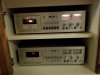
Shh!!Just a tip of 'below the radar* machines. Both Akai GXC-740D and 760D sounds great to my ears, and can be found relative cheap...


SterlingOne
Super Member
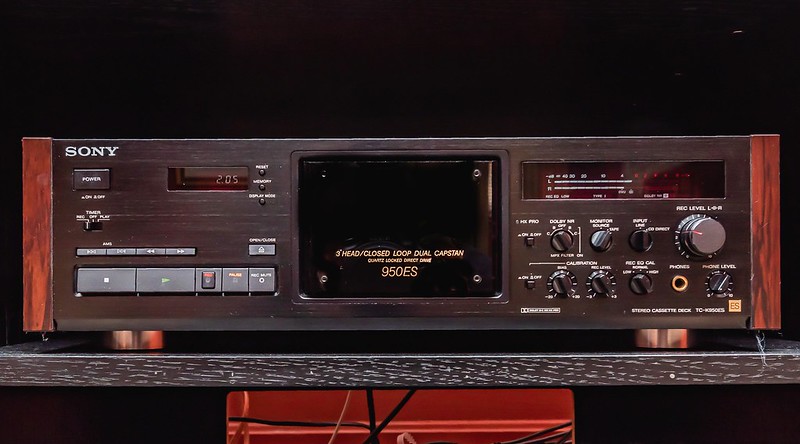
I don't know what is the best sounding cassette deck. I suspect my Sony TC-K950ES delivers pretty much what can be gleaned from the medium, a medium which was unsurpassed for pleasure of playlists over the road before the advent of recordable CDs. These days my Sony is for the most part a novelty, although on occasion I have come across cassettes which have aroused enough curiosity to want to listen to them thus making me glad I have retained the Sony.

kjello
Super Member


Rectilinear1
Professional Record Restorer
Nice R2R you have there kJello. That thing is gorgeous!!
Now I feel better about my barn find. Thanks guys.

I cannot wait to get this thing working again!!
Now I feel better about my barn find. Thanks guys.
I cannot wait to get this thing working again!!