• The move to the new server is done. There are some software and database maintenance updates in process. This has us passing the hat around to help out. We appreciate any donations. Seriously, even a dollar helps. The payment page may be found here - https://www.audiokarma.org/support.html

Best Tannoy Dual Concentrics's

Hubba

New Member
Hi,

I was wondering if anyone out there has any experience with the Tannoy Dual Concentric's?

I am wondering how the old ones compare to the new ones.

I was considering the Tannoy System 8's or the System 800's.

There is also the DMT series and the older classic 12" Little Gold Monitors which cost an arm and a leg.

Wondering if anyone heard these and how they compare?

Thanks in advance.

Nori
 
Register to hide this ad
Here's my subjective take.

The little Arena egg-shaped satellites* sound pretty good, but can get harsh in the lower mids quick as you turn up the wick.

The System 8 NFM II* is a little smoother, a little more extended up top, and can get a little louder than the System 800. (The System 800 shares a driver with the CMS8* ceiling speaker, i8AW* all-weather speaker, and possibly others.) Both of them have fairly wide dispersion. The S8NFMII has a much stouter cabinet as well as a different driver with a cast frame. (I believe the S8NFMII's driver is shared with the Saturn S8 and D500; I know it is shared, except for paint color, with the Saturn S8iw*.)

The 12 DMT II* is better-sounding all around than the 8's. It also has pattern control down lower, so it's better against boundaries or (counterintuitively) in smaller rooms. A trio of 12 DMT II's are basically my reference speakers, and have been for a few years after changing main speakers 15 or 16 times in a decade. (I put the guts in closed, low-diffraction cabinets.) Likewise, a trio of System 8 NFM II's have been a fixture in my second, nearfield system, for about the same length of time.

From what I've heard of the D700's, the 10" models may be the ideal compromise in most rooms. I've not heard the System 10 DMT II, though J. Gordon Holt ran them as his home cinema speakers for a while.

The CPA-12* is kind of in the middle. It makes a different set of tradeoffs than the 12 DMT II, being smaller, more efficient, and less extended in the bass. (It also has a paper cone, vs. poly in the 12 DMT II) It also sounds very good, but doesn't do as well in the lower mids as the 12 DMT II. There's a little harshness there.

The only pre-Tulip 'waveguide' (really a 'phase plug') Tannoys I've heard seriously underwhelmed me. But later investigations lead me to believe they may have been partially demagnetized.

IMO, Tannoy ruined a lot of the magic of the Dual Concentric in their TD line, with that supertweeter. They became just a big sweet-spot speaker. Also, the TD12 sounds colored in the mids compared to the 12 DMT II.

I've not heard the newer Precision or Ellipse series.

*currently own.
 
Last edited:
I have both DMT 12 IIs and Westminsters. The DMTs are a very accurate full-range monitor that will have a tendency to be a little brittle sounding with average SS amplifiers, while the Westminsters are wonderful with PP tube amps in a large room. The DMT has a leaner bass, while the Westminsters are fuller and more relaxed--slightly rolled-off sounding. DMT for jazz/vocals and Westminsters for classical/large scale stuff.
 
IMO, Tannoy ruined a lot of the magic of the Dual Concentric in their TD line, with that supertweeter. They became just a big sweet-spot speaker. Also, the TD12 sounds colored in the mids compared to the 12 DMT II.

I've not heard the newer Precision or Ellipse series.

The TD12 is probably the most "amp dependent" Tannoy DC speaker I've encountered. Listen to them on a pair of Rogue Audio M150 or M180 monoblocks, and they come alive. Same for some very good solid-state amps. On the wrong amp, they can be too "lean"... not enough bass energy. On the right amp, they sound pretty spectacular.

As for the supertweeter... I don't blame that, as I've built a serious combo using the ST200, the 8" concentric from the D750, and a 12" active-bass system (12" with its own amp in the speaker enclosure). That one definitely didn't suffer from focus or linearity.

Also, the Tannoy Churchill Wideband uses virtually the same supertweeter. And it's the finest, bar none, dual-concentric speaker I've ever heard. In fact, I'd say it was one of the five finest speaker systems of ANY kind, that I've ever heard, anywhere, period, regardless of price or age. It'll play ANYTHING... any musical genre, any size performance... and do it better than any other speaker I've heard.

As for the rest of the TD line... the TD10 is much more "tractable" than the TD12. It seems to thrive on many different amp combos, than the TD12. The TD12 is capable of extremely high levels of performance... you just have to set it up JUST RIGHT to do so. OTOH, it's hard to make a TD10 sound bad... no matter what.

I also have experience with the Precision 8. It reminds me of a "cleaned up" Saturn 8. Even better definition. Great dynamics, good bass extension, very smooth. Not much to fault there, especially for only $1200 or so a pair!

BTW: Another semi-modern Tannoy model I would HIGHLY recommend, is the Eyris DC3 floor-standing speaker. That's another, like the Precision 8 and D700, that it's almost IMPOSSIBLE to make sound bad, no matter where you use it, or what you use it with. Just a magnificently balanced speaker. Doesn't quite have the dynamic slam of its bigger cousins such as the D700 and such, but boy... as long as you aren't trying to fill up a cathedral-size room, it's seriously the bomb... :D

Regards,
Gordon.
 
Last edited:
Thanks everybody for the responses.

I guess nobody has heard the 12" Little Gold Monitors(?) or SRM12B.

---

The 12 DMT II* is better-sounding all around than the 8's.
I was wondering how they sounded better? (other than the bass being extended)

Thanks again.

-----------

(It also has a paper cone, vs. poly in the 12 DMT II)
Just a comment but I think the rigid poly cones, (for example, used in PB8-II's and I think the same is used in the system 800's), make the attack on kick drums sound a little too sharp and accentuated compared to the less rigid original PBM 8 cones and paper cones on other speakers. Is it just my imagination?
 
I have both DMT 12 IIs and Westminsters. The DMTs are a very accurate full-range monitor that will have a tendency to be a little brittle sounding with average SS amplifiers, while the Westminsters are wonderful with PP tube amps in a large room. The DMT has a leaner bass, while the Westminsters are fuller and more relaxed--slightly rolled-off sounding. DMT for jazz/vocals and Westminsters for classical/large scale stuff.

Wow, Westminsters.. those look insane. Such massive complex cabinets.

For these to be even comparable with the DMT 12 II's maybe says alot. Maybe you like the mid's/low mid's on the DMT12's better for jazz and vocals?

So if you used a really warm tube amplifier for the DMT 12's would they be comparable to the Westminsters (except I'm sure the bass extension and response may be better on the Westminsters)?
 
I think DMT12s with tubes are great--and the DMTs are a real bargain used. If you have a little more money, the paper coned DMT15s will give you a bit more of the "classic" Tannoy sound.

All of these are speakers are fully depreciated by now, and you shouldn't lose money on them if you decide to buy and try--that may be your best bet as all large woofer vented systems I have heard are just too room and amp dependent to generalize about.
 
I was wondering how they sounded better? (other than the bass being extended)

The biggest thing is that they don't suffer from treble modulation at high SPL, even when run full-range. Perhaps because if one's listening to them loud enough to get the cone moving substantially...that's a LOT of SPL.

Also, they throw a larger image, perhaps due to directivity being constrained lower down in frequency and thus presenting a higher ratio of direct to reflected sound. (I cross fire them, with axes crossing ahead of me, and all three speakers high mounted such that the center is also off-axis.)

Keep in mind that most of my listening to the 12 DMT II's has been in bespoke cabinets. I designed them to pay homage to the originals in terms of finish and also the DMT cabinet concept (hardwood spaceframe with more damped large panels) but to have much lower diffraction. (2" roundovers, etc.) Baffle dimensions are identical to stock, but they're sealed (and smaller in volume) so I can run them with a multisub system. (Sealed mains are easier to integrate with subs because they don't go out of phase below box resonance, and sealed cabs sized right also provide a measure of protection from over-excursion when running them full range.) Here's a pic of an unloaded cab, from the maker:
gallery24_large.png


Also, frankly, all the talk about amplifier pairing is garbage. Tannoy Duals are good speakers that will work fine with any amp. If you want to color them, get an EQ...

(Seriously, there's so much bloody mysticism about a stupid commodity part. It gets annoying.)

Just a comment but I think the rigid poly cones, (for example, used in PB8-II's and I think the same is used in the system 800's), make the attack on kick drums sound a little too sharp and accentuated compared to the less rigid original PBM 8 cones and paper cones on other speakers. Is it just my imagination?

I don't hear any extra edge to transients with the poly cones compared to paper, but if you've heard both and noticed it, maybe it's there. I would think that it has more to do with the separate tweet compared to the Dual, though.

Anyone ever hear the Tannoy Definition DC12i - Loud Speaker?

No, but it looks like a real winner. No stupid supertweet, and their most modern Dual design.

I think DMT12s with tubes are great--and the DMTs are a real bargain used. If you have a little more money, the paper coned DMT15s will give you a bit more of the "classic" Tannoy sound.

FWIW, I compared the two side-by-side, and found the 15's to be a little colored in the lower mids compared to the 12s. Perhaps that coloration is what you mean by "'classic' Tannoy sound," though.

Still pretty darned fantastic sounding, but my preference is the 12's. Maybe the 10s are the best compromise, but I've not made that comparison back-to-back.

 
Last edited:
I can tell you that by and large, the 15's are not as good as the 12's. Fatter mids, not as coherent overall. The system series are excellent speakers, but a completely different animal than the classic, old dual-concentrics. The older Tannoys need a super-tweeter. They are just not as extended in the treble as the newer Tannoys. Many of the new Tannoy models can take gobs of power, something that cannot be said of most vintage Tannoys.

My 12 in. Tannoy 3134's are circa 1990. Paper cones with rubber surrounds. The cones are very steeply angled, terminating in a sort of funnel, where the tweeter resides. This design helps mid range performance immensely. My speakers are extremely coherent, with excellent mids, highs and extended bass response. Power handling is exceptional as well.
 
I can tell you that by and large, the 15's are not as good as the 12's. Fatter mids, not as coherent overall.

That's not been my experience at all. IMHO, the two best sounding Tannoys I've EVER heard, have been the Churchill Widebands, and the Glenairs with the "hot-rod" crossovers we built for them (which sound like "baby Churchills", really). None of the 12s have been able to do that mix of bass extension, bass weight, midbass "speed", AND the holographic mids that the Churchill and Glenair can do, with ease. The Churchill Wideband, BTW, is also the FLATTEST RESPONSE of any of the DC speakers (that from the guy who was in charge of much of the design- who I've talked to personally- he set it up to be a true "studio reference" monitor, with as linear of a response as possible, with no considerations to "response shaping" other than making it as flat as possible).

Also, the Churchill and Glenair have a truly "effortless" quality to their presentation of sound, which none of the 12" could do. Cone area is king, especially when you have a design that keeps things coherent (no problems with asymmetric lobing with a DC driver)...

Regards,
Gordon.
 
Last edited:
My 12 in. Tannoy 3134's are circa 1990. Paper cones with rubber surrounds. The cones are very steeply angled, terminating in a sort of funnel, where the tweeter resides. This design helps mid range performance immensely. My speakers are extremely coherent, with excellent mids, highs and extended bass response. Power handling is exceptional as well.

The 3134's are the Duals out of the aforementioned CPA-12. (Possibly others - CMS12 with a paper dustcap? - as well.) I'm curious what you do to get extended bass out of them. Back-horn? They definitely trade low-end bandwidth for efficiency. And the efficiency is just crazy good for the size of them and the midband performance. I think they're rated at 98dB/W/m or 99dB/W/m. (The 12 DMT II, by contrast, is rated 96dB/W/m.) Subjectively, at the same volume setting they're a lot louder than the 12 DMT II's.

One of the reasons I ask is that I've been pondering what do to with my CPA-12s. They narrowly got kicked out of the main system when I found a pair of 12 DMT II's after listening to both (especially since I already had the third 12 DMT II for a proper LCR front stage) and they've just been sitting around for a while.

One benefit for the 3134 over the DMT stuff in many rooms is a narrower pattern in the highs. I think they're 60deg all around, as opposed to the 80-90deg all around pattern of the 12 DMT. In most domestic living rooms, the narrower pattern will result in a higher ratio of direct to reflected sound, and makes stuff (pictures, furniture, etc.) on the sidewalls less of a diffraction issue if you put them in the corners.


(Oh, and if you're running them with the CPA grille, take it off unless you're worried about a kid sticking her/his hand in them and bending the phase plug. It's pretty, but it does not do good things to the HF response.

The Churchill Wideband, BTW, is also the FLATTEST RESPONSE of any of the DC speakers (that from the guy who was in charge of much of the design- who I've talked to personally- he set it up to be a true "studio reference" monitor, with as linear of a response as possible, with no considerations to "response shaping" other than making it as flat as possible).

I'm sure that's true, but I wonder over what angle. The DC's I've heard with the supertweeter all had upper midrange/lower treble issues (though on axis anechoic I bet they do measure better). I blame (perhaps unfairly, admittedly) the pattern discontinuity caused by the ST.
 
It's interesting that the Churchill's driver flies in the face of traditional Tannoy practice and uses seperate magnets for the woofer and compression driver rather than a shared magnet. And ferrite magnets at that. Oh my. :)
 
It's interesting that the Churchill's driver flies in the face of traditional Tannoy practice and uses seperate magnets for the woofer and compression driver rather than a shared magnet. And ferrite magnets at that. Oh my. :)

As do the ones in the DMT series, the Dimension series, the Definition series, the Saturn series, the Sensys series, the Eyris series, the Arenas, and the newer Revolution and Revolution Signature series. All of those have double-ceramic magnets. .

Only in some of the Prestige models (Kensington, Canterbury, Westminster, etc) is the "traditional' alnico magnet, single-magnet structure retained. Even the Prestige Glenair and Glenair 10 have the ceramic double-magnet structures.

Time marches on, I guess...

Regards,
Gordon.
 
I'm sure that's true, but I wonder over what angle. The DC's I've heard with the supertweeter all had upper midrange/lower treble issues (though on axis anechoic I bet they do measure better). I blame (perhaps unfairly, admittedly) the pattern discontinuity caused by the ST.

IME, the Churchill Wideband has the most uniform response over a wide angle of any of the Tannoys I've compared them with. The ST in these is only used at 18KHz and up, IIRC...

Also, based on my experience of ADDING Tannoy supertweeters (ST100s, ST200s) to other Tannoy models that didn't have them (Glenairs, Kensingtons, my custom construction using the D750 8" dual and active bass, and others), the addition of the supertweeter definitely did NOT detract from the mid-high frequency response, whatsoever. When set up right, the only sensation, psychoacoustically speaking, is that of an increased soundstage width and depth (most likely caused by the improved phase linearity at above 10KHz, due to having the response extended from the typical 18KHz or so limit of most DC drivers, to 50KHz or higher, with the supertweeter added)... and this sensation was apparent at great off-axis angles... you could almost be outside the pair of speakers (to the left or right), and still get good center image placement, in both side-to-side AND apparent depth considerations...

Regards,
Gordon.
 
Last edited:
That's not been my experience at all. IMHO, the two best sounding Tannoys I've EVER heard, have been the Churchill Widebands, and the Glenairs with the "hot-rod" crossovers we built for them (which sound like "baby Churchills", really). None of the 12s have been able to do that mix of bass extension, bass weight, midbass "speed", AND the holographic mids that the Churchill and Glenair can do, with ease. The Churchill Wideband, BTW, is also the FLATTEST RESPONSE of any of the DC speakers (that from the guy who was in charge of much of the design- who I've talked to personally- he set it up to be a true "studio reference" monitor, with as linear of a response as possible, with no considerations to "response shaping" other than making it as flat as possible).

Also, the Churchill and Glenair have a truly "effortless" quality to their presentation of sound, which none of the 12" could do. Cone area is king, especially when you have a design that keeps things coherent (no problems with asymmetric lobing with a DC driver)...

Regards,
Gordon.
Can't speak to the models you mentioned, but frequent listening to my friend's 15s has convinced me otherwise. The reds and golds to which I listened, simply did not have the quality of sound of their 12-inch counterparts. The upper mids of the larger speakers are distinctly lacking. In fact, my friend is currently using his 15 in. golds as stands for some 12s. When he heard my 3134s, he was astonished at the bass response and clarity of sound, especially when put up against his 15s.

I am simply stating, that as a general rule, the older large Tannoys with the shallower cones, are generally not as capable at producing a good mid or for that matter treble response, as the newer similarly-sized Tannoys with (so-called) Waveguide technology. The waveguide seems to increase treble dispersion, while at the same time allowing the speaker to propagate better mid range response. The 3134s have a very large, open sound stage, due I'm sure in no small measure to the waveguide design.

Interesting, I had a set of Caernarvons, which had 10 in. drivers in very heavy boxes. Bass response was superb, but the sound was definitely lacking compared to the 3134s, at least in terms of mid range clarity and treble response. Being one who strives for the best sound and eschews the idea of collecting for collectibility' sake, I promptly sold them.
 
I am simply stating, that as a general rule, the older large Tannoys with the shallower cones, are generally not as capable at producing a good mid or for that matter treble response, as the newer similarly-sized Tannoys with (so-called) Waveguide technology.

Note, however, that other Duals with ferrite magnet/Faraday ring motors and Tulip "waveguide" (really a "phase plug") have shallower cone profiles than the 3134's do. The 3134's profile is the way it is because it has a narrower pattern than, say, the 3136GG in the 12 DMT II: 60deg vs. 90deg.

I think in many rooms your intuition (narrower pattern down to a point = cleaner sound in room) is well-founded, though. I make any valid comparisons about the "pepperpot" vs. Tulip phase plug models, though, because I have reason to believe the older ones were partially demagnetized. Perhaps that is the case with your friend's 15's as well. That would explain why they seem to lack control in the midrange compared to the newer ones.

What kind of cabinet are your 3134's in?
 
Last edited:
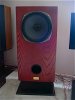
Here are mine. I had the driver response characteristics mapped by the gurus at Vancouver Audio Speaker Clinic. Response was observed to be 35 hz to 20,000 hz +/- 3db. Minimum ideal box size was calculated to be 3 cu. ft. with a 4 in. port, 3 7/8 in. in length. I had the boxes made by a cabinet-maker acquaintance. Built of 3/4 in. Oak plywood, I heavily braced the interior of each box and applied some 3/4 in. soft foam throughout the inside of the boxes. I had a couple of logos custom-made and there you have it. I made some stands to centre the tweeters at 36 in. height.

I'm not sure if mine have the tulip wave-guide or not. The Caernarvons I owned had the pepperpot waveguide.
 

Attachments

  • IMG_7668.jpg
    IMG_7668.jpg
    125 KB · Views: 207
Last edited:
Here are mine. I had the driver response characteristics mapped by the gurus at Vancouver Audio Speaker Clinic. Response was observed to be 35 hz to 20,000 hz +/- 3db. Minimum ideal box size was calculated to be 3 cu. ft. with a 4 in. port, 3 7/8 in. in length. I had the boxes made by a cabinet-maker acquaintance.

Wow! All that efficiency AND a 35Hz low corner. Not bad at all!

Are you running the stock CPA-12 crossover, or something bespoke?

I'm not sure if mine have the tulip wave-guide or not. The Caernarvons I owned had the pepperpot waveguide.

The "Tulip" phase plug (I don't think the word "waveguide" applies, even though that's what Tannoy calls it) is the concentric circles one. The 3134 from the CPA-12's use it. Here's what the phase plug looks like, outside the Dual:

tannoy_dia_7900-0550_f-500.jpg


Interestingly, the CPA-12 seems to use a higher-powered HF unit than the 12 DMT II. (1.25" voicecoil vs. 1" voicecoil.)

There was an intermediate one between the pepperpot and the tulip that looked a bit like a propeller. I've never heard speakers with that one. Here's what yours looks like:
 
Back
Top Bottom