
• The move to the new server is done. There are some software and database maintenance updates in process. This has us passing the hat around to help out. We appreciate any donations. Seriously, even a dollar helps. The payment page may be found here - https://www.audiokarma.org/support.html

Best way to use a vintage sub amp into a vintage amp/receiver for passive sub

redondo2018

Active Member
Ok, so I've a got a bunch of 70's/80's vintage amps/receivers and I recently got an RSH Sam-200 sub amp with a passive RSH TS-12AN with an impedance of 4ohms (most of my vintage amps/receivers go down to 4ohms as well). Seem straightforward below (not sure how to use the Line In however, guess that's for more 'modern' amps?) but what do I have to think about as far as impedance with the main amp and speakers? Also, I'm guessing this sub amp will run hot...

Finally, I run 15" Cerwin Vegas in my main setup so not sure I really need any more bass there, but I could be persuaded otherwise I guess ;-)

Thanks in advance!
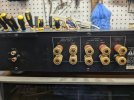
PXL_20240724_172810853.jpg
 
Register to hide this ad
The impedance of your passive sub has no relevance to the receiver you use it with since the sub will only be driven by your subwoofer amp. As long as the sub amp can handle 4 ohms, it will be fine.

I prefer driving subs with the speaker-level receiver/amp outputs for "music only" applications. The speaker-level "inputs" to the your subwoofer amp should be very high impedance, which makes it electrically virtually invisible to the receiver. Typically you can either run the subwoofer amp in parallel with your main speakers, or do the pass-through on the sub amp (e.g. connect your receiver speaker outputs to the sub amp inputs, then run the sub amp outputs to the main speakers). I prefer running in parallel.

If your receiver has pre-out/main amp loops, you could use a splitter there to drive the sub line-level inputs instead of speaker levels. I personally do not prefer the line-level method for vintage 2-channel systems. It's best for you to listen to both line-level and speaker-level connection methods (if both are possible) and determine which is best for you rather than take anybody's opinion of which is "best".
 
I prefer driving subs with the speaker-level receiver/amp outputs for "music only" applications. The speaker-level "inputs" to the your subwoofer amp should be very high impedance, which makes it electrically virtually invisible to the receiver. Typically you can either run the subwoofer amp in parallel with your main speakers, or do the pass-through on the sub amp (e.g. connect your receiver speaker outputs to the sub amp inputs, then run the sub amp outputs to the main speakers). I prefer running in parallel.
Would this have the benefit of reducing subwoofer hum as well? I'm assuming that if the sub's amp isn't active the hum will be negated.
 
The impedance of your passive sub has no relevance to the receiver you use it with since the sub will only be driven by your subwoofer amp. As long as the sub amp can handle 4 ohms, it will be fine.

I prefer driving subs with the speaker-level receiver/amp outputs for "music only" applications. The speaker-level "inputs" to the your subwoofer amp should be very high impedance, which makes it electrically virtually invisible to the receiver. Typically you can either run the subwoofer amp in parallel with your main speakers, or do the pass-through on the sub amp (e.g. connect your receiver speaker outputs to the sub amp inputs, then run the sub amp outputs to the main speakers). I prefer running in parallel.

If your receiver has pre-out/main amp loops, you could use a splitter there to drive the sub line-level inputs instead of speaker levels. I personally do not prefer the line-level method for vintage 2-channel systems. It's best for you to listen to both line-level and speaker-level connection methods (if both are possible) and determine which is best for you rather than take anybody's opinion of which is "best".
Thanks - to run parallel I would need more than 2 speaker outputs from the receiver/amp, right? So say A/B goes directly to speakers, C goes to sub amp, right? And, yes, this is for music-only - I use an active sub in my 7.1 home theater setup as my Pioneer Elite there has a sub output
 
Would this have the benefit of reducing subwoofer hum as well? I'm assuming that if the sub's amp isn't active the hum will be negated.

I prefer speaker-level because it means the sub sees the exact same signal (colored identically by the receiver amp) as the main speakers. Some people bristle at that, which is their right :). There is (ever so slightly) more distortion using the amplified signal, versus line-level, but I've found it's more important to mirror the main speaker signal since the goal is for the sub to be a seamless extension of the mains.

I think it may have less hum in many systems -- putting a splitter on the receiver pre/main loop jumpers can affect the signal going to the main speakers also (not the case if the receiver has a buffered sub outputs). If a receiver has sub outs, then line-level is more of a tossup. The signal levels with speaker-level are much higher, so they are typically less prone to hum/noise than line level.

I definitely recommend everyone try both connection methods if they are available to see which works best. There is no single right answer. The people who say I'm an idiot for using speaker level have typically never tried it it because they "know" speaker-level it is worse (because of slightly higher distortion from amp) and ignore the uniform signal advantage of using speaker-level. Don't take my word, or theirs, try both and see what works.

If you have hum with line level, I would definitely recommend trying speaker level.
 
Thanks - to run parallel I would need more than 2 speaker outputs from the receiver/amp, right? So say A/B goes directly to speakers, C goes to sub amp, right? And, yes, this is for music-only - I use an active sub in my 7.1 home theater setup as my Pioneer Elite there has a sub output

You can run two sets of cables from receiver output A (twisted together on the receiver side) -- one set from A goes to the main speakers, the other set from A goes to the subwoofer amp. You could also use A to the main speakers, and B to the sub amp input, but this means that you will have to use A+B to get the sub to play with the mains -- and selecting "B only" would be like running the receiver with no speakers attached (since sub amp inputs are usually very high impedance). Running the amp without speakers usually isn't an issue with solid state, I don't think it's generally advised for tube amps/receivers.
 
Last edited:
Back
Top Bottom