• The move to the new server is done. There are some software and database maintenance updates in process. This has us passing the hat around to help out. We appreciate any donations. Seriously, even a dollar helps. The payment page may be found here - https://www.audiokarma.org/support.html

Bi amp connection conundrum

Chuck awker

Active Member
So I have a pair of klipsch RP 600m speakers working as my front surrounds.
I was wondering,being they are bi amped speakers,if I can hook a small Pioneer receiver up and also connect to the other connections on the speakers.
 
Register to hide this ad
There are basically two types of biamping: active and passive. With active biamping, you essentially disconnect the internal crossovers (some higher end speakers have switches or jumpers to allow you to do this without hacking the insides), and replace the functionality with an electronic crossover that connects between your preamp and amps (you'll need one channel of amplification per driver, per speaker). Passive biamping is basically just what you're suggesting, removing the jumpers from the speaker terminals, connecting the amps with a Y connector from your preamp output, and then connecting one amp to the bottom speaker terminals and one to the top. Some people do that so they can run a tube amp for the treble and a high powered solid state amp for the bass, but I agree with @orsen, in most cases you're not going to hear a difference, and if one amp is significantly lower in power or quality, it could actually sound worse.
 
So I have a pair of klipsch RP 600m speakers working as my front surrounds.
I was wondering,being they are bi amped speakers,if I can hook a small Pioneer receiver up and also connect to the other connections on the speakers.

The aren't bi-amped speakers until you drive them with multiple amps.

They do have two sets of terminals, one for rhe woofer and one for the tweeter, with a "jumper" connecting them.

To bi-wire or bi-amp them, the jumper gets removed.

Were you asking if you could use the two sets of terminals to connect the speakers to two different systems (for example, an AV system and a music-only system)?

If so, the answer is a strong NO!
 
Last edited:
So I have a pair of klipsch RP 600m speakers working as my front surrounds.
I was wondering,being they are bi amped speakers,if I can hook a small Pioneer receiver up and also connect to the other connections on the speakers.
Just leave the jumpers in and hook up to one set of terminals. The speaker a and b hookups use the same amp. You are essentially inquiring about biwiring which gives no benefit in your situation.
 
Is that what he's inquiring about?

Sounded to me like he is inquiring about connecting one pair of speakers to two different amplifiers (his home theater system and the Pioneer receiver).

It will be interesting to find out what he is actually trying to do.
 
I just want to listen to the 2 speakers powered by the Pioneer like old school in stereo,I do t want surround sound.
Not sure if I was clear

That's what I thought.

Connecting two amplifiers (your surround receiver and your Pioneer receiver) to one set of speakers should not be done. Even if only one receiver is powered on, it can cause damage...unless you have a make/break switch between them.
 
Last edited:
That's what I thought.

Connecting two amplifiers (your surround receiver and your Pioneer receiver) to one set of speakers should not be done. Even if only one receiver is powered on, it can cause damage...unless you have a make/break switch between them.
Thank you,that's the answer I thought might be
 
I just want to listen to the 2 speakers powered by the Pioneer like old school in stereo,I do t want surround sound.
Not sure if I was clear

If one of the receivers has pre out/main in or something to that affect then it's possible. Many times I've connected two pairs of speakers in a similar fashion, I'm actually doing it now.

Only difference is it's a dedicated pre but I've used integrated amps for the purpose. Use an RCA Y adapter from the pre out to the main in, this will leave an extra set of main outs (the Y part of the adapter) to connect a second amp, easy peasy.

The receiver could connect to the top posts and the second amp to the bottom posts, don't forget to remove the speaker binding posts jumpers.

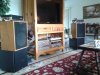
The second amp would need some sort of gain controls to balance the outputs. Better option is two identical stereo amps as in this picture with a Kenwood integrated preamp section controlling everything.

20161125_093526.jpg
 
Last edited:
He is NOT trying to connect two pairs of speakers, nor is he trying to bi-amp the speakers.

He wants to use the Klipsch speakers with two different systems (receivers):
  • his home theater/surround system, where they serve as front speakers
  • a two channel system, using a Pioneer two channel receiver
OP, fI suggest you just forget about the fact that each speaker has two sets of terminals. As I mentioned earlier, these are for users who want to bi-amp or bi-wire the speakers. This is NOT what you are asking about.

With the jumpers in place, either set of terminals serves to connect the signal from the amplifier to both the tweeter and woofer. So, connecting a second amplifier to the terminals not being used by the first amplifier would mean that the speaker is getting signal/power from two different amplifiers at the same time, and that the outputs of the two amplifiers are effectively connected together (via the jumper). Not a good thing...even if you are very careful never to have both amplifiers turned on at the same time (which of course will accidentally happen at some point).

With the jumpers removed, one set of terminals feeds the woofer and the other feeds the tweeter. You can connect separate amplifiers in this scenario, assuming that they are both getting their signal from the same source component, with one driving the tweeter and one driving the woofer. This is a form of bi-amping. However, this is not what you are asking about.

With the jumper removed and with the surround receiver connected to, for example, the woofers, and the Pioneer connected to the tweeters, the woofer will play the signal from the surround receiver and the tweeters will play the signal from the Pioneer. Could be interesting I guess...Grateful Dead thru the woofers and Lady Gaga thru the tweeters. :)
 
Last edited:
I just want to listen to the 2 speakers powered by the Pioneer like old school in stereo,I do t want surround sound.
Not sure if I was clear
You want a speaker switcher to connect to both amps. leave the jumpers in place & connect the switcher to the speakers, then connect amp a & amp b to the switcher. you can get them on amazon for between $60-120. This is not bi-amping.
 
If one of the receivers has pre out/main in or something to that affect then it's possible. Many times I've connected two pairs of speakers in a similar fashion, I'm actually doing it now.

Only difference is it's a dedicated pre but I've used integrated amps for the purpose. Use an RCA Y adapter from the pre out to the main in, this will leave an extra set of main outs (the Y part of the adapter) to connect a second amp, easy peasy.

The receiver could connect to the top posts and the second amp to the bottom posts, don't forget to remove the speaker binding posts jumpers.

The second amp would need some sort of gain controls to balance the outputs. Better option is two identical stereo amps as in this picture with a Kenwood integrated preamp section controlling everything.

View attachment 2890039
Got it.....brings back memories of my KA 3500,back in the 70s
 
Got it.....brings back memories of my KA 3500,back in the 70s

In 1978 my older brother purchased a KA-3500 at the same time I was getting a KA-7100. It was the nostalgia of that 7100 why I purchased the KA-7300, the difference being it has pre outs/main in allowing the use of external power amps.

I like vintage Kenwood integrated amps, I have (3) KA-4006 amps, their warm sonic signature has real synergy with Klipsch Heritage speakers.
 
In 1978 my older brother purchased a KA-3500 at the same time I was getting a KA-7100. It was the nostalgia of that 7100 why I purchased the KA-7300, the difference being it has pre outs/main in allowing the use of external power amps.

I like vintage Kenwood integrated amps, I have (3) KA-4006 amps, their warm sonic signature has real synergy with Klipsch Heritage speakers.
I have 2 pair of Hereseys(1 and 2s) so I may take a chance on that.
 
Just leave the jumpers in and hook up to one set of terminals. The speaker a and b hookups use the same amp. You are essentially inquiring about biwiring which gives no benefit in your situation.
I just want these speakers to play while my Pioneer is on
 
Back
Top Bottom