• The move to the new server is done. There are some software and database maintenance updates in process. This has us passing the hat around to help out. We appreciate any donations. Seriously, even a dollar helps. The payment page may be found here - https://www.audiokarma.org/support.html

Bi-Amping Input/Output Puzzle

Dave B.

Well-Known Member
This relates to another thread I posted about the dangers of connecting a Mac C22 reissue preamp to a DC-coupled amp: http://audiokarma.org/forums/index.php?threads/mac-c22-vs-direct-coupled-amps.755315/#post-10266339

For the sake of argument here, I’ll assume that the two SS amps I have (Carver M-400 and Citation Twenty-Two) are both DC-coupled. I haven’t been able to verify this.

The goal here is to bi-amp using two preamps to protect the C22 from contact with a DC-coupled amp.

I mainly listen to vinyl but enjoy CDs occasionally.

The speakers I want to bi-amp are the big AR9s. Ideally, I would like to create the bi-amp this way:

- Turntable => C22 phono input
- C22 main out => Mac MC275 Mk.III stainless => AR9 mid/highs
- C22 Tape out => Carver C-4000 preamp Tape in
- C-4000 main out => Carver M-400 (or Citation) => AR9 woofers

Questions:

- Does this configuration isolate the C22 from the DC-coupled amp?
- Issues/dangers I’ve overlooked?

Thanks for the help.
Dave
 
Register to hide this ad
That is a lot of volume control manipulation to get the system playing correctly.
 
That is a lot of volume control manipulation to get the system playing correctly.

Agreed. You would have to adjust the volume on the Carver and the Mac.

I personally doubt there's really an issue connecting to a direct coupled amp. If it turns out there is then I'd get rid of the pre because the vast majority of SS amps are direct coupled.
 
That's a lot of stuff in the signal path but other than that it should be ok as long as the preamps inputs don't have the same issue as the amp inputs that make using your pre in advisable (lack of DC blocking caps I'm guessing).
If so then you would be still be passing DC to the power amps.
 
When you biamp you generally cut lower frequencies from the upper section of the speaker. also chop the upper frequencies to the woofers with an electronic crossover, but i do not know what provisions the 9's have. the reason is that you do not waste amplifier power on frequencies that are removed by the passive crossover.
 
Dave, you should still measure the DC voltage on the output of the C22 before you connect it to the input of the MC275.

Insert the positive lead inside the output jack of the C22 and hold the negative lead to the outside of the jack (right where the shielding connects). Make sure your VOM is measuring DC volts. If you measure more than 1 volt, that's not good. Tell us what you measure.

You are NOT done! Yes, even if you get a very good reading when your C22 is stable, we now need to see what happens upon powering on. So turn the C22 off and let it cool down. Connect the VOM as before and power on the C22 all the time watching the voltage. If you see numbers bigger than 5 volts, this is exactly the problem whorau99 talked about.

Tell us what you measured.

Then, you are still not done as we need to talk about phase. We'll deal with that once we have the C22 issue resolved.

Regards,
Jerry
 
Last edited:
Jerry, thank you! I will do your procedure tomorrow morning and then file a report here. Sounds very straight forward. I think I can manage it without damaging anything. :) Thanks again.

Oh, btw, there's no problem connecting the C22 to my MC275. I've done that safely in the past. It will work with any tube or SS Mac amp. That's what McIntosh claims. The potential problem here is connecting the C22 safely to a SS DC-coupled amp, which in my case is either my Carver M-400 or Citation Twenty-Two. That's what your procedure can help me determine.

Dave
 
Last edited:
Jerry, thank you! I will do your procedure tomorrow morning and then file a report here. Sounds very straight forward. I think I can manage it without damaging anything. :) Thanks again.

Oh, btw, there's no problem connecting the C22 to my MC275. I've done that safely in the past. It will work with any tube or SS Mac amp. That's what McIntosh claims. The potential problem here is connecting the C22 safely to a SS DC-coupled amp, which in my case is either my Carver M-400 or Citation Twenty-Two. That's what your procedure can help me determine.

Dave

Dave, in this case you'll measure the tape OUT jack on the C22. Frankly, I doubt you'll have any problem. Usually the tape out is just a straight by-pass from the selector switch. Except in the case of phono! So do all of these measurements with the selector on phono.

Regards,
Jerry
 
Bear in mind a typical SS power amp requires roughly 1 to 2V to produce full rated output. Any DC at the preamp output needs to be way less than that to avert a big thump.

Rather than routing the signal through a bunch more gear to try to mitigate a DC transient, maybe a decent quality film cap between the preamp and power amps would be better and more simple.
 
Last edited:
[Jerry]: I ran your procedure on my C22's Tape out with the selector switch set to phono. It showed zero DC, both when stable and at cool power-up. This would be the output from which I would send the signal to my Carver preamp's Tape in, which in turn would feed my woofer amp (see my connection scheme in post #1 above). So, this looks "thumpless," so to speak.

[whoaru99]: I agree with you. A cluttered signal path is not optimum. Before I consider installing a thump-mitigating cap, though, I want to see what McIntosh tech support has to say about their warning regarding connecting the C22 to DC-coupled amps. I sent them a query about this and am waiting for their response. When I get it, I'll post it here.

Again, thanks to all who have offered their wisdom so far.

Dave
 
[Jerry]: I ran your procedure on my C22's Tape out with the selector switch set to phono. It showed zero DC, both when stable and at cool power-up. This would be the output from which I would send the signal to my Carver preamp's Tape in, which in turn would feed my woofer amp (see my connection scheme in post #1 above). So, this looks "thumpless," so to speak.

[whoaru99]: I agree with you. A cluttered signal path is not optimum. Before I consider installing a thump-mitigating cap, though, I want to see what McIntosh tech support has to say about their warning regarding connecting the C22 to DC-coupled amps. I sent them a query about this and am waiting for their response. When I get it, I'll post it here.

Again, thanks to all who have offered their wisdom so far.

Dave

Dave, you are good to go. You might consider C22 Tape Out to Aux Input on the Carver preamp.

So we have all incompatability issues resolved. Now let's talk about ... PHASE.

Dave the problem here is there is a 50-50 chance that your woofers will be out of phase with all of the other drivers. Reason for this is phase consistency only occurs in very expensive commercial equipment. So, hook everything up as normal. That is all Red terminals on speakers to Red on the amps. Listen to the music for a while. Then reverse the leads on the woofers in both AR9's. Listen again and pay particular attention to frequencies around your lowest xover frequency. Whichever way sounds better puts the drivers in phase with each other and that's the correct way to hook everything up.

Regards,
Jerry

PS: Signal path isn't really all that cluttered. Think about. The signal begins in the C22 selector switch and goes through the C22, power amp and finally woofers. At the same time the signal is routed to the Carver preamp, power amp and finally mids/tweeters. It's really two parallel paths. I've been doing exactly the same thing for the past eight years now.
 
Last edited:
Jerry, thank you. Your advice has been golden! I now have a much more confident, intuitive "feel" for my pending configuration.

I've always been obsessive about speaker phasing. One test that I run after connecting everything is to confirm that a true monaural signal appears to be sharply defined at the midpoint between the speakers. The C22 has a monaural setting (L+R) that will make this check a snap from any source material. I'll also add your test to my checklist.

BTW, I'm planning on driving the AR9's woofers with either the Carver M-400 or the Citation 22. They both put out 200 wpc at the 9's nominal 4 ohms. I'll put the Mac tubes on the mid/highs to optimize the "warmth" I enjoy so much from tubes playing vinyl. I see this overall setup just as you do: parallel paths. Listening is such a subjective, personal experience. I constantly have to fight the battle of listening to the music vs. listening to the equipment. Thus, if it sounds good to me, it must be good.

We have recently moved into a new home and I have a contractor about to construct a listening room in our large unfinished (heated/AC'd) basement. I'm finalizing all my stereo equipment plans now, before construction is complete. So, I'll likely be back with some more questions before move-in day. Thanks again, Jerry.

Dave
 
If you looked at the outputs with a meter I'd be inclined not necessarily to take that as gospel. A meter might not show a quick spike as a scope would reveal.
 
Dave, you are good to go. You might consider C22 Tape Out to Aux Input on the Carver preamp.

So we have all incompatability issues resolved. Now let's talk about ... PHASE.

Dave the problem here is there is a 50-50 chance that your woofers will be out of phase with all of the other drivers. Reason for this is phase consistency only occurs in very expensive commercial equipment. So, hook everything up as normal. That is all Red terminals on speakers to Red on the amps. Listen to the music for a while. Then reverse the leads on the woofers in both AR9's. Listen again and pay particular attention to frequencies around your lowest xover frequency. Whichever way sounds better puts the drivers in phase with each other and that's the correct way to hook everything up.

Regards,
Jerry

PS: Signal path isn't really all that cluttered. Think about. The signal begins in the C22 selector switch and goes through the C22, power amp and finally woofers. At the same time the signal is routed to the Carver preamp, power amp and finally mids/tweeters. It's really two parallel paths. I've been doing exactly the same thing for the past eight years now.


Guess it depends on opinion of clutter. One capacitor vs, a whole 'nother preamp seems like quite a bit more clutter to me. But, I don't make any claim to be a minimalist so, whatever, I guess.
 
Guess it depends on opinion of clutter. One capacitor vs, a whole 'nother preamp seems like quite a bit more clutter to me. But, I don't make any claim to be a minimalist so, whatever, I guess.

Whoaru99, I understand what you are saying. The signal on Tape Out, however, usually does not traverse through a preamp, so while we have two preamps, neither signal path traverses through two. I can make a few arguments for why this is actually preferred:

1. You get two volume controls and thus extremely easy control of the speaker's voice

2. You get two sets of tone controls - I turn the treble control full OFF for the woofer amp and the bass control full off for the mids/tweeters - purpose in doing this is to get the cleanest signal we can. When we mix a wide range of frequencies in an amp we just naturally create more IM distortion.

Regards,
Jerry
 
Whoaru99, I understand what you are saying. The signal on Tape Out, however, usually does not traverse through a preamp, so while we have two preamps, neither signal path traverses through two. I can make a few arguments for why this is actually preferred:

1. You get two volume controls and thus extremely easy control of the speaker's voice

2. You get two sets of tone controls - I turn the treble control full OFF for the woofer amp and the bass control full off for the mids/tweeters - purpose in doing this is to get the cleanest signal we can. When we mix a wide range of frequencies in an amp we just naturally create more IM distortion.

Regards,
Jerry


Frankly, it's an unnecessary kludge. Just use the right stuff...although I understand people want to use what they have.

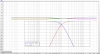
Here's a picture showing the actual tone control action of a Yamaha C-40 using sweep of 5Hz to 40kHz. There are a number of sweeps of that data:
  • Tone controls flat
  • Treble flat, then bass all the way up and all the way down
  • Bass flat, then treble all the way up and all the way down
You can see those don't behave anything like a crossover.

Then, beneath those traces, you will find a 20Hz to 20kHz graph with a 1kHz, 24dB/oct LR crossover. It's aligned frequency-wise with the graph of the Yamaha tone controls.

The action on the signal is completely different than that of tone controls and what one wants for minimizing the frequencies one does not want to amplify.

tone controls.png
 
Last edited:
Ron Cornelius at McIntosh Labs kindly addressed my concerns about mating my C22 with a DC-coupled amp. Here's what he said in his very prompt reply:

>>The C22 you own will briefly output DC when it turns on. The solution is to turn the C22 on and then wait 30 seconds before you turn your DC coupled amps on. I suspect the Carver will not pass DC but you check on the carver forums to see if this is an issue. On amps, like all McIntosh, DC is not an issue unless the amp has malfunctioned in which case the McIntosh output autoformers will dump DC to ground to protect the speakers.<<

So, it looks like a prudent, patient power-up protocol prevents problems (how's that for an alliteration?). I'll check the Carver and Citation forums to see if there is potential for either of them to "pass DC," as Ron notes.

Thanks again, everyone.

Dave
 
Back
Top Bottom