Thank you Overload! Very well done. I am going to reference this thread as I start another regarding Vandersteen Model 3's I am seeking information regarding people's experiences with Vandersteens in bi-wire vs. bi-amp configurations. I understand your intent with the thread was not to discuss the sonic differences but only to describe the processes of bi-wire and bi-amping. You have done a fantastic job of that. You have made the options very clear. Again, thanks!


You are using an out of date browser. It may not display this or other websites correctly.
You should upgrade or use an alternative browser.
You should upgrade or use an alternative browser.
Bi-Wiring & Bi-amping Clear As Mud?
- Thread starter OverLoad
- Start date

Awesome and perfect explanation! Great illustrations! Good job! :thmbsp:
Last edited by a moderator:

fred soop
Super Member
For the active crossover cases, the speakers internal crossover to the woofer should be bypassed and the woofer driven directly by the amplifier. Here is a link that will lead to several web pages where biamping is discussed at length .....
http://sound.westhost.com/bi-amp.htm
http://sound.westhost.com/bi-amp.htm
For the active crossover cases, the speakers internal crossover to the woofer should be bypassed and the woofer driven directly by the amplifier.
It appears that the active biamping diagrams posted by the OP clearly illustrate that this is the case.
Absolutely no confusion here. #1 & #2 are absolutely possible connection methods. If on #2 the A & B speaker terminals are indeed parallel with one another, and I know of no amp equipped with A & B that is not like that then electrically there is almost no difference in #1 and #2.
Actually, there are quite a few receivers and integrated amps with either a) series connections between A and B terminals, or b) a resistor circuit between them to keep impedance from dropping when two pairs of speakers are connected...in which case A could ostensibly sound different than B. Most such units are of the mid-market or lower-end variety.

SeenKurtLive
New Member
Firstly, Thanks for uploading the images and description OverLoad I really appreciate the work you put into that. I was scouring the net for some advice and found your post which lead to my registration on the forum. I am very new to the audio scene, I love music and in particular Vinyl of which I have what I consider to be a decent size 1st Press collection of VG+ to Mint records... Anyway I am basically poor and so when I set up my system it took me a while to buy each piece very cheaply from garage sales, car boots and online. I now have a little bit of cash and I want to bi-amp by system by simply adding another identical amp and a crossover.
I want to replicate the 2nd to last config set up, Active Bi-Amp Horizontal Configuration this just seems to make more sense to me than anything else...ability to control the gain on both low and high signals independently just seems correct. Anyway the question I have is do you know where I can buy the cross over? I looked on eBay and there are a few but it is a little confusing. Also does anyone what kind of cables would I need for those strange looking inputs on the back of most of the crossovers I have seen??
Current Set Up:
Pro-Ject Debut Carbon Turntable
Cambridge Audio P25 Mk2
Bowers & Wilkins S3 DM602.5 x 2
(I currently don't use a pre amp, should I be??)
Intended Set Up
Pro-Ject Debut Carbon Turntable
Cambridge Audio Pre Amp 651P
Crossover (Brand ?? - Need help here)
Cambridge Audio P25 MK2 x 2
Bowers & Wilkins S3 DM602.5 x 2
Any advice on the cross over, the non use of a pre amp in current set up or anything would be hugely appreciated as I am a complete noob...
The whole set up cost me €600 (around €580) I only paid €20 for my amp.

HTWillie
Super Member
Anyway the question I have is do you know where I can buy the cross over? I looked on eBay and there are a few but it is a little confusing. Also does anyone what kind of cables would I need for those strange looking inputs on the back of most of the crossovers I have seen??
Any advice on the cross over, the non use of a pre amp in current set up or anything would be hugely appreciated as I am a complete noob...
Welcome to the forums SeenKurtLive.
Active crossovers are somewhat rare in the home hi-fi realm, but a lot more common in pro-sound and stage-gear.
The one I use is the Phase Coupled Activator from audiocontrol, and it uses standard RCA cables for inputs and outputs. (look on hifishark.com right now! There's one listed in Germany!)
The pro-sound ones I know of are the Rane AC-22 and Rane AC-23. TI don't recall if they use 3-pin XLR cables or 1/4-inch phono plugs, but adapters are easy to find.
Another option is 12V mobile audio gear if you don't mind messy wiring. In mobile audio, active crossovers are very common and nearly every manufacturer has something to offer it seems.
SeenKurtLive
New Member
That is really helpful, do you think I am being unnecessary going for the crossover for my very entry level set up and as a noob to this? perhaps just stick with the bi amp set up through the pre amp, without a cross over? It is just that looking at the OP diagrams it seems that without the cross over it almost makes the whole set up effect-less, if that makes sense?
Sorry to make this into Q&A but I was also wondering if you think I need a pre amp? my amps Cambridge Audio P25 MK2 have MM/MC Phono switches on the rear... while it is not deafening by any means the amp seems to fill the speakers rather nicely without a pre amp. Although it can get a bit fuzzy in the mid range on high volume.
- I looked but could not find that specific crossover on that site... I saw the Audicontrol 3XS but this doesn't seem to be the same as the one you are referring to which accepts RCA cables.
Last edited:

onplane
What! No Wake???
That is really helpful, do you think I am being unnecessary going for the crossover for my very entry level set up and as a noob to this? perhaps just stick with the bi amp set up through the pre amp, without a cross over? It is just that looking at the OP diagrams it seems that without the cross over it almost makes the whole set up effect-less, if that makes sense?
Sorry to make this into Q&A but I was also wondering if you think I need a pre amp? my amps Cambridge Audio P25 MK2 have MM/MC Phono switches on the rear... while it is not deafening by any means the amp seems to fill the speakers rather nicely without a pre amp. Although it can get a bit fuzzy in the mid range on high volume.
- I looked but could not find that specific crossover on that site... I saw the Audicontrol 3XS but this doesn't seem to be the same as the one you are referring to which accepts RCA cables.
Yes, I think you are going "over the top" by attempting an active bi-amp for your speakers. There is a very good chance the resulting sound will NOT be as good as passive bi-amping. Next, to actively bi-amp your speakers requires some major surgery of the speaker internal xovers.
I strongly recommend that instead you try a passive bi-amp. For this you do NOT need a pre-amp. According to your original post, you'll have 2 Cambridge Audio integrated amps. Chose one as the MASTER and connect to all sources to it. Take the Tape Out of the MASTER and connect to it to the Aux input on the SLAVE amp.
Hook each amp to one half of your speakers (make certain that you remove the straps on the speakers - this is very important!!!). You are now passive bi-amping with independent volume controls for each speaker half. Notice that you now control the speaker's voice by varying the power sent to each speaker half.
Regards,
Jerry
Last edited:
I've been an electronics tech for over 40 years and also a lover of good HiFi. I sometimes think that if someone wants to hear a difference they are going to hear it. I also think that Bi-wiring is just another means to sell more speaker cable. Open up a quality amp and you will see that inside after the last electronic device has done its job the signal goes to some sort of binding post. I essence two wires inside leading to the outside, one set for each channel. Most of what I have seen is regular 14 gauge wire or no wire at all, just circuit board traces. There is no difference in frequency response when using multiple cables. I know it has been argued that there is but I think when you look at for instance Nordost's cables I could not find any technical measurement data to suggest their cables were any better than lamp cord, at least for distances under 10 feet. I only see bi-wiring as a means to carry more current to the speaker but even that gets to a point of diminishing returns. I know my comments may garner some very heated replies especially if I were someone who spent $56K on Nordost speaker cables. My main point is that I don't or haven't seen any empirical data to suggest this stuff really works. Sure looks pretty though.
Bi/Tri/whatever amping is a whole 'nother animal and there may be valid reasons to go down that rabbit hole. Still normally that output comes from one point source so some sort of frequency division has to be employed. I would think if a manufacturer really wanted to provide some versatility they would provide adjustable pre outputs for high/mid/low inputs to the amplifiers.
Bi/Tri/whatever amping is a whole 'nother animal and there may be valid reasons to go down that rabbit hole. Still normally that output comes from one point source so some sort of frequency division has to be employed. I would think if a manufacturer really wanted to provide some versatility they would provide adjustable pre outputs for high/mid/low inputs to the amplifiers.


JoeESP9
ESL's & tubes since 83
Many AK members bi or tri-amp their speakers. Almost all of them who do (myself included) use an electronic crossover.
The 651P is a phono preamp
The P25 is an integrated amplifier with a built in phono stage. You don't need both phono preamps.
Your P25 has only tape and speaker level outputs. There is no easy way to connect an electronic crossover. Besides, you would need at minimum another stereo amplifier in addition to the crossover.
Your speakers can be bi-wired. However, that has dubious benefits.

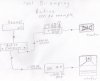
I drew these up some years ago and posted them here, I reckon it's time again.


HTWillie
Super Member
I saw the Audicontrol 3XS but this doesn't seem to be the same as the one you are referring to which accepts RCA cables.
The audiocontrol 3xs is a 12V unit for mobile audio, and it uses RCA cables as well. Most audiocontrol owner's manuals are quite easily found online in pdf form, and they are very informative, well written, and entertaining.
Instead of biamping your speakers, a crossover can be used to add a subwoofer.
This has got my attention.
At the moment I have a passive bi-amped system using a pair of Nad 302s feeding a pair of B&W DM600s,without any passive filters.
What benefit will I gain by adding them?
Secondly,at some point in the future I am planning on adding a Nad pre amp to the system,off your sketch Ive noticed I was going down the fools route,I don't want go there,so by adding an active crossover what is its function?
Thanks for stopping me running down the rabbit hole.
This has got my attention.
At the moment I have a passive bi-amped system using a pair of Nad 302s feeding a pair of B&W DM600s,without any passive filters.
What benefit will I gain by adding them?
Secondly,at some point in the future I am planning on adding a Nad pre amp to the system,off your sketch Ive noticed I was going down the fools route,I don't want go there,so by adding an active crossover what is its function?
Thanks for stopping me running down the rabbit hole.
From what I can offer I think that bi-amping really means that you don't like the crossovers that came with your speakers for whatever reason. Using passive components between the power amp output and the speaker input requires components that can take the current that will be supplied by the PA and depending upon how much welding you want to do you will need to select beefy components. This also entails a lot of trial and error in selecting components that will work for you. Active crossovers between the preamp and power amp is a much better solution. The components you choose can be of the same value but you don't have to worry about the current factor. 16volt caps would work just fine.
I have desired getting an active equalizer but not too many audio manufacturers make them. These units install between the pre and power amps and have varied attenuation and frequency crossover points, some can get quite complicated. The vintage units that pop up on eBay go for huge sums of cash, way more that I want to spend. I have been thinking about buying an active crossover that would be used in car applications. You would have total control over the signals and once they are set and you are satisfied you can put it out of site in a plastic box that you could get off eBay. It would be powered by a 12vdc wallwart. To some people this might be an anathema to incorporate car audio gear into a hi end system but it may be the only way to go. Anybody done this? What were the results?
JoeESP9
ESL's & tubes since 83
Active equalizers are "a dime a dozen" on CL and Ebay. Electronic crossovers are widely available starting at <$100.
Although they can be installed there Installing an equalizer between the pre and power amps is not the best place for them. The fact that virtually every equalizer has a tape monitor button and loop to replace the one it uses should tell you something.
Although they can be installed there Installing an equalizer between the pre and power amps is not the best place for them. The fact that virtually every equalizer has a tape monitor button and loop to replace the one it uses should tell you something.
Last edited:
Are you talking about a graphic/parametric crossover? If I understand correctly these are used usually in the tape loop and adjust the entire signal envelope. My Pioneer SG-9500 works this way and cannot be used in bi-amping. Well maybe you could use a couple of them in between the pre-power amp to attenuate certain frequency bands but you would still be dealing with fixed bandwidths. This is why I thought the car application type would work.Active equalizers are "a dime a dozen" on CL and Ebay. Electronic crossovers are widely available starting at <$100.
If you know of home hifi crossovers where the slope of attenuation and frequency cross over points can be selected please show me. The Pioneer SF-850 unit I saw on eBay went for $1K.
JoeESP9
ESL's & tubes since 83
An equalizer and a crossover are two very different devices. Equalizers can be linear or parametric. They adjust frequencies or ranges of them going to one amplifier. Crossovers are a totally different animal. They split and direct the sound to multiple amplifiers.
Your Pioneer 950 is an electronic crossover. As such it was designed to be used between a preamp and a couple of power amps. A tape monitor loop is not the correct place to connect it. The 950 does not have fixed bandwidths. They are variable. In addition, it has variable slopes. These things are evident from observing the front panel.
There are any number of "Pro" crossovers that are widely available and "reasonably" priced. Some have adjustable slopes, all have adjustable crossover frequencies and level controls. In addition you can choose from analog (my DBX 223SX for example) or digital (Behringer DQX2496 for example). I'm currently using said DBX 223SX on my front channels. The only caveat is that most "Pro" gear almost always uses either XLR and/or TRS connectors..
A really good thing is that many of the digital models are multi-band parametric equalizers as well as being a crossover as is the Behringer DQX2496. A parametric equalizer is usually more effective at curing room problems than a linear type. They usually require making measurements to adjust and set them in a set and forget manner. They are not as easy to use as a "glorified" tone control as most linear Eq's are. Either approach is valid. You just need to be honest about what your intentions are.
Do you want a tone control to play with or do you want to smooth your in room response?
Last edited:
HTWillie
Super Member
I have been thinking about buying an active crossover that would be used in car applications. ...It would be powered by a 12vdc wallwart. To some people this might be an anathema to incorporate car audio gear into a hi end system but it may be the only way to go. Anybody done this? What were the results?
Yes. I've successfully used 12V wall wart power supplies for car audio crossovers. On my desk at work I have a 200W switching power supply for use with one of my favorite old car audio amplifier. To make it work I also use a car audio eq as a preamp/source selector.