• The move to the new server is done. There are some software and database maintenance updates in process. This has us passing the hat around to help out. We appreciate any donations. Seriously, even a dollar helps. The payment page may be found here - https://www.audiokarma.org/support.html

BIC Venturi Formula 6 and 6-1a

Tucker_515

New Member
The purpose of this post is to be both informative to readers and helpful to me! A few months ago, I purchased a pair of BIC Venturi Formula 6 speakers and I love them. They are perfect for my music, which is mainly rock '70s to present, but can be anything besides country and new computerized music.

--To clarify, the BICs I talk about in this post are the first generation with 6 drivers: one 12" woofer, one 5" mid, two horn tweeters, and two super tweeters. They measure 15.75" wide X 14.75" deep X 26.25 tall and weigh 62 lbs each. They are rated at 125 watts (RMS or peak I am not sure, this info comes from the original brochure) and have 6 ohm impedance. There advertised frequency response is 20Hz-23KHz, I don't know the +/- 3 db, yet. --

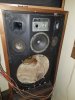
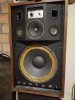
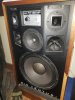
I loved my first pair so much, I found another pair and picked them up. Again, these are both the 6 driver version, but they are different. It is my understanding that there are two versions of the first generation, easily identified because one version has paper super tweeters, and the other has piezo super tweeters. See pictures below, there are also some minor aesthetic differences.

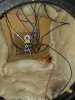
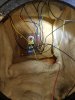
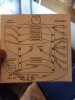
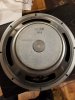
There is not much information about these BICs and even less about the differences between the first versions. I pulled a woofer from each, because I want to rebuild the crossovers, and found some more differences. First off, the crossovers are in different spots, which obviously doesn't do anything, but is still curious. The large difference is that the crossovers are not the same. There are schematics for both crossovers in the speakers themselves, which I thought was cool. Pictures of everything are all attached.

I believe the version with the paper super tweeters came first and the version with the piezo's came second because the woofers from the former are stamped BIC 120 and the crossover sheet says Model Formula 6, while the latter woofers are stamped BIC 120b and the crossover sheet says Model Formula 6-1a.

So my question is, should I rebuild the crossovers as they are, or should I upgrade one to the other? I assume I should leave them as they are, because that's how they are designed, but I am no expert.

Please, if anyone has any questions or more information about these, let me know! I'll do my best to post as many pictures as possible and document what drivers each have. I really love these and they tend to get bad reviews because of the second generation that shares the same name, but are very different. Thanks for reading!
 

Attachments

  • 20200331_195906.jpg
    20200331_195906.jpg
    119.5 KB · Views: 292
  • 20200331_195859.jpg
    20200331_195859.jpg
    103.5 KB · Views: 286
  • 20200331_195816.jpg
    20200331_195816.jpg
    82.3 KB · Views: 276
  • 20200331_195734.jpg
    20200331_195734.jpg
    78.9 KB · Views: 286
  • 20200331_195912.jpg
    20200331_195912.jpg
    118.4 KB · Views: 286
  • 20200331_195731.jpg
    20200331_195731.jpg
    91.3 KB · Views: 278
  • 20200331_215804.jpg
    20200331_215804.jpg
    88.3 KB · Views: 287
  • 20200331_215815.jpg
    20200331_215815.jpg
    65.8 KB · Views: 272
  • 20200331_215905.jpg
    20200331_215905.jpg
    119.4 KB · Views: 283
  • 20200331_215854.jpg
    20200331_215854.jpg
    66.3 KB · Views: 271
Register to hide this ad
This is really interesting as I've never seen a Formula 6 with the Motorola Piezo tweeters replacing the original phenolic ring cone tweeters. These tweeters are used in the design as super tweeters to cover the frequencies above the range of the bi-conex horn pea shooters and therefore the piezos actually make sense. I found a curbside Formula 6 with a blown woofer and blown phenolic ring tweeters but the poor sounding midrange driver and bi-conex horns still functioned as they should. It was nice to discover a cardboard sub-enclosure behind the midrange speaker which meant I could replace it with an open back driver like the late series Philips AD5060-M8 I selected. The stock midrange driver is just plain blah and should be upgraded. For the woofer I used a spare from a Lafayette Criterion 2002 model and it integrates well with the other drivers. After re-capping the cross-over it is a fine sounding frankenspeaker garage speaker which can really crank! (lol)
 
I briefly had a roommate with a pair of the Formula 6 and a big Sansui receiver. Way beyond what I could afford at the time. I did pick up a pair of what I believe were Formula 3's sometime later at half price when a local store was closing. I'm interested in anything about these early BIC speakers.
 
Thanks for the replies, I figured being BIC speakers they wouldn't get many responses. My woofers and tweeters are in great shape. The mids are in decent shape on the nicer looking pair, and in rough shape on the other. I am going to try to find a better mid, because I love how they look and want to use them to shake the room. I'm not worried about replacing the woofers because I have an M&K V125 inch sub that takes care of the lows.
 
Good luck with those hefty BIC's! I still own my BIC Formula 5's (Avnet Corporation Westbury, New York) that I purchased new in 1975-76. They have the T-slot Biconex horn (mids & highs) coupled with 10" woofer. Their cabinetry is top notch with walnut veneer over MDF, well braced inside and weigh around 35-40 lbs each. The highs were cutting out on occasion so I pulled the control unit at the top to take a look. This contains the crossovers plus other circuitry that enabled a clipping indicator, reset buttons and unique L-Pad type controls (Pop/Rock). I considered replacing the caps (5 per unit) but decided against it as you never know what else is bad, or about to go bad when something is over 45 years old. There were some transistors, etc. on that board as well. In retrospect, a gimmicky feature but it sounded good when I was 20. I disconnected and left the "control units" in place for aesthetics and installed Kasun (China/Amazon) 3-way crossovers with two L-Pads from Simply Speakers and am very pleased with the results. Other than the occasional stridency that horn drivers exhibit they sound pretty awesome, especially with jazz which is my thing. Hope this helps.
 

Attachments

  • IMG_4660.jpg
    IMG_4660.jpg
    168 KB · Views: 50
Of the first generation BIC Formula 6s there two versions, the first version I purchased new and it has two square horns spayed on the top and two phenolic ring tweeters splayed just below the horns and the 5" midrange facing forward. The second variation the phenolic ring units were replaced by 2 piezo units and I never really thought much of that change, your photos show both versions, first and second. In your case you see some of the woofers with a yellow coated fabric surround and some with black coated fabric surround and the grille covers fell apart after a few years but there is a guy on ebay that sells nice replacement grilles. The horns like on yours show up on ebay from time to time, new phenolic units are available and a replacement midrange is available. I have replaced my phenolic units along with the midrange and it does balance the sound but I still need to recap the crossovers. There was a BIC formula 6 spec 2 that had a midrange coaxially mounted on the woofer had the T slot tweeter midrange assembly, it was a cross between the Formula 5 and the Formula 7. Finding a 12" woofer with a 5" coaxially mounted midrange would be an effort for anyone. I know people toss the BICs under the bus but with some small upgrades they sound nice and definitely will punch out some sound. I have both 1st generation Formula 6s and the Formula 7s.
 
I believe piezos are capacitative, not resistive loads. So a standard crossover topology will not work properly with them (which is one reason why they often don't sound good. Properly implemented, they can be fine, though there are obviously significant differences between various models, and those differences aren't always obvious from looking at them since the horn doesn't necessarily change. All of which is to say, if the crossovers are different, it is probably for a good reason. If you want to recap, probably won't hurt and might help (I'm not a recapping true believer, obviously). Otherwise I wouldn't change things just to change them.
 
I have a pair of the Formula 6 with the two square 3 1/4" lend Piezos below the horns. I believe these were the first version of the Formula 6. The OP's photos show one crossover diagram labeled "MODEL FORMULA 6-1A" which shows three CHOKES which are contained in my units. Sadly I had to have my cabinets redone after spending too many years of their lives powering the music in a college drinking establishment. The only replacement so far were one woofer that the outside ring had became too flimsy. I think it is time for new caps and resistors as that speaker's woofer still moves with any movement of the receiver's volume control. Also have new Piezos for them.well, may as well replace the other woofer and mids while I'm in there. The diagram for my units show the negative side of the tweeters to the resistor and a 250muh CHOKE and the positive side to a.5MF/100VNP capacitor and a.5 Mh CHOKE. I don't understand what all this means but I can operate a soildering iron. Hope I don't need any wicking wire! I have enjoyed my BIC's through the years when I wanted to rock out but I don't know that they will play hapy with a Fischer 800C I have comming. I also want to thank the OP for starting this thread.It motivated me to register on the forum.
I contacted the BIC company and they were nice enough to reply but they did not have a clue. I think some one else just bought the BIC name.
 
I have some thrift store find Formula 6s (the three choke crossover / piezo version) that I use as garage speakers. The drivers were fine except the mids. Replaced them with Ebay units that don't quite fit ( a little too large diameter)
Without studying the crossover design, I blindly put poly caps in the crossovers from Patsexpress. Broke them in and there is an improvement but the highs and deep bass don't seem right still. After studying the crossover, things seem not right in a couple of areas starting with the 16uf cap wiring. Typically, a second order (12db/octave) low pass has the cap in parallel with the woofer and the input to the woofer/cap thru the 0.5mh inductor. The picture/schematic has the 16uf cap and 0.5mh choke wired so they are completely ineffective, being shunted by the thermistor or the brightness pot.....so the woofer is basically being driven full range (not a good thing for the impedance curve and woofers usually make weird noises at frequencies above their capabilities)
Any thoughts on what I am seeing?
 
Last edited:
If you find a source for a 5" true outside diameter mid range please let me know. I just redid one of my three choke crossover / pezio speakers. The bigest obsticles I ran across was finding the replacement 1uF/1W cap and a replacement midrange with true 5 inch outside diameter.
 
I have some thrift store find Formula 6s (the three choke crossover / piezo version) that I use as garage speakers. The drivers were fine except the mids. Replaced them with Ebay units that don't quite fit ( a little too large diameter)
Without studying the crossover design, I blindly put poly caps in the crossovers from Patsexpress. Broke them in and there is an improvement but the highs and deep bass don't seem right still. After studying the crossover, things seem not right in a couple of areas starting with the 16uf cap wiring. Typically, a second order (12db/octave) low pass has the cap in parallel with the woofer and the input to the woofer/cap thru the 0.5mh inductor. The picture/schematic has the 16uf cap and 0.5mh choke wired so they are completely ineffective, being shunted by the thermistor or the brightness pot.....so the woofer is basically being driven full range (not a good thing for the impedance curve and woofers usually make weird noises at frequencies above their capabilities)
Any thoughts on what I am seeing?


Mastercraft9, have you done any more analysis of the crossover? I have a pair of Formula 6's (6-1A the same configuration as yours) that I purchased new, in "77," along with a Pioneer SX950 and a couple other components (long gone). The BIC's have just a couple of nicks in the back corners, but look pretty good after an oiling. I haven't used them in several years as the DW does not want them in the living room. I recently replaced the crossover electrolytic's with poly's and ordered a pair of ebay horns to replace the blown originals. I plan to use them in the basement, on some walnut stands that I made, for them, 35+ years ago. Recapping the SX950 is the next project. It is beautiful, complete, and original - except for one lamp that I replaced with an OEM part). Following that is a solid walnut plinth for the Pioneer PL-55DX. I'm sure I'll be happy with the original setup, but, would consider thoughtful suggestions.
 
I have an odd ball question. I wonder why the drawings of both versions show both tweeters but only one horn? I have the Piezo models and just replaced them with 8 ohm tweeters. Gonna have to give myself a rest before tackling the other one.
 
The purpose of this post is to be both informative to readers and helpful to me! A few months ago, I purchased a pair of BIC Venturi Formula 6 speakers and I love them. They are perfect for my music, which is mainly rock '70s to present, but can be anything besides country and new computerized music.

--To clarify, the BICs I talk about in this post are the first generation with 6 drivers: one 12" woofer, one 5" mid, two horn tweeters, and two super tweeters. They measure 15.75" wide X 14.75" deep X 26.25 tall and weigh 62 lbs each. They are rated at 125 watts (RMS or peak I am not sure, this info comes from the original brochure) and have 6 ohm impedance. There advertised frequency response is 20Hz-23KHz, I don't know the +/- 3 db, yet. --

I loved my first pair so much, I found another pair and picked them up. Again, these are both the 6 driver version, but they are different. It is my understanding that there are two versions of the first generation, easily identified because one version has paper super tweeters, and the other has piezo super tweeters. See pictures below, there are also some minor aesthetic differences.

There is not much information about these BICs and even less about the differences between the first versions. I pulled a woofer from each, because I want to rebuild the crossovers, and found some more differences. First off, the crossovers are in different spots, which obviously doesn't do anything, but is still curious. The large difference is that the crossovers are not the same. There are schematics for both crossovers in the speakers themselves, which I thought was cool. Pictures of everything are all attached.

I believe the version with the paper super tweeters came first and the version with the piezo's came second because the woofers from the former are stamped BIC 120 and the crossover sheet says Model Formula 6, while the latter woofers are stamped BIC 120b and the crossover sheet says Model Formula 6-1a.

So my question is, should I rebuild the crossovers as they are, or should I upgrade one to the other? I assume I should leave them as they are, because that's how they are designed, but I am no expert.

Please, if anyone has any questions or more information about these, let me know! I'll do my best to post as many pictures as possible and document what drivers each have. I really love these and they tend to get bad reviews because of the second generation that shares the same name, but are very different. Thanks for reading!

Both of your photo's of the crossovers look the same. Nothing like the crossovers in my three choke Pezieo tweeter Formula Six's. And the mids really are 5 inch exactly. outside frame diameter. 5.125" frame or larger will not fit.
I still haven't located any with a true 5 inch outside frame diameter mid or full range drivers.
 
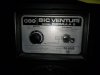
Recent threads about these speakers has me intrigued. In particular, the "dynamic tonal balance" feature is a curious innovation. It seems to function like a variable loudness control built into the speaker rather than amplifier.

The same circuit is used in all models [ edit-- except for Model 1 ] I've viewed prior to Spec II. It consists of a parallel RLC filter with adjustable resistance. Apparently an adjustable notch filter of sorts, intended to depress midrange at lower listening levels to maintain perceived tonal balance according to Fletcher Munson compensation curves. Woofer, mid and tweeter circuits are individually series connected to this filter. The super tweeter is not, as it's very high frequency range (15 kHz and up) is outside the influence of the Fletcher Munson effect.

Here's a simplified model of the basic crossover circuit:

Dyn_tonal-balance-ckt.png
I wonder if this concept is unique to BIC? Haven't noticed anything similar elsewhere.
 
Last edited:
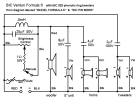
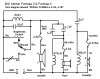
I've compiled crossover information for most, if not all variations of Formula 2, 4 and 6 models prior to Spec II. Since the OP's intention is to have a public information based thread, I'll post schematics here for quick reference should anyone be on the hunt.

Early crossovers are fairly simple -- free running woofers and first order filters (discounting RLC filter). Note differences in component values between Formula 2 and Formula 4. Later versions are identical for both models.

BIC_Formula-2.png
BIC_Formula-4.png

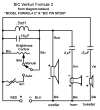
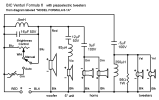
The early Formula 6 crossover is the only one I've found with a slight variation of the RCL filter, which is identical among all other (North American) model iterations. This version has BIC 020 phenolic ring tweeters rather than the later 030 piezoelectrics.

BIC_Formula-6.png

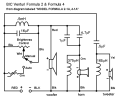
Next version of Formulas 2 and 4 have 2nd order mid and tweeter filters, and share identical component values. Only woofer size differs.

BIC_Formula-2-1A_4-1A.png

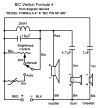
Later Formula 6 shows similar changes to crossover filters and now sports piezoelectric tweeters.

BIC_Formula-6-1A.png

Latest Formulas 2 and 4 add fuse protection for each driver.

BIC_Formula-2-1B_4-1B.png

It's possible that Formula 6 also had a final fused version. Haven't seen an example though, so it's speculation until one turns up.
 
Last edited:
I've compiled crossover information for most, if not all variations of Formula 2, 4 and 6 models prior to Spec II. Since the OP's intention is to have a public information based thread, I'll post schematics here for quick reference should anyone be on the hunt.

Early crossovers are fairly simple -- free running woofers and first order filters (discounting RLC filter). Note differences in component values between Formula 2 and Formula 4. Later versions are identical for both models.

View attachment 2157299

View attachment 2157300

This early Formula 6 crossover is the only one I've found with RCL filter component values that differ slightly from all other models and their iterations. This version has BIC 020 phenolic ring tweeters rather than the later 030 piezoelectrics.

View attachment 2158305

Next version of Formulas 2 and 4 are more robust with 2nd order filters, and share identical component values. Only woofer size differs.

View attachment 2157311

Later Formula 6 shows similar changes to crossover filters and now sports piezoelectric tweeters.

View attachment 2157315

Latest Formulas 2 and 4 add fuse protection for each driver.

View attachment 2157322

It's possible, probable even, that Formula 6 also had a fused version. Haven't seen an example though, so it's speculation until one turns up.

Thank you Stuart for your schematic of the Formula 6 with piezo tweeters. It was a big help with my deletion of the piezoelectric tweeters and replacement with conventional voice coil tweeters. Even with the deletion of the 56 ohm 1W resistor and swap to conventional tweeters, the design as it is still works in both automatic or switched to the "brightness control" manual mode. I guess I will be wondering who came up with this design when I go to the great beyond.
 
While documenting differences between Venturi Formula models it would be remiss to not include European variants with their own unique qualities. Only finding testimony from Swedish AK members, so it's hard to gauge BIC's market penetration in Europe as a whole.

Peculiar differences they report include: products are made in Spain, model numbers are appended with a "W" suffix (Formula 2W, 4W etc.) and crossover circuits show differences. More profoundly, they all report as late as 2018 having intact, original foam grilles -- most peculiar compared to the North American experience! Also, their models don't seem to have wiring diagrams attached inside their cabinets.

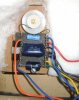
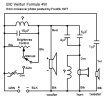
Fredrik 1977 shows pics of a Formula 4W circuit which can be compared to N. American versions:

Formula-4W.jpg


There's a small cap hidden beneath the large blue one in center. Schematic, best that I can tell, looks like this:

BIC_Formula-4W.png

Kind of a cross between early first order version but with a second order horn filter like later versions. Also shows component value differences from any of the N. American variations. Presumably other "W" models have similar differences from N. American counterparts. It would be interesting to see a Formula 6W.
 
Last edited:
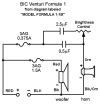
To complete the model lineup prior to Spec II, here's a brief look at Formula 1.

BIC_Formula-1-1B.png

It's basically a Formula 2 without the super tweeter, and having a simpler tonal balance control feature without an "auto" control option. Because this is derived from a wiring diagram labeled 1-1B and shows fuses it can be presumed that there are earlier versions of this model.
 
Last edited:
To complete the model lineup prior to Spec II, here's a brief look at Formula 1.

View attachment 2184565

It's basically a Formula 2 without the super tweeter, and having a simpler tonal balance control feature without an "auto" control option. Because this is derived from a wiring diagram labeled 1-1B and shows fuses it can be presumed that there are earlier versions of this model.

My Veturi Mark 6's were built in Westbury NY for BIC. Didn't they do a lot of audio production up there during the day for various labels?
 
I've compiled crossover information for most, if not all variations of Formula 2, 4 and 6 models prior to Spec II. Since the OP's intention is to have a public information based thread, I'll post schematics here for quick reference should anyone be on the hunt.

Early crossovers are fairly simple -- free running woofers and first order filters (discounting RLC filter). Note differences in component values between Formula 2 and Formula 4. Later versions are identical for both models.

View attachment 2157299

View attachment 2157300

The early Formula 6 crossover is the only one I've found with a slight variation of the RCL filter, which is identical among all other model iterations. This version has BIC 020 phenolic ring tweeters rather than the later 030 piezoelectrics.

View attachment 2158305

Next version of Formulas 2 and 4 are more robust with 2nd order filters, and share identical component values. Only woofer size differs.

View attachment 2157311

Later Formula 6 shows similar changes to crossover filters and now sports piezoelectric tweeters.

View attachment 2157315

Latest Formulas 2 and 4 add fuse protection for each driver.

View attachment 2157322

It's possible, probable even, that Formula 6 also had a fused version. Haven't seen an example though, so it's speculation until one turns up.

Thanks Stuart! Your schematic is easier to read than the diagram found inside the speaker. All three oem chokes are air-core and it appears that the x-over was designed with purpose. I previously replaced all the electrolytic's with non-audiophile poly caps. Thinking about replacing the 56 ohm resister with a better part. I do think the biggest weakness in the box is the 5" driver. I've been trying various settings on the ADC SS 300SL trying to improve the lower mids. Has anyone had any luck finding a good 5" replacement driver?
 
Back
Top Bottom