

You are using an out of date browser. It may not display this or other websites correctly.
You should upgrade or use an alternative browser.
You should upgrade or use an alternative browser.
Bokeh! show it off
- Thread starter treserious
- Start date


Very nice!
Focus is dead on
 I'm having trouble with that, the eyes just aren't what they used to be, lol

Tapehead47
Addicted Member
What a shot! Fantastic :thmbsp:
Tapehead47
Addicted Member

Nice! I like how the flowers spiral out of focus.


In the interest of learning and refinement...
I have enjoyed this thread an want to see more. But I think that it needs stating (without singling any pics or people here- but I too have posted some misrepresentations of the effect) that Bokeh is not just shallow depth of field, per se. It is about HOW the out of focus highlights are rendered and is related to lens imperfections- primarily that of spherical aberration. Some lenses have it with a resulting pleasing effect, some not. And it is weird how the same lens can produce different bokeh when depth of field is changes, or aperture, or even by close focusing. This, from http://digitalslrphotography.50webs.com/lenses.html, has helped me get past the "shallow depth of field" being confused with "bokeh" conundrum.
-----------------------------------------
If It Ain’t Bokeh, Don’t Fix It
The term has almost become a buzzword, and is used to describe the aesthetic qualities of the out-of-focus parts of an image, with some lenses producing “good” bokeh and others offering “bad” bokeh. Boke is a Japanese word for “blur,” and the h was added to keep English speakers from rhyming it with broke.
You’ve probably noticed that out-of-focus points of light become disks, which are called circles of confusion. These fuzzy discs are produced when a point of light is outside the range of an image’s depth-of-field. Most often, circles of confusion appear in close-up images, particularly those with bright backgrounds, as shown in the figures below (the upper left). The circle of confusion is not a fixed size, nor is it necessarily always a perfect circle. The viewing distance and amount of enlargement of the image determine whether we see a particular spot on the image as a point or as a disc. The shape of the lens’s diaphragm can determine whether the circle is round, nonagonal, or some other configuration.
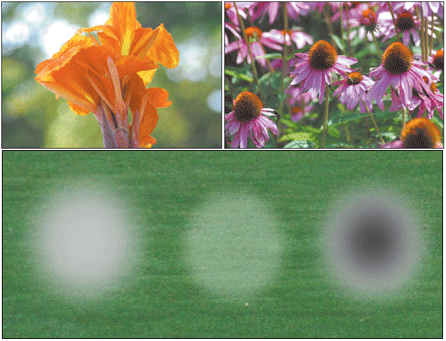
The quality of those disks of out-of-focus light in the background determines a lens’s bokeh (top left), Light edges around the out-of-focus disks reveal the worst kind of bokeh (top right), Good bokeh (bottom left), neutral bokeh (bottom middle), and bad bokeh (bottom right)
Good bokeh and bad bokeh derives from the fact that some of these circles are more distracting than others. Some lenses produce a uniformly illuminated disc. Others, most notably mirror or catadioptic lenses, produce a disk that has a bright edge and a dark center, producing a “doughnut” effect, which is the worst from a bokeh standpoint. Lenses that generate a bright center that fades to a darker edge are favored because their bokeh allows the circle of confusion to blend more smoothly with the surroundings.
Evenly illuminated disks, or, worst of all, those with lighter edges (like those of a mirror lens) are undesirable. If you look carefully at upper right's figure, you can detect some bokeh of the most objectionable sort. The bokeh characteristics of a lens are most important when you are using selective focus (say, when shooting a portrait) to deemphasize the background, or when shallow depth-of-field is a given because you’re working with a macro lens, long telephoto, or with a wide-open aperture. The lower figure shows what the three general varieties of bokeh look like when captured and isolated from their native habitats so you can see them more clearly.
I have enjoyed this thread an want to see more. But I think that it needs stating (without singling any pics or people here- but I too have posted some misrepresentations of the effect) that Bokeh is not just shallow depth of field, per se. It is about HOW the out of focus highlights are rendered and is related to lens imperfections- primarily that of spherical aberration. Some lenses have it with a resulting pleasing effect, some not. And it is weird how the same lens can produce different bokeh when depth of field is changes, or aperture, or even by close focusing. This, from http://digitalslrphotography.50webs.com/lenses.html, has helped me get past the "shallow depth of field" being confused with "bokeh" conundrum.
-----------------------------------------
If It Ain’t Bokeh, Don’t Fix It
The term has almost become a buzzword, and is used to describe the aesthetic qualities of the out-of-focus parts of an image, with some lenses producing “good” bokeh and others offering “bad” bokeh. Boke is a Japanese word for “blur,” and the h was added to keep English speakers from rhyming it with broke.
You’ve probably noticed that out-of-focus points of light become disks, which are called circles of confusion. These fuzzy discs are produced when a point of light is outside the range of an image’s depth-of-field. Most often, circles of confusion appear in close-up images, particularly those with bright backgrounds, as shown in the figures below (the upper left). The circle of confusion is not a fixed size, nor is it necessarily always a perfect circle. The viewing distance and amount of enlargement of the image determine whether we see a particular spot on the image as a point or as a disc. The shape of the lens’s diaphragm can determine whether the circle is round, nonagonal, or some other configuration.
The quality of those disks of out-of-focus light in the background determines a lens’s bokeh (top left), Light edges around the out-of-focus disks reveal the worst kind of bokeh (top right), Good bokeh (bottom left), neutral bokeh (bottom middle), and bad bokeh (bottom right)
Good bokeh and bad bokeh derives from the fact that some of these circles are more distracting than others. Some lenses produce a uniformly illuminated disc. Others, most notably mirror or catadioptic lenses, produce a disk that has a bright edge and a dark center, producing a “doughnut” effect, which is the worst from a bokeh standpoint. Lenses that generate a bright center that fades to a darker edge are favored because their bokeh allows the circle of confusion to blend more smoothly with the surroundings.
Evenly illuminated disks, or, worst of all, those with lighter edges (like those of a mirror lens) are undesirable. If you look carefully at upper right's figure, you can detect some bokeh of the most objectionable sort. The bokeh characteristics of a lens are most important when you are using selective focus (say, when shooting a portrait) to deemphasize the background, or when shallow depth-of-field is a given because you’re working with a macro lens, long telephoto, or with a wide-open aperture. The lower figure shows what the three general varieties of bokeh look like when captured and isolated from their native habitats so you can see them more clearly.

onepixel
.
Very nice!
Very nice!
Yes! +1
The more I look at that image, the more I appreciate it. :thmbsp: